

The Bronze Age, which succeeded the Stone Age, marks our discovery in the crafting of bronze, an alloy of copper and tin that is far harder and more durable than each metal alone. Not only notable in the advancement of metalwork, but the Bronze Age is considered the golden age of civilization, as numerous other technologies were invented during this age, such as writing, mathematics, astronomy, astrology, and the rise of nation-states and empires.
Beginning in the 14th century BC, international trading reached its height throughout the ancient Mediterranean world, from the Aegean to Mesopotamia. By this time, the Minoans and Mycenaeans of the Aegean were well established, as were the Hittites in Anatolia. The Hyksos had been evicted from Egypt, and the Egyptians had begun the 18th Dynasty and the New Kingdom period. Thutmose III, advancing on the heels of Hatshepsut’s peaceful trading expeditions and military exploits, took Egypt to a pinnacle of international power and prosperity. Written in the Amarna Letters, “Gold is like dust in your land” was the refrain of the day as trade with Egypt was sought for its gold mined from Nubia. The Amarna Letters, inscribed on nearly 400 clay tablets in Akkadian cuneiform, the diplomatic lingua franca of this time, show insights into trading relations between Egyptian pharaohs and other kingdoms. Some letters include 300 lines of itemized gift-giving, including gold, silver, copper and bronze, lapis lazuli, linen cloth, sweet oil, perfumes. Gift exchanges frequently included physicians, sculptors, masons, and skilled laborers, demonstrated by the similarities between architectural structures in Egypt, Anatolia, Canaan, and the Aegean. Recent findings of Aegean-style paintings and painted floors in Egypt, Israel, Turkey, and Syria indicate that Aegean artisans may have made their way into Egypt and the Near East as early as the 17th century BC.
The largest, wealthiest, and most completely excavated artifact of the Bronze Age is the shipwreck discovered off the southwestern coast of Turkey at Uluburun, or the “Grand Promontory.” The cargo carried in the ship consisted of an assortment of goods from at least seven different countries, states, and empires. In addition to its primary cargo of ten tons of Cypriot copper, one ton of tin, and a ton of terebinth resin, there were also two dozen ebony logs from Nubia, almost two hundred ingots of raw glass from Mesopotamia, about 140 jars of terebinth resin, remains of grapes, pomegranates, figs, and spices like coriander and sumac, pottery from Cyprus and Canaan, including oil lamps, bowls, jugs, and jars, scarabs from Egypt, swords and daggers from Italy and Greece, and even a stone scepter-mace from the Balkans. There were also gold jewelry, ivory, elephant tusk, and a statue of a Canaanite deity made of bronze overlaid with gold. Most importantly an Egyptian scarab of solid gold spelling out the name of Nefertiti, which was used only during the first five years of her reign, helps date the ship, which could not have sailed before Nefertiti came to power about 1350 BC.
The end of the 13th century BC marked the beginning of the end of the Bronze Age for the Near East, as massive destruction occurred in the Aegean and Eastern Mediterranean regions, spreading as far east as Mesopotamia. A series of earthquakes struck Greece, as well as the rest of Aegean and Eastern Mediterranean beginning about 1225 BC, lasting as long as 50 years until 1175 BC. Climate change, in particular drought, led to widespread famine. The arrival of a certain Sea Peoples, whose archeological evidence was found in the Levant from Ugarit in the north to Lachish in the south, had been blamed for the collapse, though the evidence is far from clear. It is theorized famine may have driven them out of the western Mediterranean to attack Egypt and the Near East. In the year 1177 BC, during the reign of Pharaoh Ramses II, Egyptian records stated the Sea Peoples came sweeping through the region, wreaking havoc for the second time, and great land and sea battles were fought in the Nile delta. By 1130 BC, life as the inhabitants knew it in the Aegean, Eastern Mediterranean, Egypt, and the Near East came to an end.
The collapse of the Bronze Age served as a source of inspiration for numerous works that would become the classical literary canon of the West. For example, Homer’s 8th-century BC Iliad depicts the Trojan War in 1250 BC. While the location of the ancient Troy is found to have existed as present-day Hisarlik in Turkey, the Trojan War is not evidenced to have actually happened, but was likely an accumulation of events that happened in the span of 200 years. At the end of the Trojan War, while Homer continued his epic tale with The Odyssey, which follows the homeward journey of the king of Ithaca Odysseus, the Roman poet Virgil wrote the Latin epic poem Aeneid in 19 BC to tell the legendary story of Aeneas, a Trojan who fled the fall of Troy and travelled to Italy, where he became the ancestor of the Romans. The second book of the Bible told of the Exodus of the Hebrews from Egypt, in which the Israelites wandered in the desert for 40 years before entering and conquering Canaan. Carved in 1207 BC during the reign of the Egyptian Pharaoh Merneptah, the Merneptah Stele, also known as the Israel Stele, features a victory hymn which writes, “Israel is laid waste, bare of seed,” the oldest known text referencing an entity known as Israel outside the Bible.
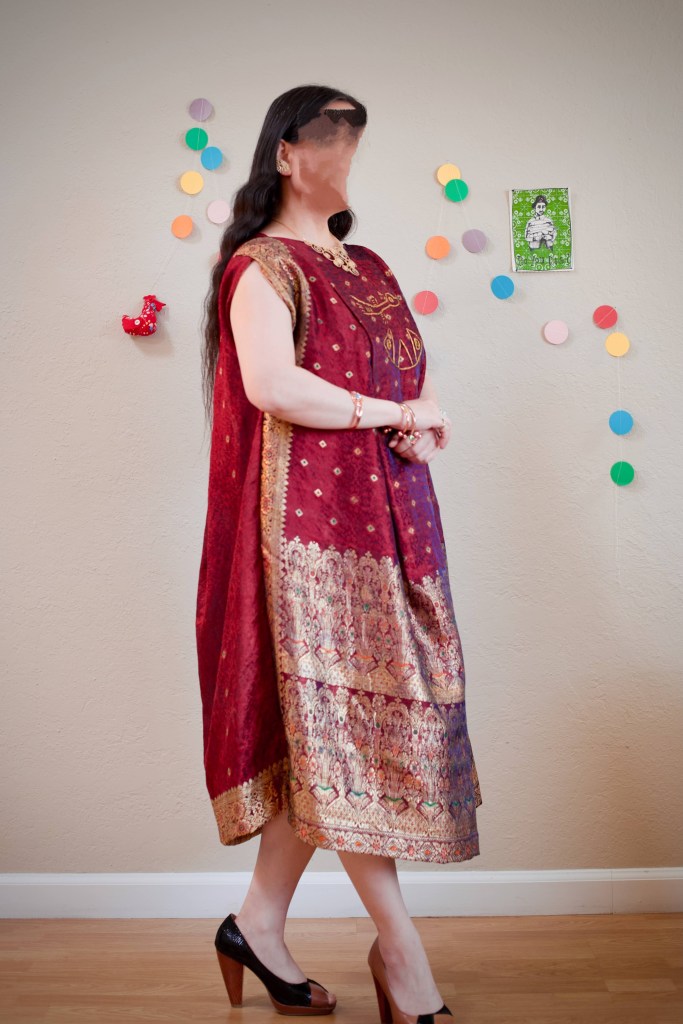
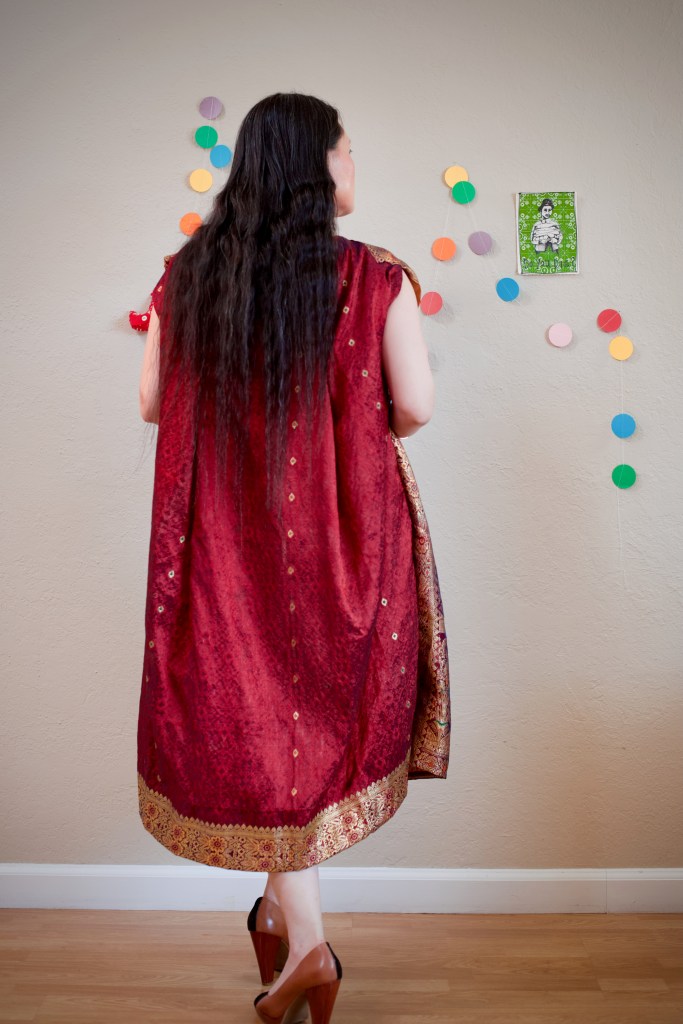
Inspired by the Bronze Age, this dress is embroidered with motifs featured on the Đông Sơn bronze drum, an emblem of ancient Vietnamese culture. The Đông Sơn culture was a Bronze Age material centered on the Red River Delta in northern Vietnam beginning around 1000 BC. The Dongsonians were Austroasiatic speakers and were skilled bronze casters, evidenced by the Dong Son bronze drums found throughout northern Vietnam and Yunnan and Guangxi in China. The collapse of the Đông Sơn culture dates to the Trưng Sisters’ defeat by the Han general Ma Yuan in 43 AD, in which he had an effigy of a horse cast from a seized bronze drum and was quoted to say, “For moving through the heavens, nothing compares with the dragon; for moving over the earth, nothing compares with the horse.” From here began the rise of Chinese migration and cultural influence in the Red River Delta, in which the earliest Sino-Vietnamese vocabulary were borrowed into the ancestral Vietnamese language, until the standardized Tang Dynasty readings that form the bulk of the formal Hán-Việt vocabulary.

