The end of the Bronze Age brought the Iron Age. With the collapse of the Bronze Age, writing was lost in mainland Greece for the next four centuries, entering Greece into its own dark age. Thus the Iron Age is also known as the Greek Dark Age. At the end of the 8th century BC, the Greek poet Hesiod wrote in Works and Days, “Would that I were not among the men of the fifth generation, but either had died before or been born afterwards. For now truly is a race of iron, and men never rest from labor and sorrow by day, and from perishing by night; and the gods shall lay sore trouble upon them.”
But not all were lost, as other parts of Mesopotamia were able to weather the Bronze Age collapse and survived through it. By the late 10th century BC, the ancient Near East would re-emerge under the Neo-Assyrian Empire. The 9th-century BC Assyrian King Ashurnasirpal II is credited with reestablishing Assyria’s dominance across the ancient Near East. He commissioned a tremendous number of building projects and military campaigns to expand the Assyrian Empire. The King’s palace was decorated everywhere with alabaster slabs covered with carvings and inscriptions depicting his achievements, heroic conquests, the spoils and tributes he received. His scribes went to great lengths to describe the barbaric treatment of his captures, such as “I flayed Bur-Rammanu, the criminal, and draped his skin over the wall of the city of Sinabu.” He started a new genre of historical art by depicting his victories in reliefs rather than just inscriptions on the walls in his palace and on the bronze gate bands, a practice subsequently continued by later Assyrian kings. Ashurnasirpal II’s son, Shalmaneser III, continued his father’s relentless conquest each and every year for the 34 years of his reign. He described himself as “great king, strong king, king of the universe, unrivalled king, dragon, the weapon which destroys all quarters.” The Assyrian Empire was so far-flung that the King instituted a new method for relaying information. Like the “Pony Express” system used in 19th-century America, the Assyrian used mules along what was known as the “King’s Road,” in which a rider traveled a set distance, then handed the information to the next rider, and so on until it reached its destination. Later empires would also adopt the invention of standing armies and political propaganda by Assyria.
The Phoenicians also survived the collapse of the Bronze Age, becoming independent traders and merchants, transporting goods across the Mediterranean and Aegean Seas. Other than their purple dye which was prized for centuries, the Phoenicians are best remembered for their writing system, which was ultimately derived from the Egyptian hieroglyphs. It was adopted and adapted in the Aegean and later in Italy, forming the basis of the Greek alphabet and Latin alphabet. It was also modified to be used in Iron Age Canaan to write inscriptions in Old Hebrew. The island of Cyprus, whose name means copper, which was well known for its copper ores and copperworking during the Bronze Age, transformed itself almost immediately through the development of ironworking. Even though iron by itself was not much harder than bronze, steel, made by adding a small amount of carbon to iron, is one of the hardest metals on earth, yet stronger and lighter than bronze. The discovery of steel quickly made iron the most popular metal for weaponries and farming tools. While continuing to produce decorative bronze objects such as vessels and stands, bowls, and amphoroid krater for export, Cyprus-made iron knives with bronze rivets dating back to 12th century BC have been found in cemeteries. By the 11th century BC, Cyprus-made iron knives and swords were found on Crete, mainland Greece, Syria, and southern Levant.
In the southern Levant, the Israelites took over most of what had been Canaan, after feuding with the Philistines during the reign of the Israelite King Saul, the first king of the United Monarchy in the late 11th century BC, as well as King David’s in the 10th century BC, and then his son Solomon’s. By the Bible account, Solomon is credited with building the original Temple in Jerusalem, supplied with cedar and cypress timber and craftsmen and laborers from Hiram, King of Tyre in central Canaan, modern-day Lebanon. Excavation at the site of Rehov, a major Canaanite city, unearthed an apiary, or a bee keeping facility, which lasted into the first quarter of the 9th century BC. It’s estimated that the apiary yielded nearly 1000 kg of honey and 100 kg of beeswax yearly, which may explain why ancient Israel is mentioned as “a land flowing with milk and honey” in the Book of Exodus 3:8.
Greece’s Iron Age ended around the 8th century BC, when writing returned and Greek culture resumed on a path that led to more than basic subsistence. Classical Greece began in the 5th century BC, following independence from the Persian Empire. The rise of Macedon began with King Philip II in 359 BC, father to Alexander the Great, who expanded his empire across Asia. The death of Alexander in 323 BC marked the beginning of Hellenistic Greece. One could propose it also signifies the end of the Dark Age for the West, as ancient Greek scientific and literary achievement would lay the foundation for subsequent Western civilizations. But for others, the next Great Age for the West would not arrive until the birth of Jesus Christ:
“The last great Age, foretold by sacred Rhymes
Renews its finish’d Course, Saturnian times
Rowl round again, and mighty years, begun
From their first Orb, in radiant Circles run.
The base degenerate Iron-off-spring ends;
A golden Progeny from Heav’n descends;”1
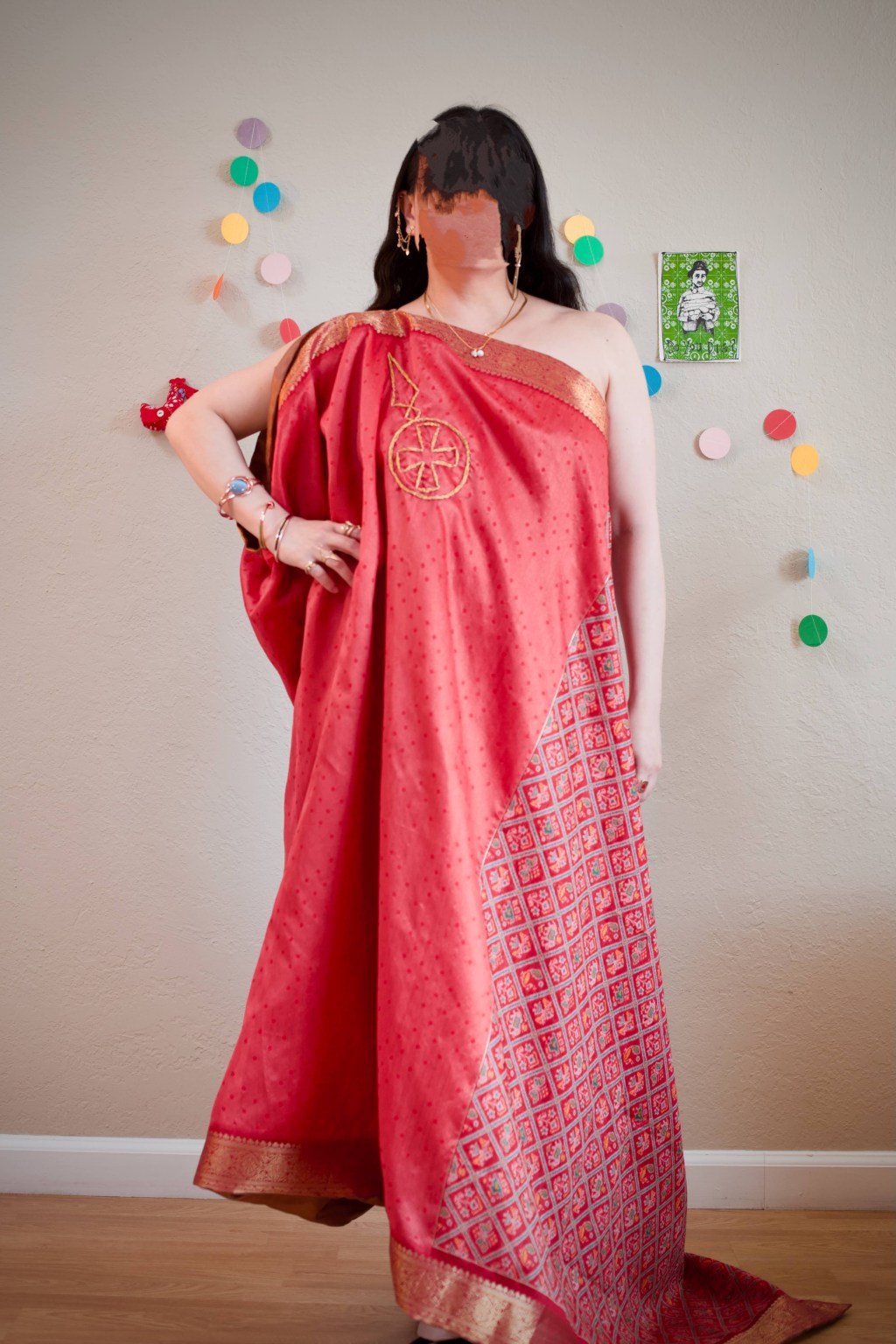
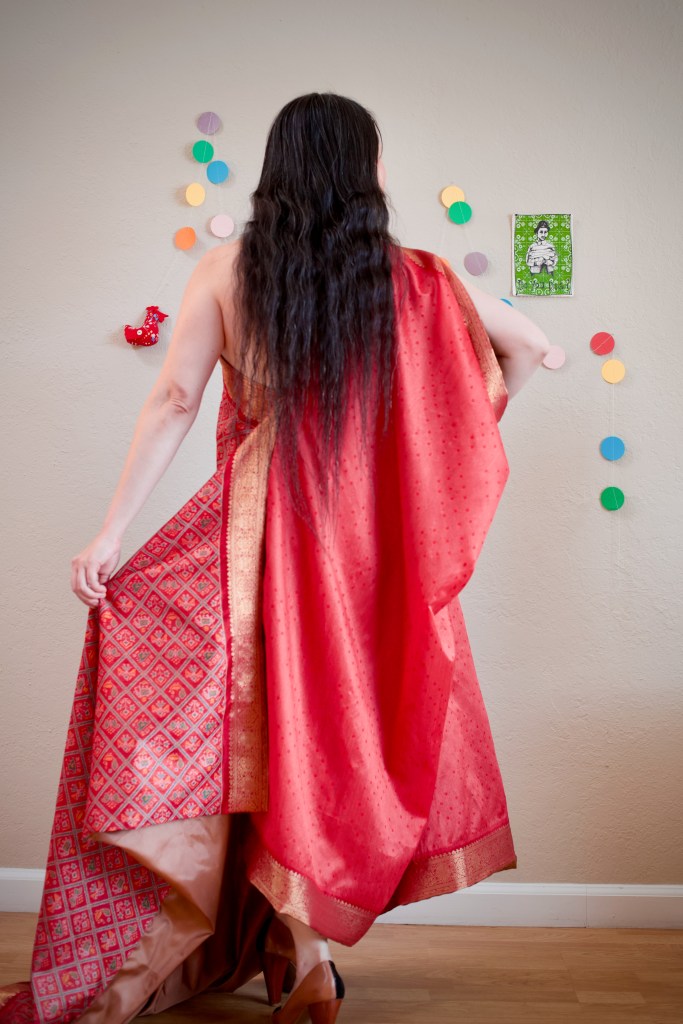
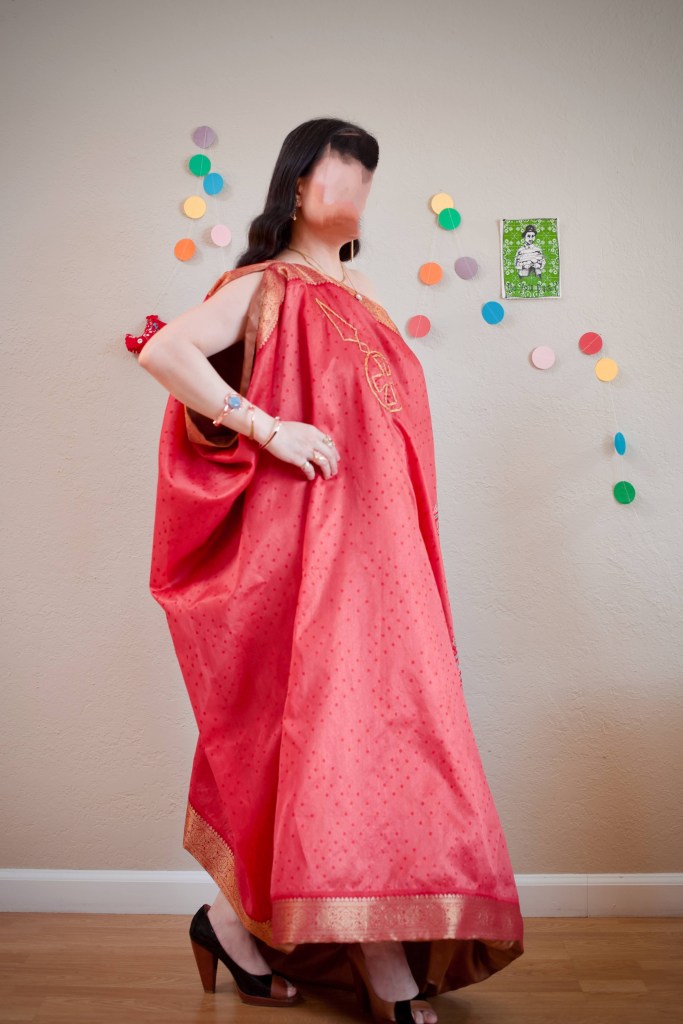
Inspired by the Iron Age, this dress is embroidered with the symbol of iron, which is also the symbol for man and Mars, a planet colored in red from its iron deposits. Inside is the Iron Cross, a military emblem first commissioned by the 18th-century King of Prussia Frederick William III during the German Campaign of 1813. Berlin iron jewellery reached its peak production between 1813 and 1815, when the Prussian royal family urged citizens to donate gold and silver jewellery for military funding. The inscription “Ich gab Gold für Eisen”, or “I gave gold for iron”, was also used in later war efforts, including the Franco-Prussian War, World War I, and World War II.
1. Virgil, Pollio.

