
“For there are some eunuchs, which were so born from their mother’s womb: and there are some eunuchs, which were made eunuchs of men: and there be eunuchs, which have made themselves eunuchs for the kingdom of heaven’s sake. He that is able to receive it, let him receive it.”
– Mathew 19:12
A eunuch is a boy or man who has been castrated. The biblical historian Eusebius wrote in his Ecclesiastical History that, as a young man, the third-century Christian scholar Origen of Alexandria secretly paid a physician to surgically castrate him in order to devote his entirety for “the kingdom of heaven’s sake”. Origen, however, in his Commentary on the Gospel of Matthew, which was written near the end of his life, condemned any literal interpretation of Matthew 19:12, asserting that only an idiot would interpret the passage as advocating literal castration.
The deliberate elimination of the male reproductive organs by castration had been practiced since ancient times for various reasons. In 16th-century Italy, prepubertal castration was performed to preserve the male unbroken voice into adult life. The development of complex polyphonic church music combined with elaborate ornamentation required voices in the higher register. The Papal church choir had used boys and adult male falsettists imported from Spain, since there was a Papal injunction against women singing in public. However, children’s voices lack power, while the sound of the falsetto was regarded as being inferior to that of the castrato. As a castrato’s body grew, the lack of testosterone caused his bone-joints to not harden in the normal manner. Writers of the time noted a tallness of stature, which was unusual in the 18th century, as a consequence. There was a smooth pale skin, with, later in life, fine wrinkles around the eyes, no beard, plentiful scalp hair, a tendency to obesity, rounding of the hips, and narrowness of the shoulders, and the pitch of the speaking voice was similar to that of a female. While this practice was against the Church’s canon law, it was tolerated on the ground that the music so produced was for the honor of God. By 1640 castrati were members of all the main choirs of Italy, and they continued to take their place in the Papal chapel for over three centuries.
The coming of opera to the Italian musical scene in the early 17th century brought the church choir castrati to the main stage. Castrati with the finest voices became operatic idols. During the 18th century, opera seria spread from the operatic centres of Naples, Venice, and Rome to other European cities, including London, where the top castrati were regarded as international stars who could command enormous fees. The most famous castrato of all was Carlo Broschi (1705-82), known as Farinelli, who had a legendary voice spanning over three octaves and thoracic development such that he could hold a note for a whole minute without taking breath. Charles Burney wrote in General History of Music, “No vocal performer of the present century has been more unanimously allowed by professional critics as well as general celebrity to have been gifted with a voice of such uncommon power, sweetness, extent, and agility as Carlo Broschi, called Farinelli”. Farinelli took London audiences by storm, one Englishwoman of fashion being so carried away during his performance that she exclaimed, “One God, one Farinelli!”
As the 18th century progressed, the enthusiasm for opera seria waned and, consequently, so did the need for castrati. But in the Sistine Chapel, they continued to be members of the choir. The last castrato in the Vatican was Alessandro Moreschi who died in 1922 at the age of 64. A 20th century authority on the castrati, Franz Haböck, knew Moreschi and described his voice as being powerful, but pure and clear as crystal, with effortless breath control.
In China, the practice of using castrated men as guardians of the emperor’s inner court began more than 2,000 years ago. During the Han Dynasty, the supply of eunuchs was maintained by punishment, in particular punishment for treasonable offences. The Chinese historian Sima Qian was castrated by order of the Han Emperor of China for dissent. A man being castrated was said to be “sent to the silkworm house.” Like raising silkworms, castrated men were shut in an enclosed room during castration and recovery to prevent death.
With the abolition of castration as punishment starting in AD 547, slave raiding expeditions were organized to capture young boys from indigenous tribes of Southern China. By the Tang Dynasty, it became custom for provincial officials to send to the capital a quota of castrated boys as part of their annual tribute. Meanwhile the eunuchs had risen to occupy impressive positions within the Tang Imperial Court, despite having little or no education. As guardians and servants of the Imperial Harem, they were an undesirable necessity. Being court favourites and rivals to the administrative class, they were seen as a menace, undermining the court such that their destruction would bring its collapse. “For if you attack the wood-worms by setting fire to the wood, though the worms will all perish, the wood itself must be consumed as well.”
By the reign of Empress Wu (684-705), the eunuchs had begun to take to themselves wives, and in the reign of Hsüan Tsung (712-756) they had deserted their quarters in the palaces for large mansions and estates in the metropolitan area, and were adopting, in addition to young eunuchs, ordinary children of both sexes to whom they could bequeath titles and possessions. All eunuchs were brought up in the Buddhist faith, and to Taoism they were also favourably inclined. They exercised an almost complete official control over the activities of both. As Envoys of Faith and Works, the profits they drew from commissions upon enforced repairs to monasteries and the purchase of live birds and animals for release were enormous. The eunuchs reached their zenith during the reign of Emperor Wanli in the late 1500s during the Ming Dynasty, when the emperor authorized the hiring of a large number of eunuchs and withdrew himself from the day-to-day running of the court. They became essential intermediaries between the outer bureaucratic world and the inner imperial one.

The last eunuch, Sun Yaoting, was just days shy of 94 years old when he died at his home in a Beijing temple in 1996. He was memorialized in a traditional ceremony at the Guanghua Temple in Beijing, where his family laid a gold cloth across his face, put rings on his fingers, and shrouded him in white silk embroidered with the dragon and phoenix emblems of China’s imperial tradition. In one corner of the palace, a granite block still marks the spot where some of Mr. Sun’s fellow eunuchs were said to have lost their ”three precious.” Traditionally, a eunuch preserved his genitals so that they would be buried with him to guarantee his reincarnation as a ”full” man. Unfortunately for Mr. Sun, his family had destroyed his precious jar during the Cultural Revolution of the 1960s.
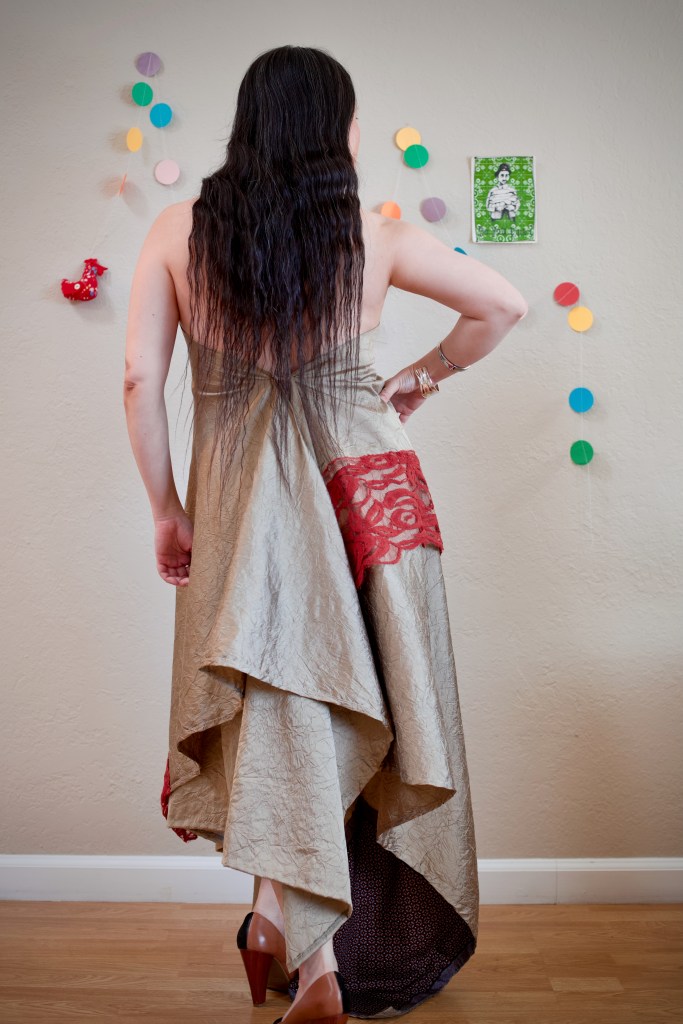
Inspired by the castrato, this dress is embroidered with the treble clef and “o” to symbolize the eunuch. At the foot of the dress is the helmet of the 11th-century Vietnamese military general Lý Thường Kiệt, who served the Lý Dynasty. He is considered among the greatest military leaders, who led the country in the fights against the Song Dynasty’s aggression, at once launching aggressive campaigns into Champa. Even though already married, he chose to be castrated in order to better serve his government. The stele erected during the Lý Dynasty recorded, “In his early youth, he was appointed to serve Emperor Thái Tông within the Forbidden Palace.” Compiled during the Trần Dynasty, the Chronicle of the Spirits of the Viet Realm wrote, “Because of his handsome appearance, he was castrated and appointed to the position of Palace Attendant.”
 hardlyplaying.blog