
It is said that Hermaphrodite, the child of Aphrodite and Hermes, was born so remarkably beautiful that the freshwater nymph Salmacis forced herself upon him in order to keep him forever. This androgynous boy of a woman’s body with male genitals had long symbolized for the ancient Greeks and Romans erotic love, passion, and lust. According to the Greek playwright Aristophanes, humanity started as three sexes: male-male people who descended from the sun, female-female people who descended from Earth, and male-female people who came from the Moon. The androgynous humans were spherical with four legs, four hands, and two heads. They were extremely powerful and dared to rebel against the Gods.
Over time, androgyny has come to describe not only the intersex, but also those possessing the spiritual qualities of the other sex. For a woman, she may exhibit talent in physical sports, or in domains of knowledge considered men’s, such as math, science, and literature. Such is the story of Atalanta, a maiden whose face you might truly say was boyish for a girl, yet too girlish for a boy, who devoted herself to the sports of the chase. To her many suitors she challenged them to a race, but death must be the penalty of all who would try and fail. As the virgin darted forward, she looked more beautiful than ever. The breezes seemed to give wings to her feet; her hair flew over her shoulders, and the gay fringe of her garment fluttered behind her. A ruddy hue tinged the whiteness of her skin like a crimson curtain cast on a marble wall. All her competitors were distanced, and were put to death without mercy.

By the 19th century, the Russian-born philosopher Lou Andreas-Salomé whose brilliance and radiant blue eyes were said to be so captivating that she amassed a throng of famous men who would develop a lifelong unfulfilled infatuation with her. She was a muse to the Austrian poet Rainer Maria Rilke, who wrote her passionate love letters and dedicated his Book of Hours to her. Her 1882 poem Hymn to Life inspired the German philosopher Friedrich Nietzsche, her lover at the time, to set it to music:
“Surely, a friend loves a friend the way
That I love you, enigmatic life —
Whether I rejoiced or wept with you,
Whether you gave me joy or pain.
I love you with all your harms;
And if you must destroy me,
I wrest myself from your arms,
As a friend tears himself away from a friend’s breast.”
When she declined his marriage proposal the second time, Nietzsche was devastated. Inspired by his conversations with Salomé and as an antidote to his pain, he wrote Thus Spoke Zarathustra.
For a man, he may exhibit the occupation for naught but the road to elegance and happiness. Such a man is called the Dandy. These beings have no other role than to cultivate the idea of beauty in their persons, to satisfy their passions, to feel and to think. Even though the dandy does not aspire to money as to something essential, he leaves that gross passion to vulgar mortals, it goes without saying that he must have at his disposal a sizable fortune in order to indulge his taste for the finer things in life. The French poet Charles Baudelaire, in The Painter of Modern Life, distinguished Dandyism from mere physical beauty: “Dandyism does not even consist of, as many thoughtless people seem to believe, an immoderate taste for fashion and material elegance. To the perfect dandy these things are no more than the symbols of his aristocratic superiority of spirit. … It is the pleasure derived from astonishing others, and the proud satisfaction gained by never oneself being astonished. A dandy may be blasé, or he may be a man who suffers; but in the latter case, he will smile like the Spartan lad though bitten by the fox beneath his tunic.”
The modern-day Dandy is the Metrosexual – one who is meticulous about his personal style, grooming, and appearance. Written for Salon in 2002 in an article titled Meet the Metrosexual, Mark Simpson described the metrosexual man as “a young man with money to spend, living in or within easy reach of a metropolis – because that’s where all the best shops, clubs, gyms and hairdressers are. He might be officially gay, straight or bisexual, but this is utterly immaterial because he has clearly taken himself as his own love object and pleasure as his sexual preference.” One who is “less certain of his identity and much more interested in his image – that’s to say, one who was much more interested in being looked at (because that’s the only way you can be certain you actually exist). A man, in other words, who is an advertiser’s walking wet dream.”
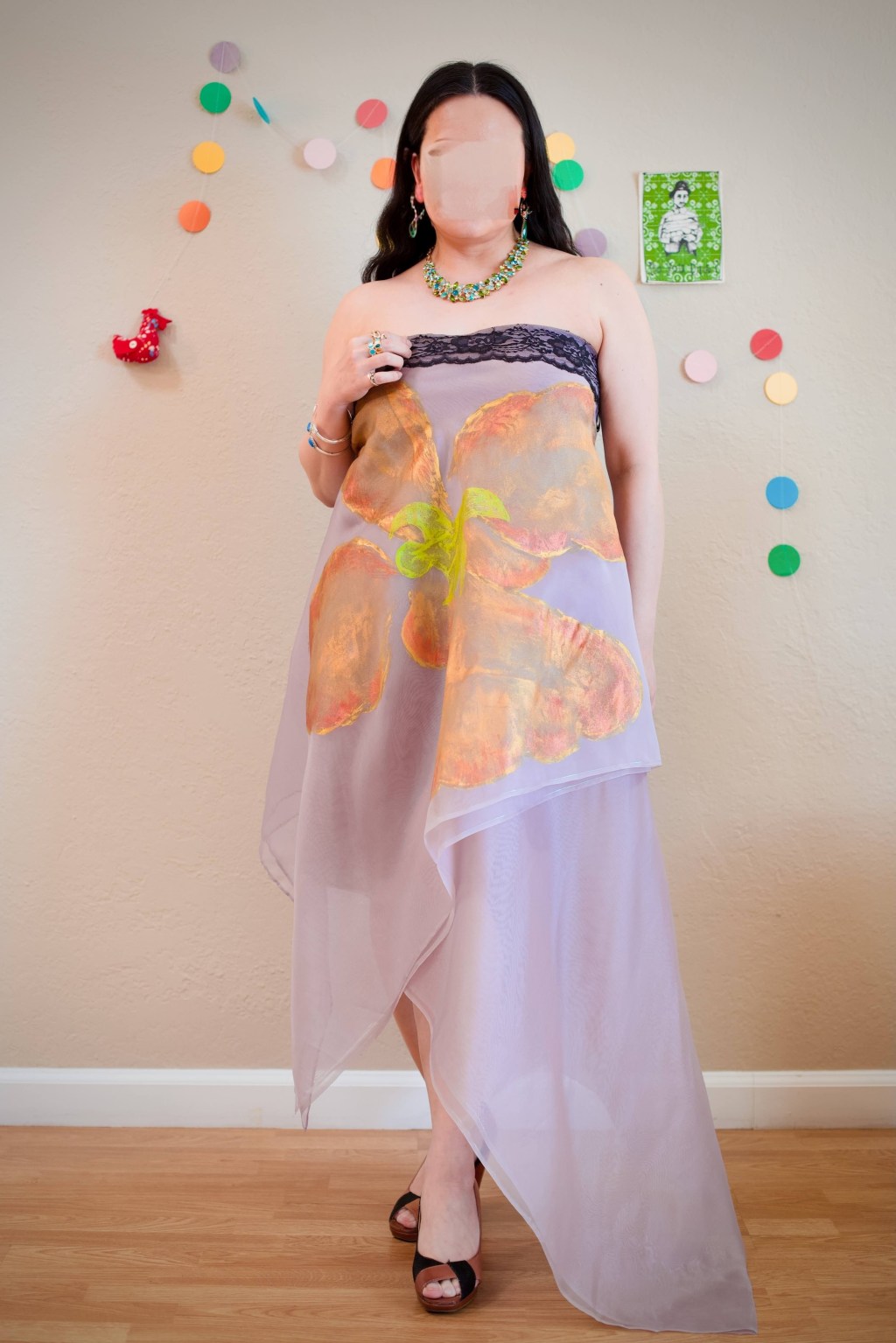
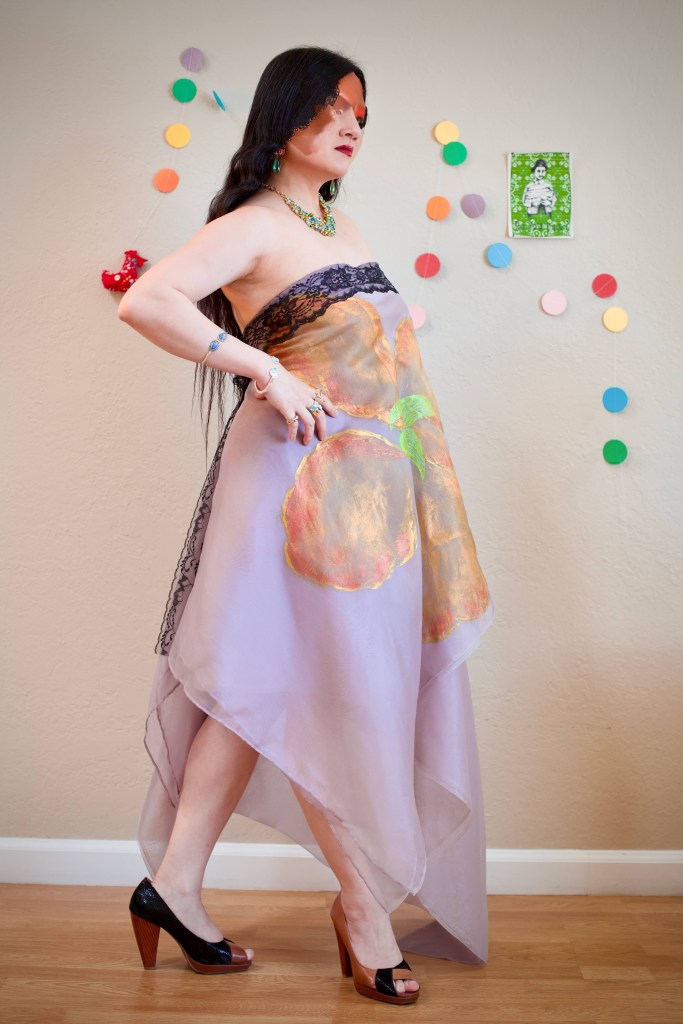
This dress is hand-painted with an orchid flower motif to symbolize the androgynous. The orchid is a hermaphrodite, whose reproductive organ is the fusion of both male and female parts (stamens and pistil) into a single organ, called the column. The orchid motif is inspired by Georgia O’Keeffe’s painting of an orchid, whose green-colored column appears like someone laying about to unwind – hanging loose.

