Buddhist books arrived in China during the first century AD. From these books, the Chinese learned of the Buddha and became familiar with the names of the sacred places he had consecrated by his presence. Over time, new converts who desired to learn more of their religion risked the peril of travel to visit the western regions. Yijing, the Tang Buddhist monk and renowned writer who lived about 670 AD, wrote that 500 years before his time, 20 men had found their way to the Mahabodhi tree in India, and for them a Maharaja called Srigupta built a temple, which was called the “Tchina Temple.” In Yijing’s days it was in ruins. In the year 290 AD, a Chinese pilgrim named Zhu Zixing visited Khotan, and another named Fa-ling visited North India shortly after.
Among the first travel records in detail was that of Faxian. In 400 AD, he departed Chang’an to travel along the Silk Road and spent 10 years in India to acquire Buddhist scriptures. Then in the year 518, Sung Yun, a native of Dunhuang, was sent by the Empress of the Northern Wei Dynasty to the western countries to seek for books. His team brought back 170 volumes of the Great Development series. They seem to have taken the southern route from Dunhuang to Khotan, and thence by the same route as Faxian across the Pamir mountains. Sung-yun, after reaching so far as Peshawar and Nagarahara, returned to China in the year 521 AD.
The most illustrious and famous traveling record of all was that of Xuanzang in 629 AD. At the age of 20 he was fully ordained as a priest. At the age of 26, he set out from Chang’an and journeyed across Central and South Asia. Returning to China in 645 AD, he had brought back with him more than 600 bodies of Buddhist works along with numerous statues of the Buddha in silver and sandalwood, all carried by 22 horses. It was not only Buddhist scriptures that he gave, but also detailed records of all the visited kingdoms and their people. His travel records inspired the 16th-century novel Journey to the West, which became one of the four great novels of classical Chinese literature, considered the pinnacle of Chinese fiction. Journey to the West would inspire numerous subsequent works throughout East Asia. For example, the Japanese manga series Dragon Ball is inspired by this work, in which its protagonist Son Goku is based on the monkey Sun Wukong in the original.

By the 16th century, the Silk Road had been all but forgotten. At the turn of the 20th century, it became a favorite spot to dig for treasures of the lost world for enthusiasts and archeologists. Using Xuanzhang’s Records of the Western Regions, they would map ancient towns that had been swallowed up by the desert for over a thousand years.
In 1900, Sir Marc Aurel Stein from Budapest of Hungary, while making his way from Kashgar and Yarkand, came upon the remains of Dandan-Uiliq, or “the houses with ivory”, a historic oasis town in the Taklamakan Desert. Abandoned in the late 8th century, it was then marked only by a few dead fruit trees in what was once an orchard. In that same year, Wang Yuanlu, a Taoist monk who was the lone guardian of the Mogao Caves, or the Temples of the Thousand Buddhas, discovered a room behind the back wall where he sat. Behind this 11th-century wall was piled high with long-forgotten and dust-furred manuscripts and scrolls. When Wang told the local officials of his discoveries, he was ordered to “seal the room back up again.”
Seven years later, Stein traveled to Dunhuang to verify the rumors of a “great hidden deposit of ancient manuscripts.” Being shown through the aperture, he wrote of the room: “Heaped up in layers, but without any order, there appeared in the dim light of the priest’s little oil lamp a solid mass of manuscript bundles rising to ten feet from the floor and filling, as subsequent measurement showed, close on five hundred cubic feet.” It became one of the greatest archaeological discoveries of the century. The Library, as it was known thereafter, contained documents in 17 languages and 24 scripts, including a copy of the Tang Dynasty Diamond Sūtra. Stein bought around ten thousand documents and artworks, including this copy of the Diamond Sūtra, for the British Museum for the beggarly sum of £130.

Today Buddhism in Central Asia has largely disappeared. Most recently, the two monumental Buddhist reliefs in the Bamiyan Valley of Afghanistan were reduced to rubble with artillery, anti-tank mines, and explosives. It was said after one of the explosions failed to obliterate the face of one of the Buddhas, a rocket was launched that left a hole in the remains of the stone head. Perhaps the most affectionate remnant of Buddhism importation into East Asia along the Silk Road would be the Graeco-Buddhist style art reliefs found across East and Southeast Asia, where the Buddha is portrayed in classical style, with a Hellenistic dress. It was the Yuezhi who established the Kushan Empire that turned Buddhism from a local Indian cult into a world religion. The Kushans adopted the Greek alphabet and minted coinage on the Greek model. For 200 years, the Kushan Empire ushered in a period of peace – the “Pax Kushana.” They became a trade center along the Silk Road, bringing silk into Rome and Buddhism into China.
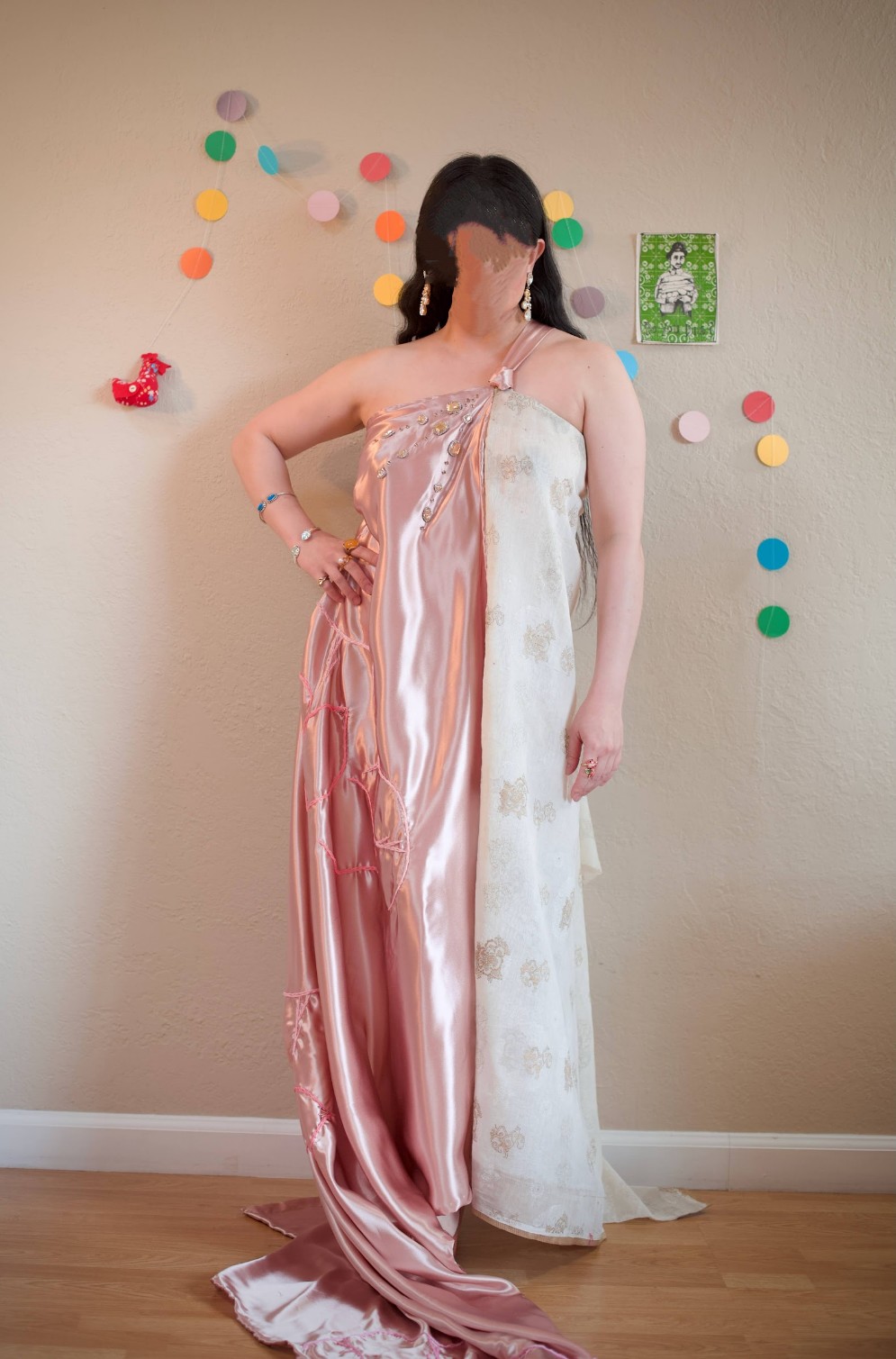
Inspired by the Journey to the West, this dress is embroidered with lotus flower motifs and rhinestones to symbolize the Diamond Sūtra.

