More than two millennia ago, the Han people knew of the Horse of Heaven from far to the west of China. It came from Ta Yuan, ancient Ferghana, the Chinese equivalent for a local name for Greeks or Ionians, “Yavan”, which was described by Zhang Qian, China’s pioneer in Western Asia, as a land where people lived in walled cities, cultivated the grape, and placed high value on women, as husbands were guided in their decisions by the advice of their wives.
This horse was a fact of political power, for while the Qin Dynasty was unifying China, the Xiongnu to the north had created a vast empire on the steppes. The horse and mastery of its management was the essential “machine” that made it possible. If the Han world was to control the Xiongnu, China too must develop a “machine” capable of meeting the technological advance of the empire to the north. It was this drive to control the Xiongnu that drove the mission of 138 BC, when the Han court dispatched Zhang Qian to the Western regions with a group of 99 members to make contact and build an alliance with the Yuezhi against the Xiongnu. In 125 BC, Zhang Qian returned to China from Ferghana, reporting on the excellent horses in that area. He described them as blood-sweating steeds whose stock was the offspring of the Tianma, the Supernatural Horse. The reported blood-sweating came from the parasite Parafilaria Multipapillosa that is still common in Central Asia. It causes a slight bleeding under the horse’s skin when the animals are active during hot weather, particularly in the summer. The foamy sweat takes on a pink tinge from the blood oozing through the skin.
Even at the time of early attempts to import the horse, they were clothed in the aura of divinity. A commentary to the Ch’ien Han Shu, or Book of the Former Han, wrote, “Upon a high mountain in the kingdom of Ta Yuan were horses which could not be caught. So at the foot they placed mares of various colors, and the results of their unions were colts which all sweated blood. Hence the term ‘offspring of Supernatural Horses’.” The arrival of the first heaven sent horse in the year 120 BC from the waters of the Wowa Pond, near Dunhuang of West China, was commemorated by an official named Pao Li-chang:
“Tai-i1 has given the horse of heaven –
Moist with crimson sweat, foaming russet spittle
A will and spirit wondrous and strange –
Trampling the floating clouds, darkened it races aloft.
And oh this horse has leapt ten thousand li,
And with what can it be paired?
The dragon its companion.”
1. The Supreme One
The forged alliance with Ferghana had the Wusun gifting Emperor Wudi one thousand blood sweating supernatural horses in 107 BC, but they were of a different breed. Thus the emperor sent a military expedition to Ferghana in 104 BC to obtain the Heavenly Horses, which ended disastrously. In his second campaign against Ferghana in 102 BC, 60 thousand men, 100 thousand oxen, 30 thousand horses, donkeys, mules, and myriads of camels were sent to complete the mission. This venture resulted in about 30 Heavenly Horses which were used as breeding stock. The Ferghana also agreed to send two Heavenly Horses each year to the Emperor, and lucerne seed was brought back to China to provide superior pasture for raising these fine horses. Poems and music celebrated this importation in 101 BC:
“The horse of Heaven has come
As he must in the time Chih-hsu1
He will shake himself and rear
Who knows when.
The horse of heaven has come
Open the far gates
Raise up my body
I go to Kunlun.
The horse of heaven has come
Mediator for the dragon
He travels to the gates of heaven
And looks on the Terrace of Jade.”2
1. Chih-hsu corresponds with the sign Ch’en in the Chinese dating system of the year when the poem was composed, which corresponds to the green dragon.
2. In the Tale of King Mu, Son of Heaven, King Mu of the Zhou Dynasty dreamed of being an immortal. He set out to visit the Western heavenly paradise of the Queen Mother of the West on Mount Kunlun in order to taste her Peaches of Immortality. His celestial chariot was drawn by eight heavenly horses to meet with her on the Jade Pond.

Evidently the horse had gone beyond an artifact of political power to become a ritual connection with the emperor and a symbol of cosmic power. Upon his victory against the Trung Sisters’ uprising in 43 AD, the great Han general and horseman Ma Yuan had an effigy of a horse cast from a seized Jiaozhi bronze drum, of which he was quoted to say, “For moving through the heavens, nothing compares with the dragon; for moving over the earth, nothing compares with the horse.”
Over the coming centuries, demand for Central Asia’s horses became an important economic driver of the Silk Road. By the 8th century, the “Thousand-Autumn Holiday”, which celebrated the Tang Emperor Xuanzong’s birthday, the fifth day of the eighth lunar month, notably included a troupe of one hundred dancing horses, whose performance was ordered by the emperor himself. These horses were decreed to be caparisoned with patterned embroidery, haltered with gold and silver, and their manes and forelocks dressed out with pearls and jades. Their tune, which was called Music for the Upturned Cup, had several tens of choruses, to which they shook their heads and drummed their tails, moving in tune to the rhythm. Excavation at a dwelling in Ch’ang-An in 1970 unearthed a silver wine-flask dating to Xuanzhong’s reign, featuring a prancing horse with winecup in mouth in gold relief. The horses were thus quite literally acting out The Upturned Cup:
“The dragon colts of the imperial fold are well-grouped, well-composed;
The thoroughbred foals from the astral corral are unwonted and uncommon.
In easy expanse of gambade and prance, they answer to the rhythm,
Full of high spirits, treading each other’s prints, and never wavering.”
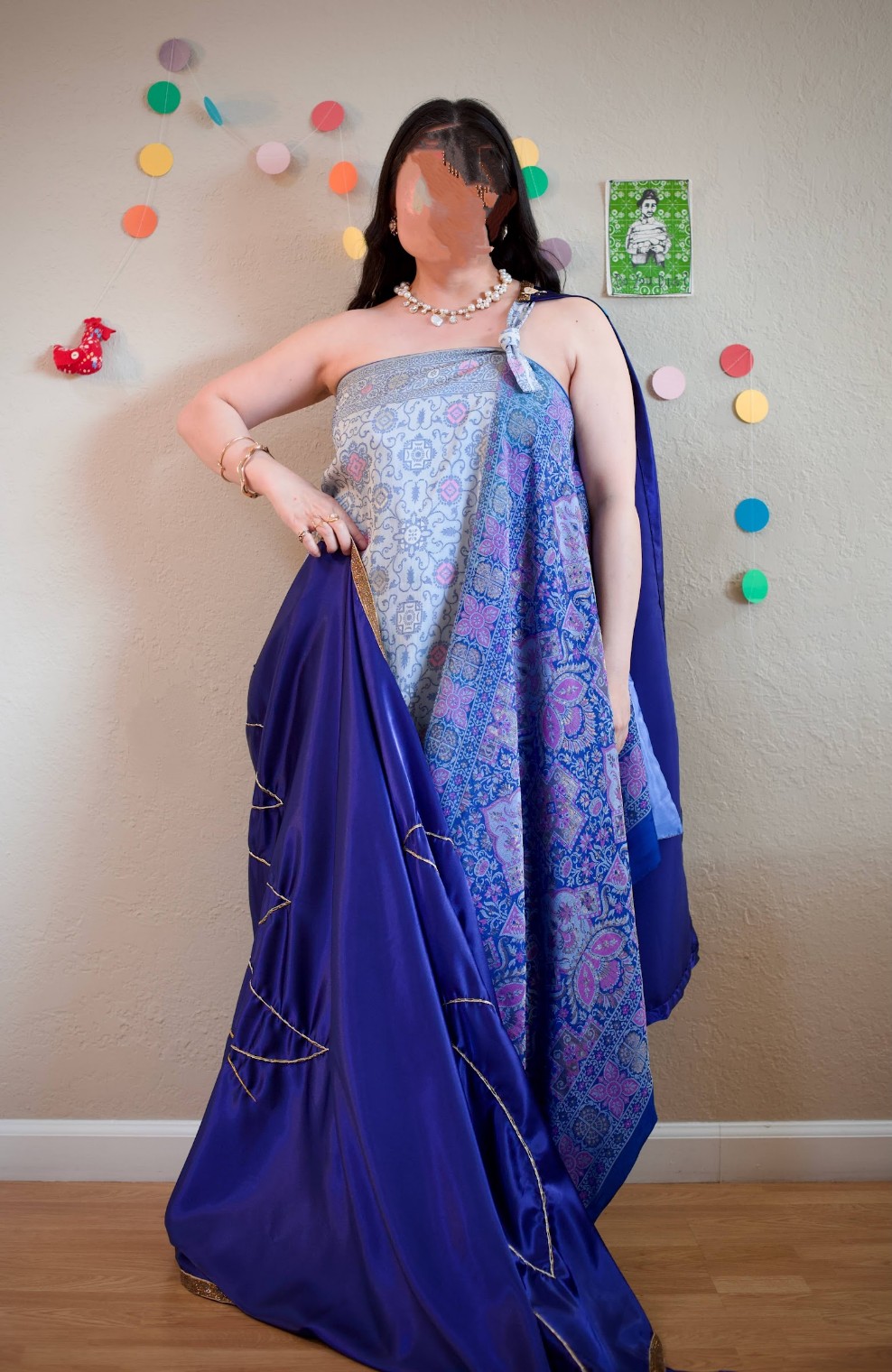
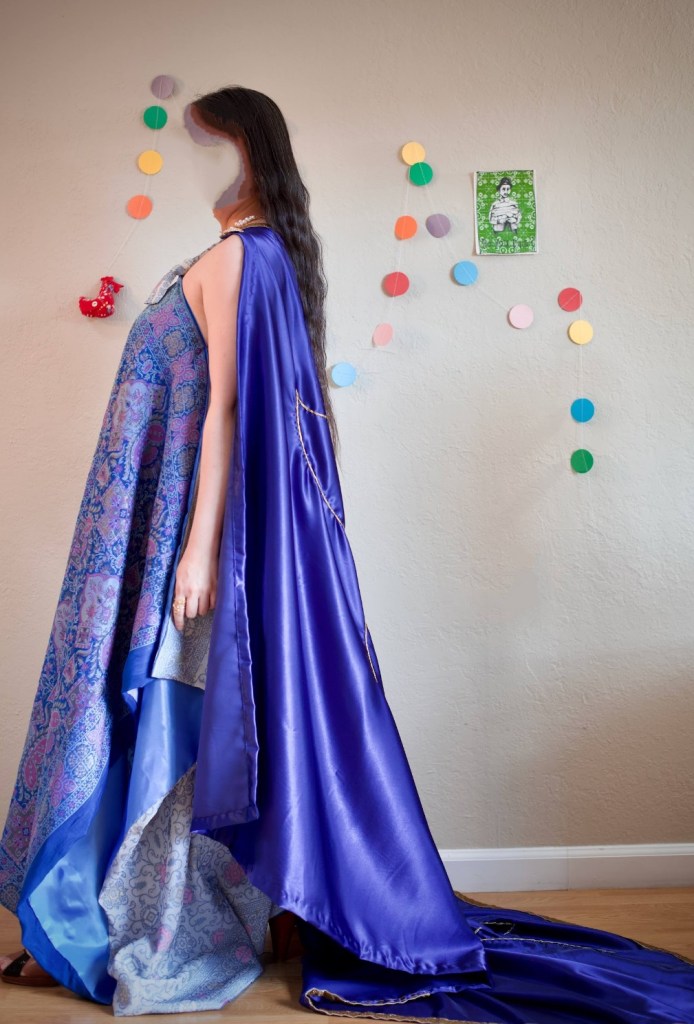
Today the Akhal-Teke horse is considered to be the descendant of the original Fergana horses. They have a reputation for speed, endurance, and intelligence, and are fine sport horses. There are certainly other excellent horse breeds in the western world, but for the people of the Far East, these legendary animals were the winged horses of the West – gateway to a new frontier, and to another Heaven. Inspired by the Heavenly Steed, this dress is draped in a silk panel embroidered with a gold horse motif. The base dress is crafted from a vintage silk sari.

