It is said that almost five thousand years ago, while sitting in the shade of a mulberry tree in her garden, the Empress Hsi Ling-Shi found a fallen cocoon in her teacup. The cocoon softened in the hot tea and unraveled into a long, lustrous thread, thus beginning the invention of the silk loom and the art of sericulture. Today the empress is revered as the Silk Goddess, and temples dedicated to her dot the landscape of China.
Traces of silk proteins discovered in a group of tombs dating to 8500 years ago indicate China to be the oldest location producing silk. China kept the cocoon as the source of silk secret, to be revealed on penalty of death. It was not until the 2nd century BC that silk was officially exported outside the country, as one Han official wrote of the exchange with the Xiongnu tribesmen who ruled the Mongolian steppes in 81 BC: “A piece of Chinese plain silk can be exchanged with the Xiongnu for articles worth several pieces of gold and thereby reduce the resources of our enemy. Mules, donkeys, and camels enter the frontier in unbroken lines; horses, dapples and bays and prancing mounts, come into our possession.” Thus the Silk Road, a network of trade routes stretching from the Far East to Central Asia, and onward to Europe, had begun.
The historian Dio Cassius reported the Romans to first see fine quality silk at the battle of Carrhae in 53 BC, when the Parthians unfurled their snapping banners. The Latin name for silk is “sericum”, being derived from the word Serica, which means China. Soon silk was employed to lavish public buildings and public events. Julius Caesar paid for silk awnings to be hung throughout Rome to provide shade for spectators at his military triumph. Murals at Herculaneum and Pompeii show elite women wearing translucent fabrics which were likely fine, loosely woven silk. Seneca the Younger wrote in De Beneficiis, “I see there raiments of silk – if that can be called raiment, which provides nothing that could possibly afford protection for the body, or indeed modesty, so that, when a woman wears it, she can scarcely, with a clear conscience, swear that she is not naked. These are imported at vast expense from nations unknown even to trade, in order that our married women may not be able to show more of their persons, even to their paramours, in a bedroom than they do on the street.”
Beside its unrivaled luxurious softness, silk has a luminous appearance that no other natural fabric can compare. The two very fine filaments extruded by the silkworm together form the core of the silk fiber. Each filament, called a brin, has the cross-section of a rounded-comer equilateral triangle. Arranged with their bases together, they form a diamond shape. Silk’s luminescence is created by light reflecting off the different faces of its polyhedral fibers. Whereas the rounded fibers of cotton and wool scatter and reflect light equally in all directions, the planar surfaces of silk’s sharply angular fibers create a dance of light and shadow as it moves.
By the 4th century, the poet Su Hui had innovated a classical genre of Chinese poetry on a piece of silk. She wrote her poem Star Gauge upon the news of her exiled husband’s marriage to another woman. It took the form of a grid of 29 by 29 characters, which were embroidered in different colors onto the silk. It is both part and the apotheosis of a genre of Chinese poetry called hui-wen shih, or “reversible poems.” This genre relies on the characteristics of Chinese logographs which can be read in any direction, allowing the poem to be read forward and backward. But Star Gauge’s unique structure lets the reader wander in any direction horizontally, vertically, or diagonally, which allows for a total of over 3000 possible poems, making it unrivaled in complexity for this genre of poetry to date. Su Hui is depicted in the Wu Shuang Pu, or the Table of Peerless Heroes, by Jin Guliang.
The long-guarded secret of silk-making finally escaped China by the 6th century. Among the artworks discovered in a shrine cellar at Dandan-Uiliq by the British archaeologist Sir Marc Aurel Stein, a wooden panel tells the legend of a princess from Loulan who was promised to the ruler of the kingdom of Khotan. Having spent her life swaddled in silk, she was not enthused of a silkless future. Thus she smuggled mulberry seeds and eggs of the silk moth to Khotan, hiding them in her head-dress. But it was likely an act of industrial espionage by two Nestorian monks on behalf of the Byzantine Emperor, Justinian I, who ruled from 527 to 565 AD. They managed to observe the entire silk-making process, then walked out of China with silkworm eggs concealed in their hollow canes, effectively ending China’s silk monopoly.
Silk’s softness was not valued by all, however. In 15th-century England, for example, silk was chemically treated so that it would become heavy and crisp in order to produce a stiff drape, which was considered elegant and much prized. When silk becomes coarse, it makes a rustling sound, of which quality William Shakespeare used as a metaphor for vanity in Cymbeline: “prouder than rustling in unpaid-for silk.” In fashion, the technical term “scroop” describes the dry rustling sound made by silk when it is rubbed or squeezed. The French word for scroop is “frou-frou”, an onomatopoeia coined to capture the sound of the swish and sway as can-can dancers performs splits, cartwheels, and high kicks, all while flashing frothy tiers of their silk petticoats.
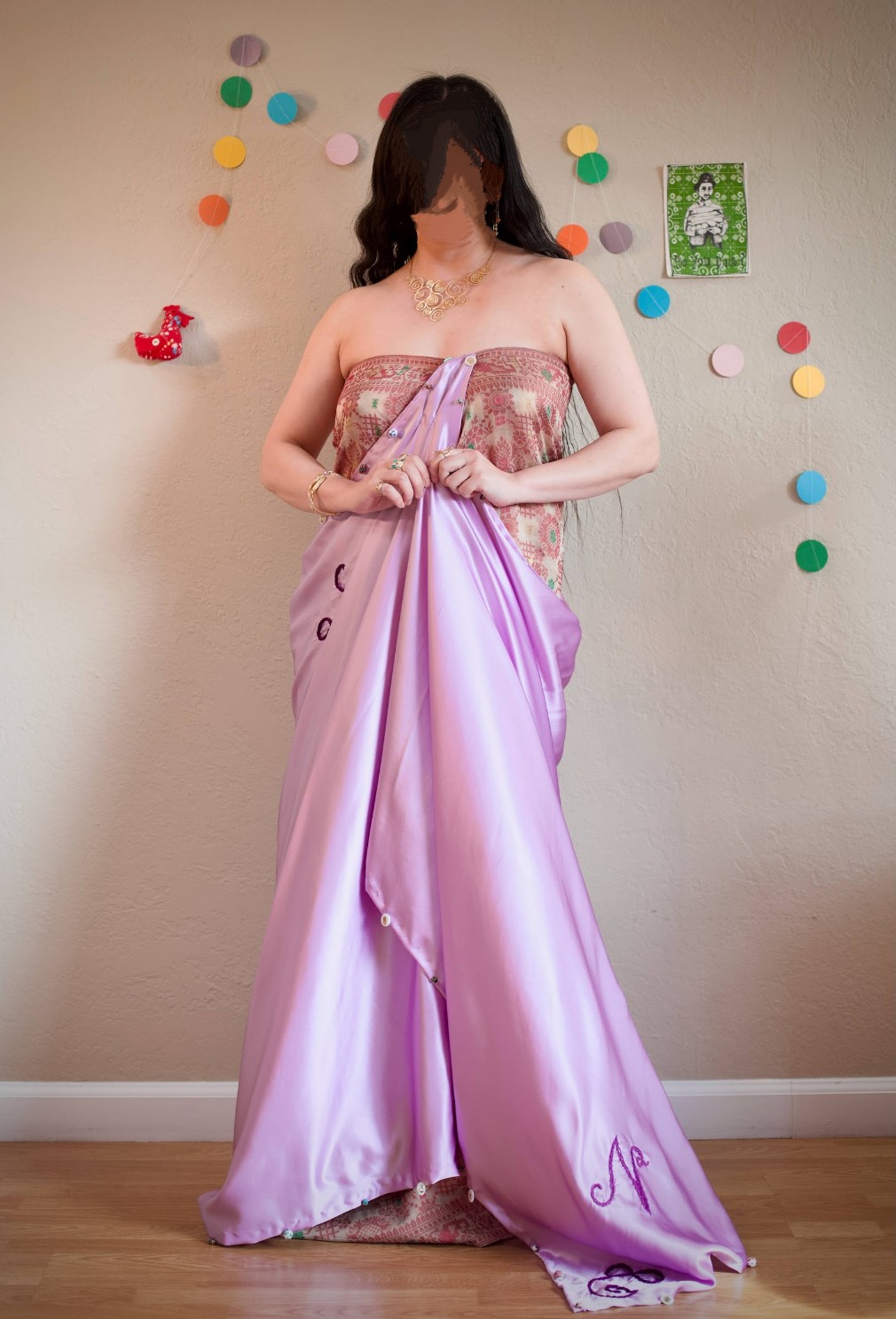
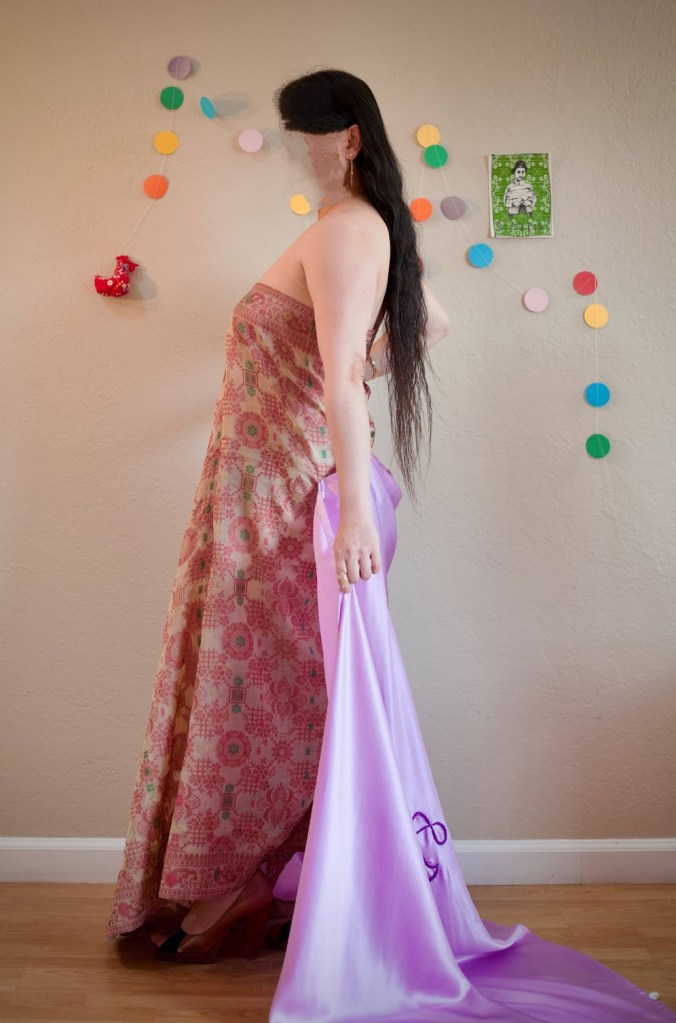
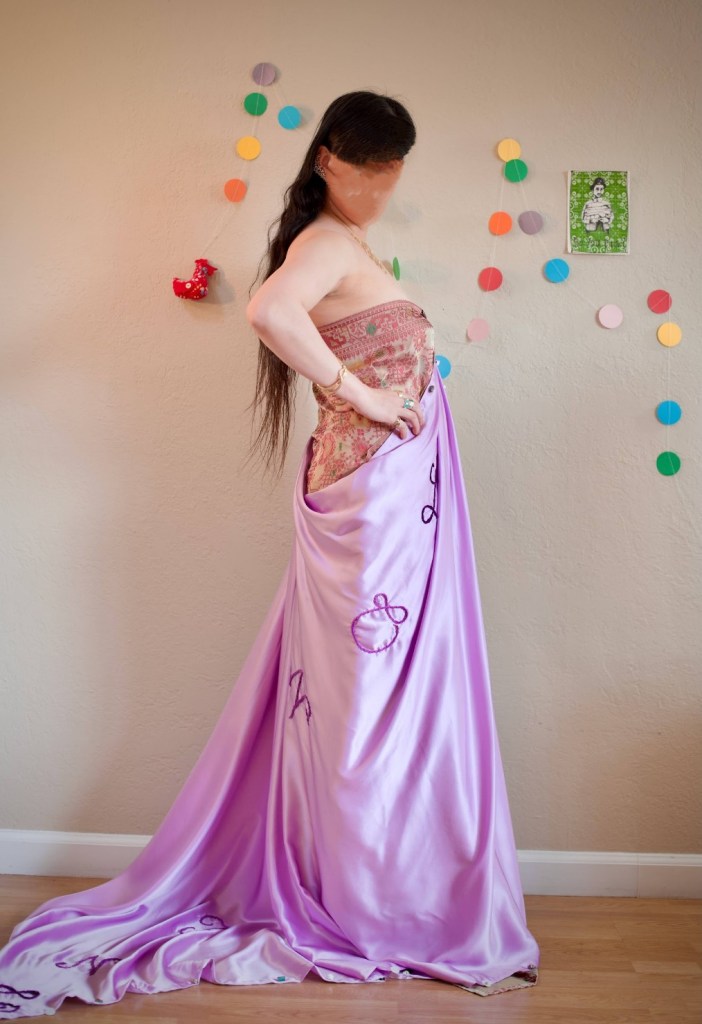
Today silk is more affordable than ever and comes in an abundance of varieties, from soft and sheer like chiffon, stiff and sheer like organza, smooth and lustrous like charmeuse, to a heavily woven like damask. At the same time, newly invented fabrics promise to better accommodate modern living, some even carrying us deep down under the sea or up into space. Yet, regardless of what modern technology has improved upon textiles, silk is still synonymous with quality and luxury, the finest cloth human ever invented in order to cover ourselves. Inspired by Su Hui’s poem Star Gauge, this dress is draped in a silk panel, which is embroidered across with the word “longing.” The base dress is crafted from a vintage silk sari.
 hardlyplaying.blog