The Golden Ratio ɸ is an irrational number, meaning that it cannot be expressed as a fraction of two natural numbers. The Golden Ratio is especially associated with number 5, as it can be expressed as ɸ = (1+ √5)/2, with √5 being an irrational number.
Beginning in the 4th century BC, Greek interest in constructing two-dimensional planes and three-dimensional solids led to interest in the Golden Ratio, as it is closely associated with these objects. For example on a plane, the edge lengths of the pentagon and pentagram have the Golden Ratio. In solids, four of the five Platonic solids, the cube, the octahedron (8 identical triangular faces), the dodecahedron (12), and the icosahedron (20) are also closely related to the Golden Ratio. If we connect the centers of all of the faces of the cube, we obtain an octahedron; connect all the centers of the faces of an octahedron, we obtain a cube. The same procedure can be done to map an icosahedron into a dodecahedron and vice versa, and the ratio of the edge lengths of the two solids, in which one is embedded in the other, can also be expressed in terms of the Golden Ratio, as ɸ2/√5. Consequently the Golden Ratio is featured in Euclid’s Elements for its applications in geometry, the pentagon, and Platonic solids.
In the Golden Rectangle, the length of its sides are in a Golden Ratio to each other. Suppose we cut off a square from this rectangle, what’s left is a smaller Golden Rectangle whose dimensions are smaller than the original rectangle’s dimensions by precisely a factor ɸ. Suppose this procedure is done indefinitely, we will produce smaller and smaller Golden Rectangles, each with dimensions deflated by a factor ɸ. The series of continuously diminishing rectangles converges to a never-reachable point, which is called “the Eye of God,” because of this divine property which only applies to the Golden Rectangle.
Plato, in Timaeus, called his fifth solid, the dodecahedron, that “which the god used for embroidering the constellations on the whole heaven.” The dodecahedron can be found floating on Salvador Dalí’s Sacrament of the Last Supper. Dalí explained his elaboration of the number 12 upon the symmetrical geometric patterns of his painting: “I wanted to materialize the maximum of luminous and Pythagorean instantaneousness based on the celestial communion of the number twelve: twelve hours of the day – twelve months of the year – the twelve pentagons of the dodecahedron – twelve signs of the zodiac around the sun – the twelve apostles around Christ.”
Leonardo of Pisa, or Leonardo Fibonacci, was among the most important mathematicians of 13th-century Europe. It was the historian of mathematics Guillaume Libri who, in 1838, nicknamed him Fibonacci, which means “son of good nature”. During his time, Leonardo referred to himself as Leonardo Bigollo, where “Bigollo” means something like “a traveler” or a “man of no importance” in the Tuscan and Venetian dialects respectively. Beside being known for the Fibonacci sequence, he wrote the Liber Abaci, or Book of the Abacus, which introduced the Hindu-Arabic numeral system into Europe. This system was clearly superior to the Roman numerals previously in use, as it became very cumbersome with large arithmetic operations. Consequently he devoted the first seven chapters of his book to the Hindu-Arabic notation and its use in practical applications.
Simply explained, the Fibonacci sequence is one in which the next number is the sum of the two previous numbers. Fibonacci discovered this pattern while studying the problem of rabbit breeding. While he did not associate this pattern with the Golden Ratio, remarkably it is the Golden Fibonacci, because the ratio between two consecutive numbers approaches ɸ as the sequence continues indefinitely. This property was discovered in 1611 by the German astronomer Johannes Kepler. Remarkably this pattern is found abundantly across nature. For example, plants arrange their leaves in a Fibonacci pattern, as the location of the leaves is found to be determined by the angle between the lines connecting the stem’s center with successive leaves, and this angle is determined by the Golden Ratio. In another example, the pineapple eyes, which are the hexagonal scales on its surface, are aligned in rows which follow a Fibonacci sequence. Within a Golden Rectangle, connecting the successive points of the “whirling squares” produces a spiral that coils inward toward “the Eye of God”, the logarithmic spiral, which appears to be nature’s favorite “ornament”, as it is found in rose petals, sunflowers, seashells, whirlpools, hurricanes, giant spiral galaxies.
The three painters who integrated mathematics into their arts during the Renaissance were Piero della Francesca, Leonardo da Vinci, and Albrecht Durer, as an understanding of arithmetic, geometry, and proportion was essential to creating the perspective of depth in order to achieve realism in painting. It was the Italian mathematician Luca Pacioli who translated Piero’s work from Latin into Italian, who coined the term “The Divine Proportion.” “There is one only and not more,” he compared the Golden Ratio to unity as “the supreme epithet of God himself.” In his second volume of The Divine Proportion, he wrote the treatise on proportion and its application to architecture and the structure of the human body, which was based on the work of the Roman architect Marcus Vitruvius Pollio. This concept of the human body imposing the perfect proportion is depicted in Leonardo da Vinci’s painting of the Vitruvian Man. The German painter Albrecht Dürer was convinced that mathematics was “the most precise, logical, and graphically constructive of the sciences.” He studied Euclid’s Elements and mathematics and arts from the works of Luca Pacioli, architecture, proportion, and perspective from the works of Vitruvius and others. He wrote the treatise on measurement with compass and ruler in 1525, among the first books on mathematics published in German.
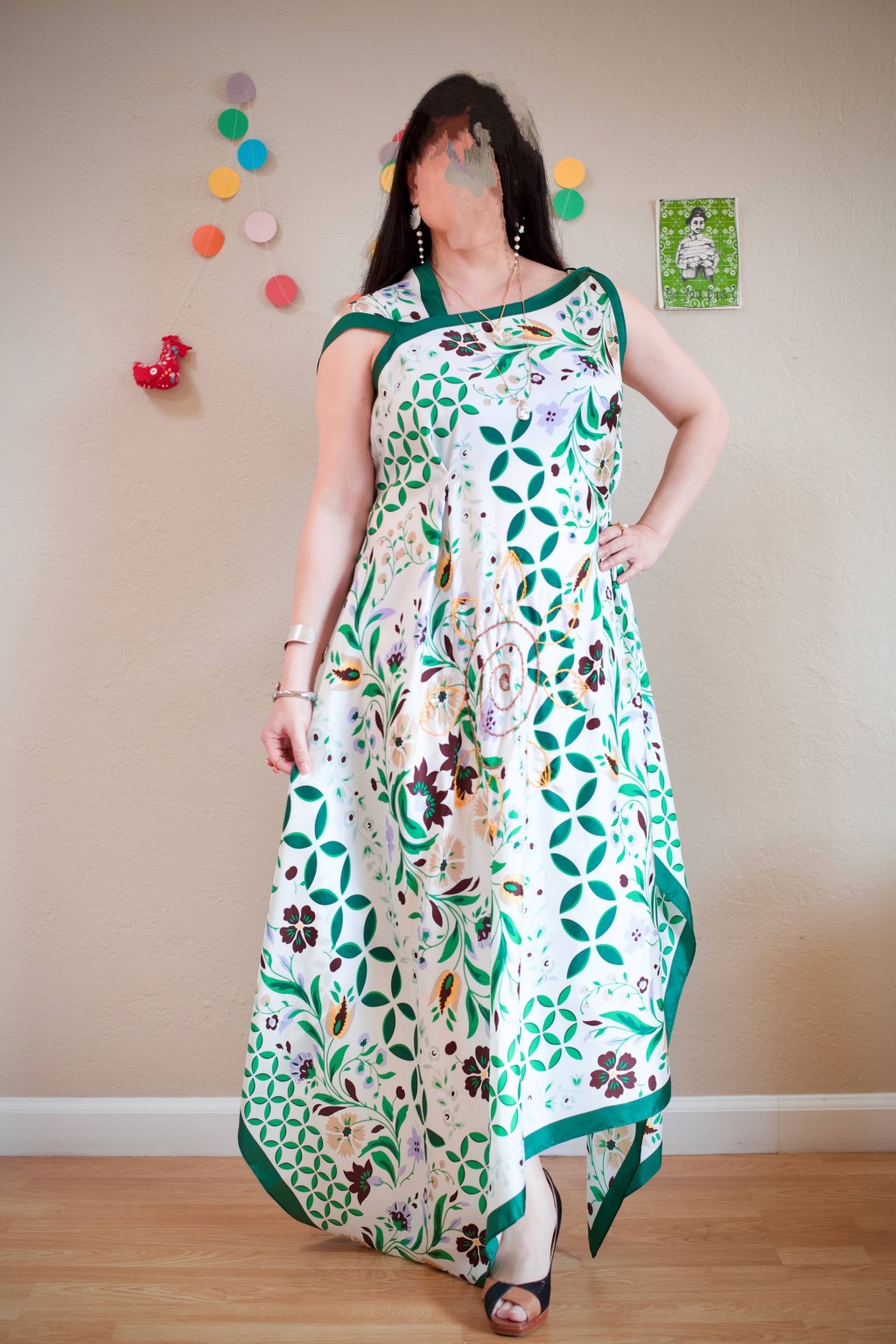
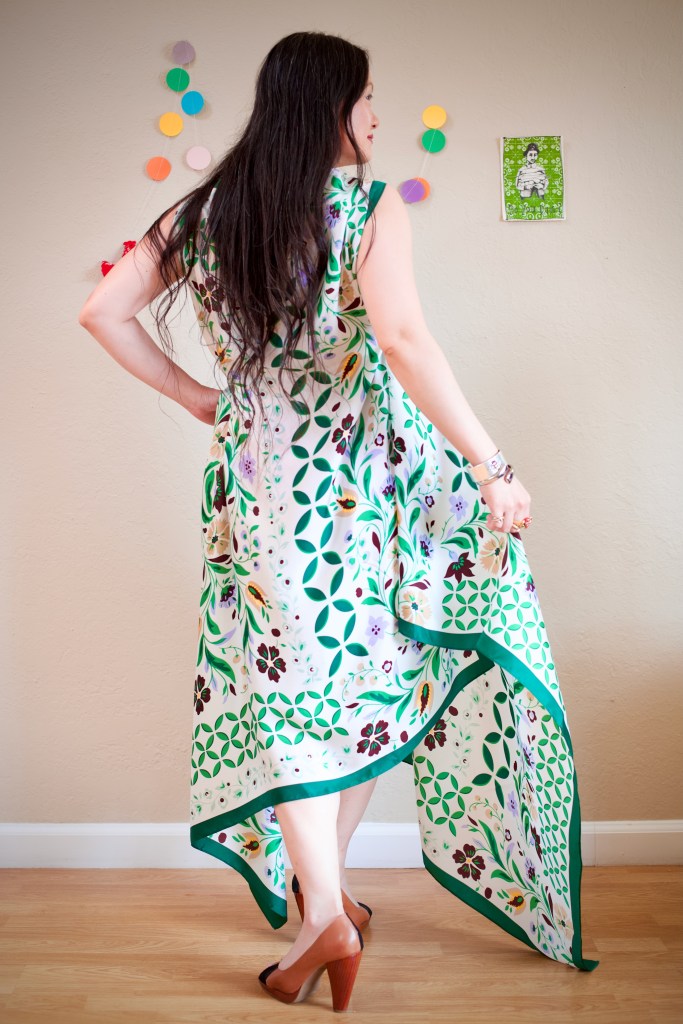
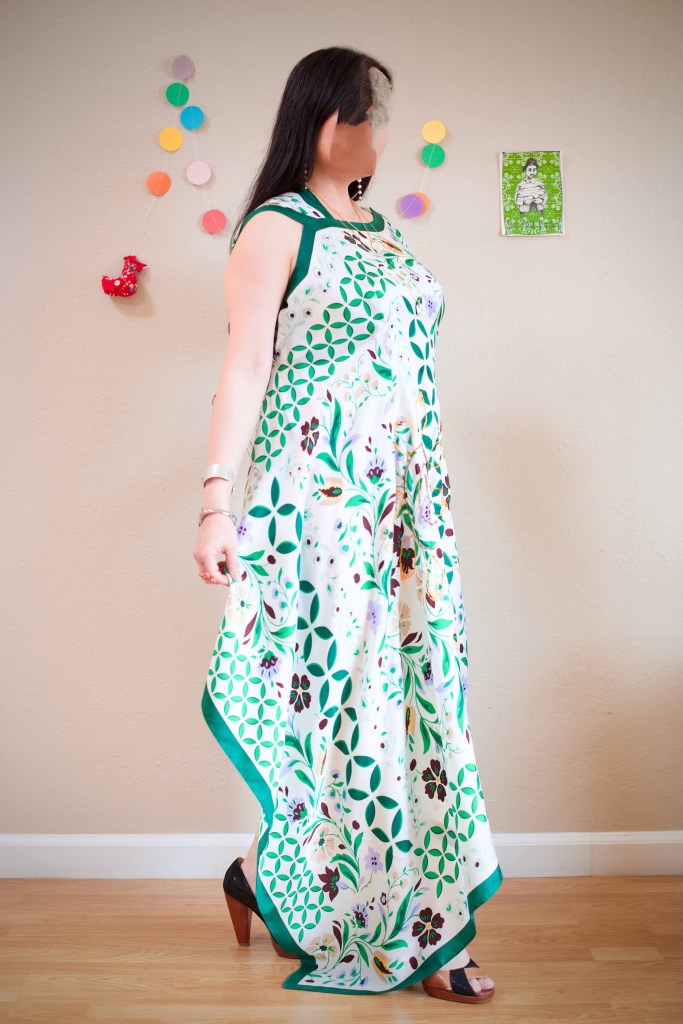
Inspired by the Golden Ratio, this dress is embroidered with a motif of a spiral sunflower. Look closely at the center of a sunflower, you will see seeds arranged in two overlapping sets of spirals radiating outward: one winding clockwise and the other counterclockwise. The number of spirals in each direction is almost always two consecutive Fibonacci numbers, for example 34 spirals going in one direction and 55 going in the other. This spiral arrangement is dictated by the Golden Angle, or 137.5°. As the flower grows, each new seed is placed at the Golden Angle from the previous one. This exact mathematical spacing ensures that the maximum number of seeds can be tightly packed together without any empty gaps or overcrowding, which guarantees that every single seed receives the optimal amount of sunlight, water, and nutrients.

