
In this legendary tale of the Wedding of Andromache and Hektor, the Greek poet Sappho wrote of “myrrh and cassia and frankincense rode on the wind” to perfume the streets of Troy. As early as the 7th century BC, Far Eastern spices had already found their way to ancient Greece. For centuries, Arab merchants controlled the lucrative spice routes to the Mediterranean and Europe while keeping their sources a secret. Great tales of spices were spun, like how the cassia grew in a shallow lake guarded by fierce bat-like beasts, and Arabian cassia-pickers covered themselves in oxhide armor and fought through the creatures to reach the plants. Aristotle, in History of Animals, wrote of the Ceylon cinnamon: “People who live where the bird comes from say that there exists a cinnamon bird which brings the cinnamon from some unknown localities, and builds its nest out of it; it builds on high trees on the slender top branches. They say that the inhabitants attach leaden weights to the tips of their arrows and therewith bring down the nests, and from the intertexture collect the cinnamon sticks.”
The word “spice” derives from the Latin “species”, meaning goods of a particular value. Throughout history, spices were highly desirable as other rare commodities such as ivory, opium, leopard skins, and lapis lazuli. A large portion of the spice trade was conducted over sea, as the most sought-after spices grew on impenetrable forest islands of Southeast Asia, of which the Greeks called the “Golden Peninsula.” From here they would begin their journey on local outrigger boats or Chinese junks. Sailing across the Indonesian archipelago, they would pass either north toward China or through the Strait of Malacca toward India. This voyage had been made since 300 BC, and by the 4th century, the pips were being taken on as far as England. Arab dhows would pick up the spices and take them across the Indian Ocean to the ports of Arabia, where they would be loaded onto caravans to continue the trek across the deserts. Those bound for Europe would either move from Byzantium into Eastern Europe or be loaded onto ships once more in the Mediterranean Sea, passing through Alexandria to Italy. From Venice, they might round the Iberian Peninsula to be delivered to the ports of Western Europe. In the long chain of middlemen, only the first few handlers knew the origins of the goods, only the last few knew the destinations, and no one could see the trail in its entirety.
It’s little surprise then that the Arabs became the experts in the handling and processing of spices. The founder of Islam, Muhammad (AD 570-632), also co-owned a shop that stocked myrrh, frankincense, and Asian spices. For four centuries following his death, his followers, the Mohammedans, became outstanding scientists for their time. They advanced the process of extracting flower scents from blossoms and herbs and created techniques to distill essential oils from aromatic plants. In the 9th century, the Arab philosopher Al-Kindi wrote the groundbreaking text known as The Book of the Chemistry of Perfume and Distillations, which detailed over 100 perfume recipes and distillation techniques, aromatic waters, salves, camphor preparations, and fragrant oils. As the first to document a process for fragrance production, he is considered the father of perfume. The principles behind Al-Kindi perfume production, such as controlled distillation temperatures, layered blending of botanicals, and balanced ratios between volatile and base materials, still echo in modern perfumery today.
Among the most revered spices in Arab culture is “oud.” The 8th-century scholar Al-Shafi’i wrote in his Encouragement to Travel Extensively:
“And if the sun stood still and did not move,
Not Arabs nor non-Arabs would approve.
Gold ore’s bestrewn, where found, just like the sand,
And oud is merely timber in its land.
But when the latter is estranged, it’s prized.
The former, when estranged, like gold’s, apprized.”
“Oud,” which means wood, refers to aloeswood, which is a principle ingredient in perfume, and Al-Kindi himself detailed five recipes dedicated to it. Aloeswood is a resin-infused wood that forms in the Aquilaria tree growing across the tropical regions of Southeast Asia. Particularly, it only forms under certain stress conditions upon the tree, and forms unevenly within the tree’s wood fibers, making it among the rarest commodities for incense and perfume blending. The best grade of oud is hard, nearly black, and very heavy. The most densely resinous pieces of aloeswood sinks in water, giving rise to its Chinese name, “cb’en hsiang”, or “Sinking in Water Aromatic.” The oud trade had been established since the Han Dynasty (206 BC – AD 220), when Chinese traders ventured into An-nam, now part of Vietnam, where they found top-quality trees in abundance. Arab and Persian traders established settlements on the outskirts of Canton as early as AD 300.
By the mid 13th century, it had become customary for elite Muslims to bathe and perfume themselves with oud smoke before going to the mosque for morning prayer. A small chip placed among tobacco in the bowl of the mada’ah, or water pipe, sweetens the smoke and keeps the pipe fresh. While oud is generally considered more of a man’s scent, women place bits of the wood in a mabkhara, a small, hand-held charcoal brazier used to scent clothes. It is said when you walk by a woman on the street and you smell oud, you know that she is from a good family. It is a sign of wealth, good breeding, refinement, and status.
Today the international hub for the oud trade is Singapore. The business is dominated by Chinese traders who receive oud from Vietnam, Cambodia, Laos, Burma, Thailand, Borneo, Hainan Island, and Indonesia. The best oud sells for $5000 to $10,000 per kilogram. At present, the rarest and most expensive type, called “Kỳ Nam”, comes from Vietnam, which must be stored in a cool place to keep its scent from deteriorating. Chinese Singaporean use oud as incense for the home, worship, and marriage ceremonies. It is said oud can be taken with herbs to cure stomach ache, and its scent is a cure for insomnia. A tea made from oud is supposed to warm the body and restore youthful vigor to older men.
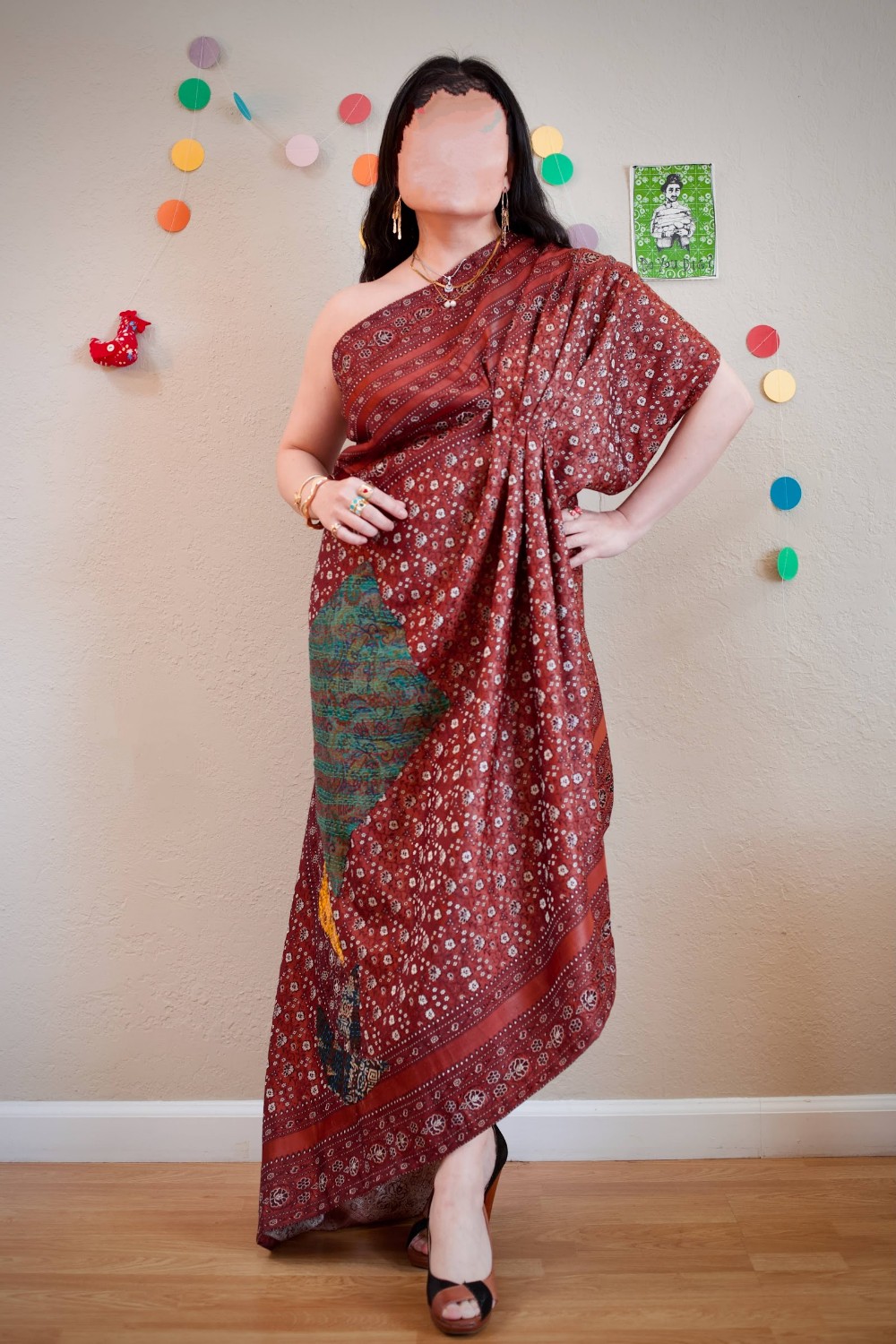
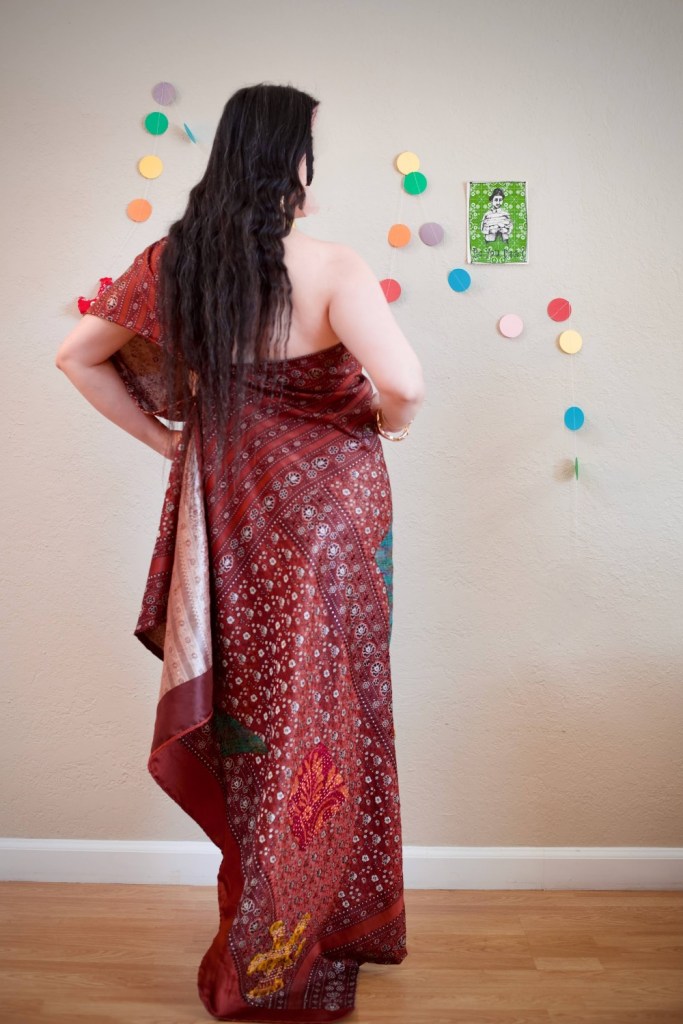
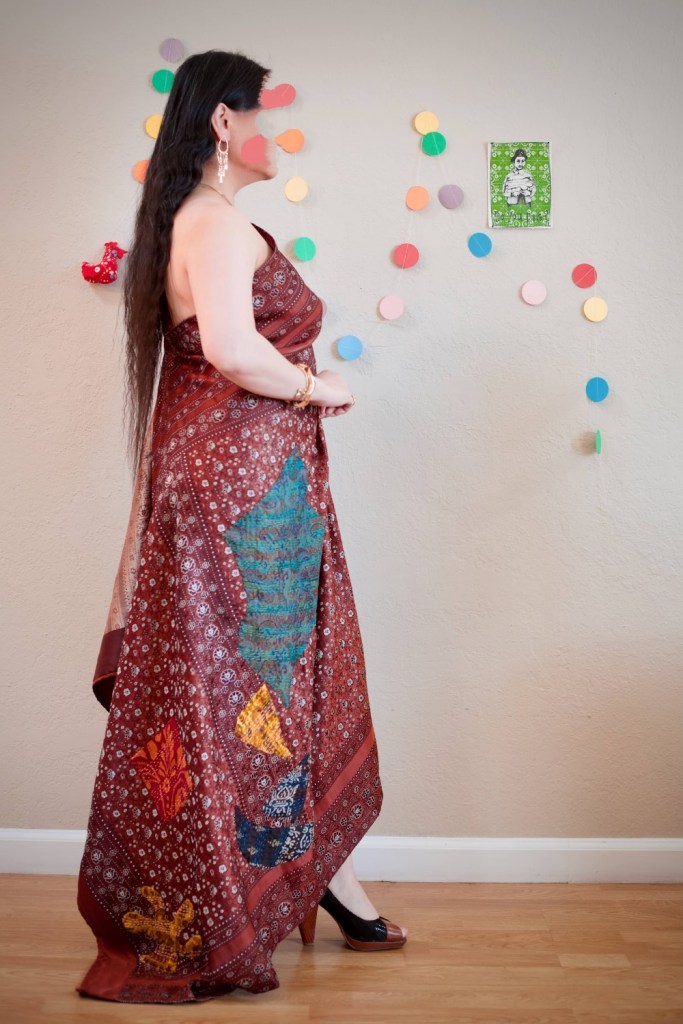
Inspired by the spice trail, this dress, which is crafted from a vintage sari, is adorned with patchworks depicting a vessel passing through the Indian Seas to arrive at Southeast Asia. The treasures of this Golden Peninsula would inspire many more voyages throughout the ages, and inspire many more texts, stories, and poetry from across the West:
“Lo, gleaming blue, o’er fair Sumatra’s skies,
Another mountain’s trembling flames arise;
Here from the trees the gum1 all fragrance swells,
And softest oil a wondrous fountain wells.”
– Luís de Camões, The Lusiad
1. Benzoin, a species of frankincense. The oil mentioned in the next line, is that called the rock oil, petroleum, a black fetid mineral oil, good for bruises and sprains.
 hardlyplaying.blog