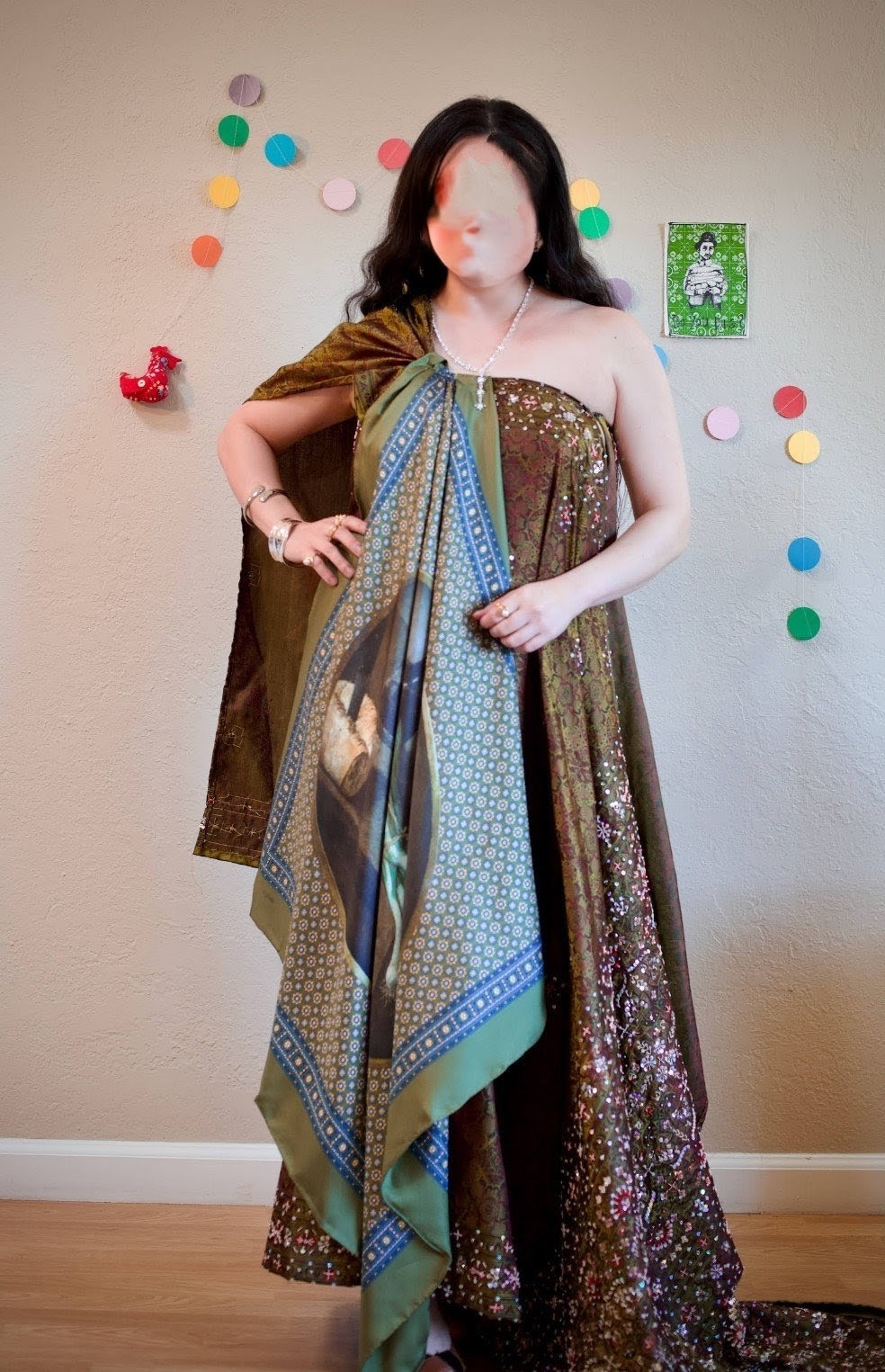
The Last Supper
Painted in 1498, Leonardo da Vinci’s The Last Supper has been described as “one of the greatest manifestations of intellectual power in art,” the most literary of all great pictures. The painting interweaves powerful telling of the gospel story and visual techniques which illustrate the artist’s mastery. It tells the Bible story of Jesus and his 12 Apostles over the Passover meal. During this time, Jesus instituted the Eucharist, the Lord’s Supper, by sharing with his disciples bread and wine, which he said was his body and blood, and announced that one of the disciples would betray him.
In this work, Da Vinci used identifiers both from biblical and apocryphal stories to give visual reference to the 12 apostles. For example, Bartholomew, who is said to have been skinned alive, has a knife pointed directly at him by Peter. His feet are crossed even though he stands, alluding to the Golden Legend by Jacobus de Voragine, which told of Bartholomew being crucified, then taken down before his death and flayed. On the far side of the table, Judas, the apostle who betrayed Jesus for 30 pieces of silver, clutches a moneybag and has knocked over a salt cellar. He has an extended portion of neck showing, which may foreshadow his later suicide by hanging after Jesus was arrested.
A visual technique exemplified in the painting is a system of mathematical rules known as linear perspective, which gives depth to the picture in order to achieve realism. Here Jesus is seated at the center of the table. The room is symmetrical, with Jesus’ head framed by the largest of three windows symmetrically arranged on the back wall. The vanishing point falls to his right temple, where all converging orthogonal lines meet. Viewed from the refectory, the work creates the illusion of an extension of the real room’s space. Leonardo was inspired by the idea of perfect or divine proportions, which was the focus in his painting of the Vitruvian Man. Here the musical interval of the Octave 2:1, the perfect fifth 3:2, and the perfect fourth 4:3, all together formulating the numerical proportion 12:6:4:3, composed the grouping order of the 12 apostles, of which may explain the artist’s decision to break tradition by placing Judas on the far side of the table.
During the Renaissance, the study of the liberal arts was referred to as the sciences, which were defined as disciplines of philosophy, theology, rhetoric, geometry, astrology, music, and arithmetic, whereas painting and sculpting were considered manual work, comparable to today’s blue-collar jobs. In utilizing scientific techniques to tell theological stories, Leonardo da Vinci proclaimed for painting to be elevated to a work of the mind and not merely of the hand. In beginning a painting with line and perspective, it was akin to the science of geometry and astronomy. He put painting above the science of poetry because the sense of sight was richer than that of hearing. Words died once they were spoken, but the image of a painting remained.
The Eternal Feast
In 1993, archaeologists who unsealed the tomb of Zhang Wenzao (1029-74) near the city of Xuanhua, China, were treated to a feast. Set upon two wooden tables placed before a coffin entirely enveloped in Sanskrit characters was an array of porcelain dishes of pears, chestnuts, jujubes, and other victuals, left untouched for over 900 years. On the floor of the tomb were additional vessels believed once to have held wine. The wall murals depicted scenes of daily life to complement this display of food. In the antechamber, an orchestra played music as servants prepared hot beverages that were then served by attendants in the main hall. In accordance with Buddhist customs, Zhang and his wife were cremated, their ashes placed in compartments contained within near life-sized straw manikins. This discovery gave a glimpse into the funerary custom of the Liao Dynasty, which placed importance on continuity between this life and the next, where the dead would feast as the living once did.
Feasting has been an important social and ritual activity in China since the Bronze Age. The period between 10th and 14th century, which spanned the Liao, Song, Jin, and Yuan dynasties, witnessed rapid economic growth and flourishing of the arts. In this 500-year time frame produced a wealth of artworks portraying banquets and feasting. Founded by a confederation of nomadic Khitan tribes, the Liao modeled their empire on the preceding Tang Dynasty. One of the many traditions appropriated from the Tang was the construction of elaborate underground tombs stocked with the paraphernalia of feasting. Scenes of banqueting within Liao tombs, which followed a funerary custom going back as far as the Han Dynasty beginning in 206 BC, ensured the soul of the deceased would be nourished and honored for eternity. As the tradition of building grand underground tombs began to wane from the 10th century, artworks were expressed in other mediums meant for the living, portraying feasting of court women, scholars, and business men. While the scene is set in its contemporary period, the depictions feature stylistic and literary nods to the Tang Dynasty, imbuing an artistic nostalgia for China’s Golden Age.
A most renowned work, the Palace Banquet, painted during the Song Dynasty, depicts an intimate view of the women’s palace quarters. On the second-story terrace they gather at a banqueting table to celebrate the seventh night of the seventh month, when the Cowherder and the Weaving Maid would meet over the Magpie bridge. Behind the banquet, a woman gazes out beneath a pair of intertwining trees, which alludes to the poem Song of Ever Lasting Sorrow, written by Bai Juyi, about the tragic love story between the Tang Emperor Xuanzong and his consort Yang Guifei, who was one of the four great beauties of ancient China:
“On the seventh day, in the seventh month,
In the Palace of Longevity,
When no one else was around.
Right as the bells for midnight tolled,
And this he whispered, so this she heard:
“May we be birds, our wings adjoining,
Up into the sky together we will rise,
Should we be trees, our branches interlinked,
Down in the fields together we will sprout.”
Heavens and lands with their infinite years,
Till they had their day,
This love will stay unrequited, this sorrow unceasing.”
The Pineapple
While modern art may not portray a biblical story or be as grand as a feast, it often becomes a medium to express individuality in a very casual setting, like that of a business advertisement. In the summer of 1938, Georgia O’Keeffe was offered an all-expenses paid, nine-week trip to Hawaii as a commercial art commission for the Hawaiian Pineapple Company, now known as Dole. In exchange, O’Keeffe agreed to produce two paintings without artistic restrictions for their advertising campaign for pineapple juice.
Once returned to New York, O’Keeffe submitted two of her works, Crab’s Claw Ginger Hawaii and Papaw Tree, Īao Valley, Maui. Although it was not specified that she would produce a painting featuring pineapple, her submission of the papaya tree was rejected by Dole because their competitor at the time produced papaya juice. Their advertising agency then flew a pineapple plant from Hawaii to New York. 36 hours later, it was delivered to the artist’s studio, to which she exclaimed, “It’s beautiful. I never knew that. It’s made up of long green blades and the pineapple grows in the centre of them.”
The Pineapple Bud first appeared in Ladies’ Home Journal in October 1940. The ad read, “Perhaps you have never seen a pineapple bud – and words cannot describe the glowing crater of color which on the Dole plantations grows and ripens into a luscious big pineapple… Perhaps you have never tasted Dole Pineapple Juice – and there is no other way to discover the fragrant, zestful goodness of this pure juice.” The painting depicts the leaves, stretching like blades, engulfing the pineapple bud as if to swallow it whole, invoking an image of a spider or an octopus. Contrast this with her 1922 The Green Apple, which sits a single, smooth green apple tilted on a black plate. She was then quoted in the New York Sun, “It is only by selection, by elimination, and by emphasis that we get at the real meaning of things.” Over the course of her career, O’Keeffe would paint hundreds of these single depictions of flowers, fruits, and plants, all of which undoubtedly define who she is as an artist today.
 hardlyplaying.blog