Inhabited since prehistoric times, the city of Vienna is much older than one may anticipate. Among the oldest known relics found near Willendorf, the Venus of Willendorf indicates this area to be occupied since at least 30,000 years ago. Since Roman times, Vienna has become a gateway between Western and Eastern Europe.
For 600 years, the Habsburg Empire resided over Austria, Hungary, and Bohemia, stretching from the woods of Russia to the shore of the Adriatic. Consequently, the Viennese are a blend of all people passing through the city. When one became prominent in Prague or Kraków, in Budapest or Trieste, they would immigrate to Vienna. Even though the city is known as the world’s capital of classical music, its most famous composers came from elsewhere. Joseph Haydn was born in the town of Rohrau on the border with Hungary, and had a strong Hungarian influence. Mozart was born in Salzburg, Beethoven from Bonn, and Brahms from Hamburg. But all came to Vienna and stayed because the genius loci inspired them to create. The Viennese themselves didn’t care for their greatest composers. Neither Haydn nor Mozart was popular, and Beethoven was totally misunderstood. It appeared a Vienna genius was understood only by a fellow genius. Mozart said of then 17-year-old Beethoven: “Someday the world will notice him.” Yet it remains that Vienna today is considered the cradle of three great musical schools – classicism, romanticism, and modern music.
Located far inland next to snowy mountains, Vienna summer is hot, winter cold, with brilliant sunshine for all seasons. Generations of Viennese architects had enhanced the effect of its natural brightness by designing street facades to provide sharply etched contrasts between light and shadow. The encircling walls and glacis with its avenues of trees and refreshing air drifting from the mountains and vine-covered hills bestowed an advantage to Vienna like no other large European city.
In Vienna, every building with no distinct architectural style is called “baroque”. Paradoxically, the age of baroque, stretching from 16th-century Italy to 18th-century Germany and Austria, saw very little baroque planning in its cities and did not come into being until the later half of 19th century and early 20th century. Local architects invented their own style, called “Viennese”, or “Ringstrasse”, of which no other European capital had anything alike. Had the Louvre, the Sorbonne, the Opera, the Bourse, the Theatre Francais, the Chamber of Deputies, and the Hotel de Ville been placed along the Champs-Elysees, it would be comparable to the Ringstrasse. In 1533, the Habsburgs made the city their favorite residence, and since the 17th century, it housed the court, the aristocracy, and the bourgeoisies rich enough to afford high rents. The imperial residential city thus became a center of wealth and power, of learning and taste. Architects employed an ornate classicism with lavish prodigality to meet their patrons’ desire for self-glorification. Whether erecting a church or a palace, a monastery or a bourgeois dwelling, a hospital or a theater, the architect was to create the most splendid and impressive structure that money could buy. The Ringstrasse provided unprecedented opportunities for new young architects to realize their dreams of freedom from restraints of frugality or aesthetic simplicity.
The American historian Carl Schorske contrasted the spatial concepts for the Ringstrasse’s layout with baroque planning, which favored radiating avenues and open vistas so that space served as a magnifying setting to the buildings encompassing it. With the Ringstrasse, no long vistas led the eye to a single monument, no radical avenues linking the city with the suburbs. Its buildings floated unorganized in a spatial medium whose only stabilizing element was an artery of men in motion. Though such compact layout afforded the pedestrians an aesthetic element of surprise – that was one after another startling object coming into view.
Toward the end of the 19th century, the architect Adolf Loos criticized the Ringstrasse style as being created during “an era of parvenus” and compared Vienna to “Potemkin’s Town.” By 1898, a group of young artists seceded from the Künstlerhaus, Vienna’s art establishment, and founded the Secession Movement. The city became a springboard for the phenomenon of modern art, launching prominent careers for Gustav Klimt, Egon Schiele, the architects Otto Wagner, Joseph Hoffman, and Koloman Moser, who erected austere, elegant, modern facades without a single ornament.
As post-war Austria changed from one of Europe’s most rigidly hierarchical societies to one of the least class-ridden, Vienna is now inherited by the people at large. The city today is prosperous and efficient, its existing architectures and buildings repurposed for the masses. Its opulent way of life has become a relic, like its coffee houses. Vienna’s first coffeehouse opened in 1684, a year after the Turkish siege, which also brought the music of Janissaries to Austria. It then became fashionable as a musical symbol of the exotic charm of the Orient, and was dramatized by Mozart in the Entfuhrung aus dem Serail, an early example of multicultural, cross-over fusion of musical styles. It was in the coffeehouses where one could converse with poets and writers, and inform themselves of world-historical events such as the French Revolution.
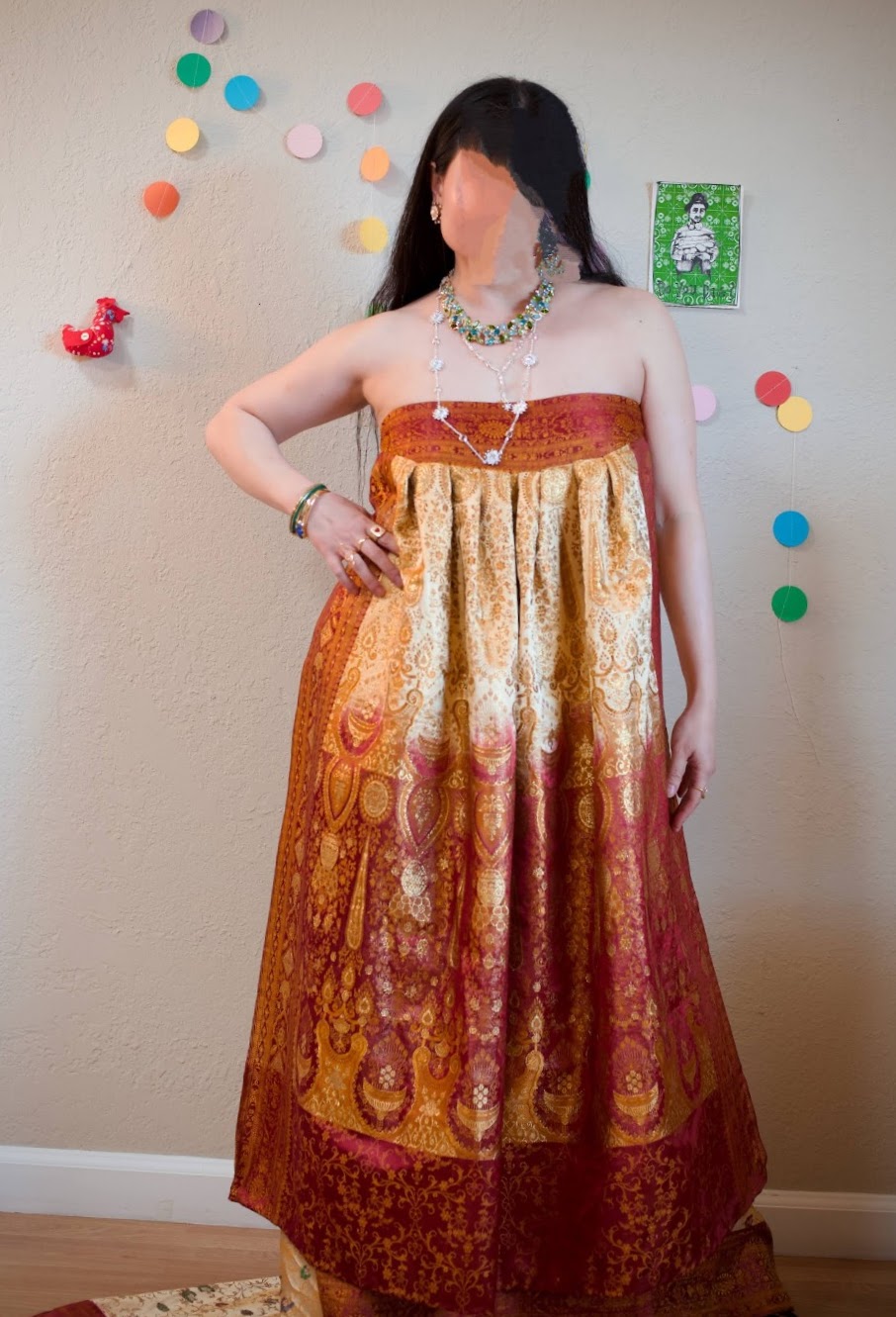
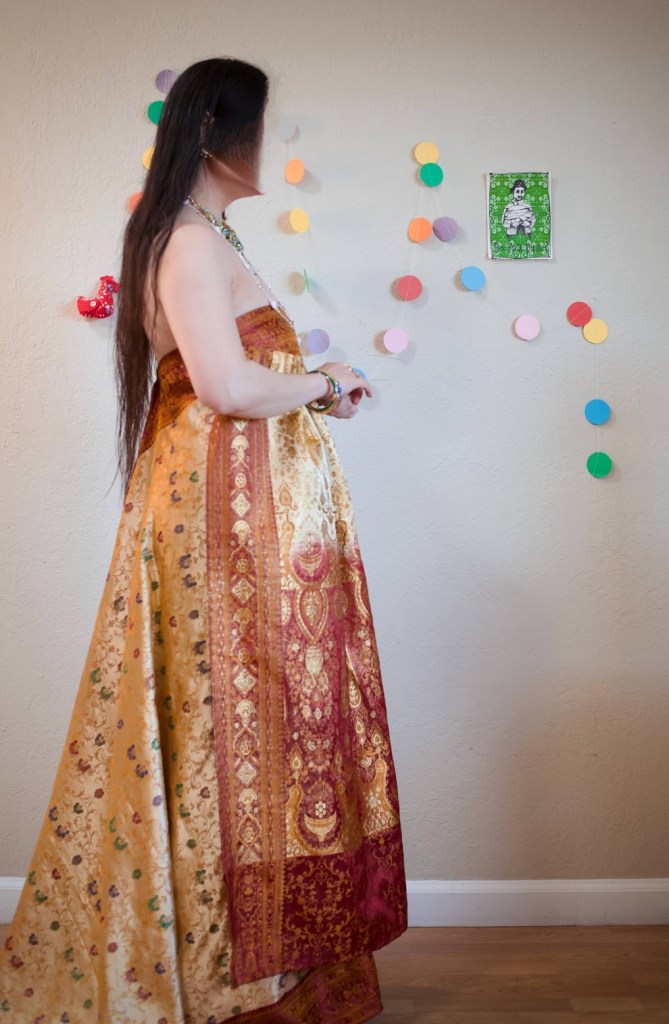
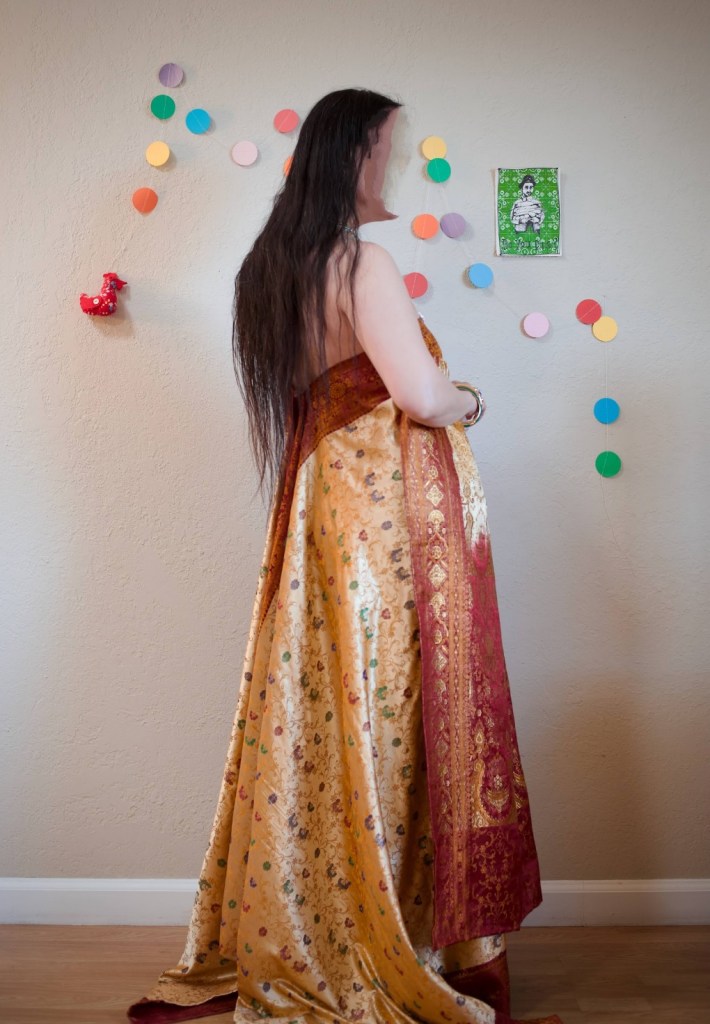
Inspired by the city of Vienna and Marie Antoinette, who was an archduchess of Austria before she became a Queen of France, I have crafted this gown, whose cloth comes from a vintage silk-base sari. In this gown I aim to blend Viennese opulence with 18th-century French fashion. Marie Antoinette’s love for striking colors revolutionized the French court palette, replacing traditional muted and subdued tones with innovative and adventurous use of color in fashion. The Queen’s wardrobe inspired every level of society of her times. Her impact was so profound that it catapulted Paris into becoming the world’s fashion capital, a title it still holds today.
 hardlyplaying.blog