The beauty which we admire of Paris today is largely in thanks to Baron Haussmann, who, under the auspices of Louis Napoléon, oversaw the complete overhaul of the city in the mid 19th century. The initial impact of the works in the 1850’s and the 1860’s was of shock and disorientation, as old landmarks and street patterns seemingly vanished overnight. Yet renovation proceeded as fast as destruction. Within months, hundreds of thousand cubic meters of earth were removed to create a brand new infrastructure of sewerage, water, and gas supply. Hundreds of new buildings bordered new boulevards, adorned with elegant cast-iron lamps and tree-lined pedestrian walkways. “Soon we shall not be content unless we construct a palace between lunch and dinner,” exclaimed the Paris Nouveau Illustré, as the speed at which the whole was completed astonished Parisians and foreigners alike.
At the center, the Champs-Élysées would become Paris’ most fashionable new quarter. At the Place de l’Étoile, streets were lined with elegant residences, where not long ago were not more than waste-lands. The Arc de Triomphe, within a few years, found itself surrounded by a circle of palaces, separated by wide boulevards and fine avenues. “In Paris, it only needs a few years to transform a swamp into a magnificent quarter,” wrote L’Illustration. By 1860, lawns, clusters of trees, walks, and benches covered the Place de la Concorde, the Rond-point, and the Cours-la-Reine. “No city today can be compared with Paris for its garden, its elegant parks, its rich foliage, and its ravishing flowers,” exclaimed César Daly in his 1863 Revue Générale de l’Architecture.
This largest public works project ever undertaken in Europe did not go without criticism. Beside the staggering cost, Paris solved the problem of housing for the working class mainly by driving them outside its boundaries. Still stung by the Revolution of 1789, Baron Haussmann redesigned areas such as the Faubourg Saint-Antoine in order to enable suppression of insurrection. Upon his visit to Paris in 1867, Mark Twain wrote in The Innocents Abroad, “[Louis Napoléon] is annihilating the crooked streets and building in their stead noble boulevards as straight as an arrow – avenues which a cannon ball could traverse from end to end without meeting an obstruction more irresistible than the flesh and bones of men – boulevards whose stately edifices will never afford refuges and plotting places for starving, discontented revolution breeders. Five of these great thoroughfares radiate from one ample centre – a centre which is exceedingly well adapted to the accommodation of heavy artillery. The mobs used to riot there, but they must seek another rallying-place in future. And this ingenious Napoléon paves the streets of his great cities with a smooth, compact composition of asphaltum and sand.”
By the 1920’s, Paris had become the epicenter of culture, attracting the best of American expatriate writers. With an incredibly affordable cost of living, many came with their families and made the city their home for decades. Earnest Hemingway described their flat on Rue Cardinal Lemoine as having no hot water and no inside toilet facilities except an antiseptic portable container, but a fine view. He and his wife, Hadley, could always have a lovely meal and drink Beaune and afterwards, read books rented from Shakespeare and Company, which was owned by Sylvia Beach, and then go to bed and make love on their comfortable mattress on the floor, beneath the walls covered with pictures that they liked. And in these incredibly romantic environs, they promised to never love anyone else but each other.
Others came here to find themselves. James Baldwin wrote in The Discovery of What It Means to Be an American, “I left America because I doubted my ability to survive the fury of the color problem here. I wanted to prevent myself from becoming merely a Negro; or, even, merely a Negro writer. I wanted to find out in what way the specialness of my experience could be made to connect me with other people instead of dividing me from them.” And in Paris, “he suddenly came out of a dark tunnel and found himself beneath the open sky. … It is the day he realizes that there are no untroubled countries in this fearfully troubled world. … The freedom that the American writer finds in Europe brings him, full circle, back to himself, with the responsibility for his development where it always was: in his own hands. … Nothing will efface his origins, the marks of which he carries with him everywhere. I think it is important to know this and even find it a matter for rejoicing, as the strongest people do, regardless of their station. On this acceptance, literally, the life of a writer depends.”
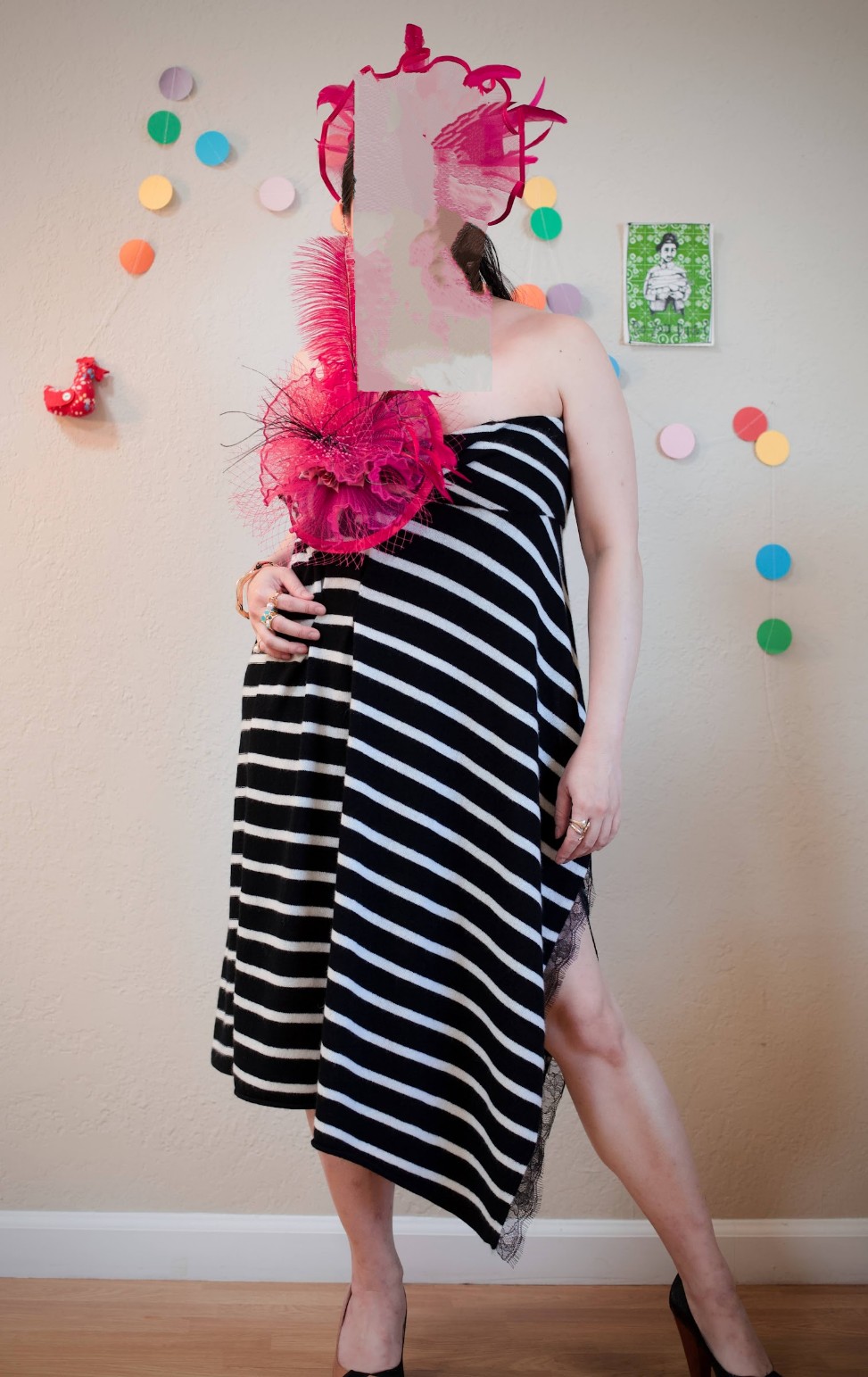
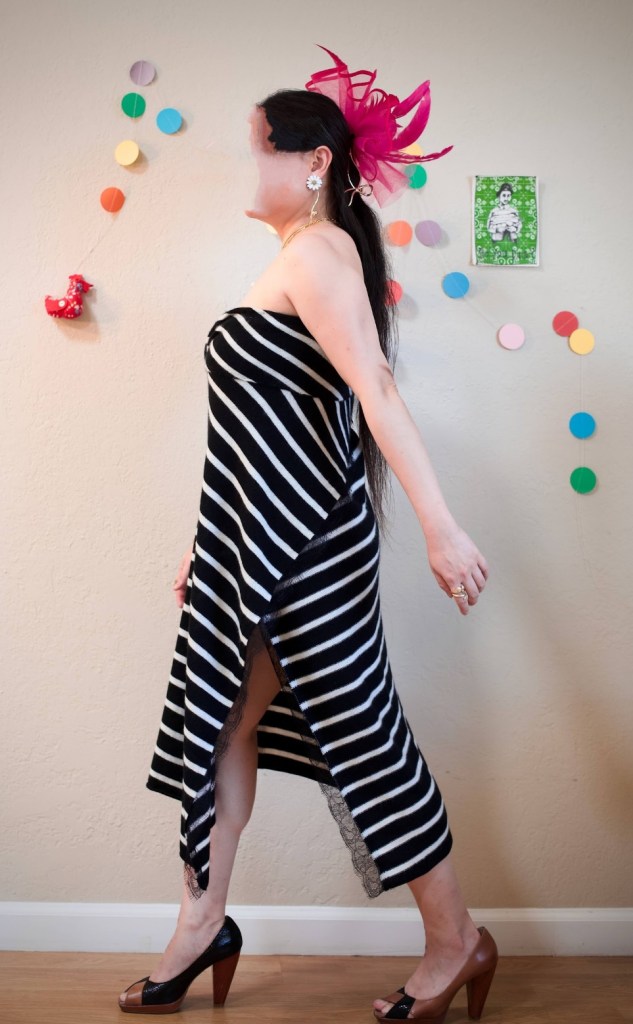
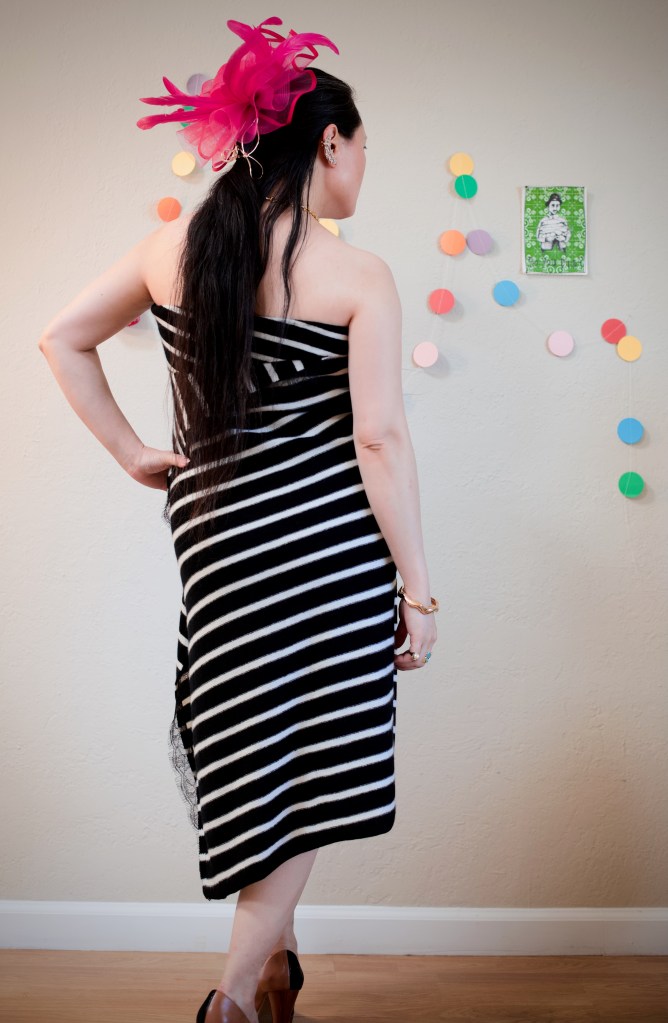
Inspired by the city of Paris, I have crafted this dress from a cashmere rectangle of the striped pattern, a fashion pattern as representative of France as the Eiffel Tower. The striped pattern was first introduced on the marinière as the French Navy’s uniform in 1858. It became a fashion staple when the fashion designer Coco Chanel took seaside holidays in this Navy style. The feather adornments are inspired by those worn by Cancan dancers of the Moulin Rouge, who propelled this dance to a very popular art form throughout the 19th and 20th century.
 hardlyplaying.blog