Among the images of Tibet that the world has come to know are the prayer flags strung along trails and peaks high in the Himalayas. They are called “rlung ta”, which means “windhorse”. Of the rlung ta composition, the windhorse is at the center, surrounded by four animals of the cardinal directions – the Garuda, the dragon, the white tiger, and the snow lion. The horse is depicted as a winged horse, and is said to carry prayers to the heavens.
The windhorse carries the energy of good fortune. It symbolizes the transformative energy to turn negativity into positivity. The windhorse is associated with moving energy, and that which it carries, symbolically depicted as a jewel, is the mind. This analogy of energy is like a horse and of the mind like a rider. When one’s windhorse is strong, there is harmony between the mind and its true nature, thus their wisdom elevates. In the Epic of King Gesar, who was the fearless lord of the legendary kingdom of Ling, he is often depicted to mount a winged horse with a chakra on its forehead and feathers of the Tshung-bird on its ears while waging epic battles against demons.
In Mongolian tradition, the windhorse is tied to shamanism. The soul – the force housed within one’s chest – is their windhorse. A strong windhorse allows the shaman to see through deception, thus to be able to accomplish their goals. One could raise their windhorse through offerings and prayers to heaven, the earth, and the spirits of ancestors, through smoke of sacred herbs, and through sacrifices performed during rituals and festivals. One could also lose their windhorse by violating taboos, disrespecting the spirits of ancestors, or offending the spirits of nature through acts such as killing animals for no purpose.
In Chinese folklore, the Tianma, or the heavenly horse, is depicted as a winged horse with dragon scales. The Tianma came from the Scythian caves associated with the Scythians and the Yuezhi, who later established the Kushan Empire. Coming out of the Indo-Greek Kingdom, they had retained much of their Hellenistic heritage. Evidently the Tianma’s depiction bears resemblance to the Pegasus, the mythical winged horse of ancient Greece. Most likely the heavenly horse’s remote ancestor was the Akhal-Teke. The Han Dynasty Emperor Wu, who ruled China from 141 to 87 BC, was an aficionado of the Central Asian horse. He waged a series of military campaigns, known as The War of the Heavenly Horses, to Ferghana, present-day Uzbekistan, to acquire these horses. In the Book of Han, it was written in 101 BC:
“The horse of heaven has come
From the regions of the West
Trampling shifting sands
And the barbarians of the nine directions have submitted.
The horse of heaven has come
Out of the waters of springs
Like a tiger’s spine, double
Like a spirit, transforming itself.”
The Tang Dynasty poet Li Bai was also particularly fond of the Tianma, as he believed himself to be this horse. In Song of the Heavenly Horse, he wrote:
“From the Scythian cave came the heavenly horse
With tiger-stripe back and dragon-wing bones.
Neighing to clouds in the blue. Shaking a mane of green.
Orchid strong jaw sinew
Speed tokened cheeks
He vanished when he ran
Over the Kunlun. To the West Edge of Earth.”
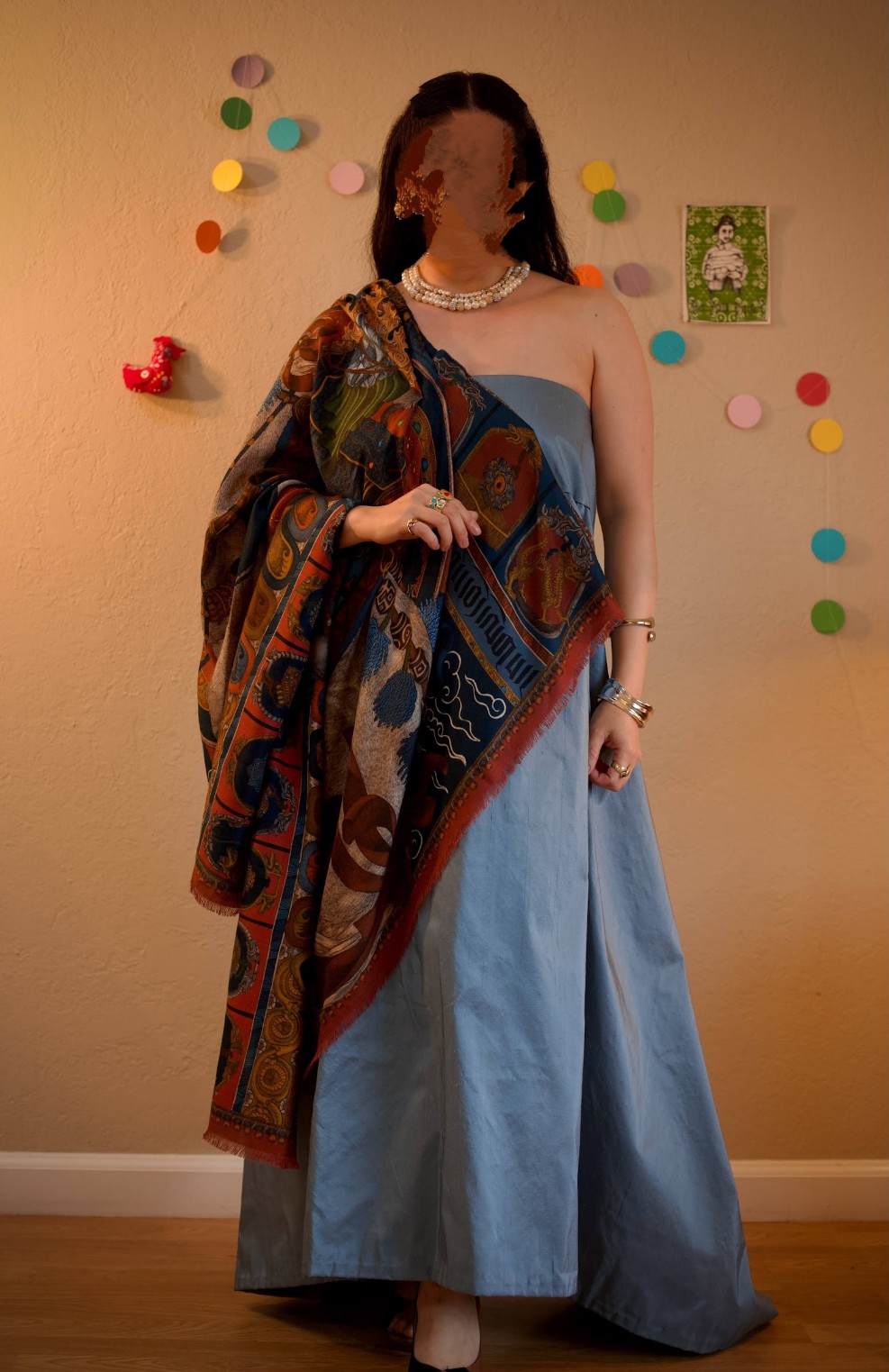
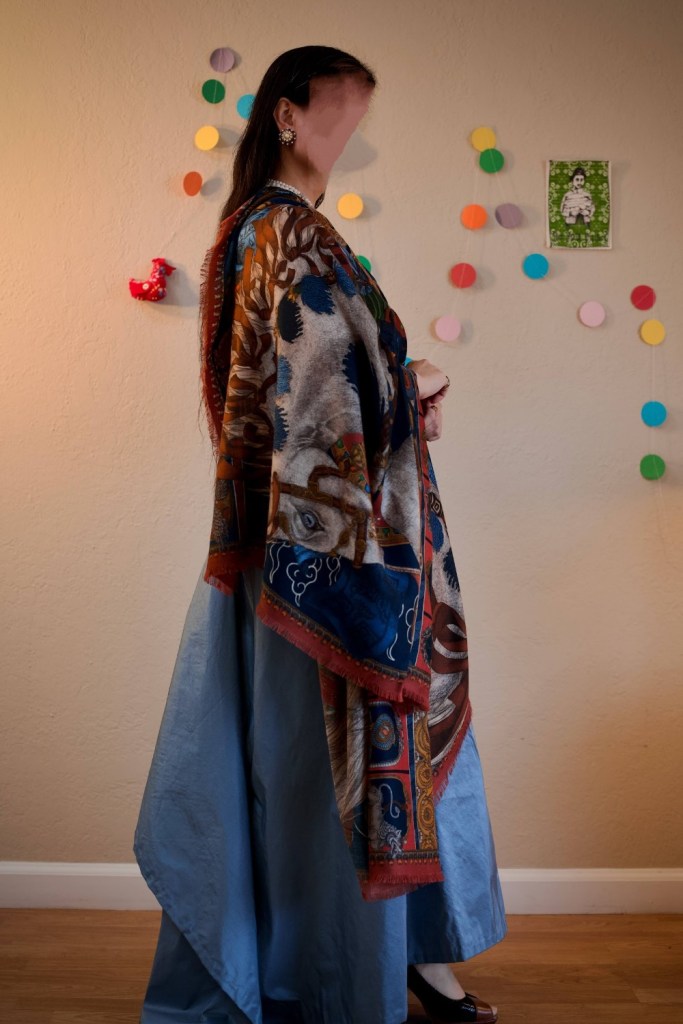
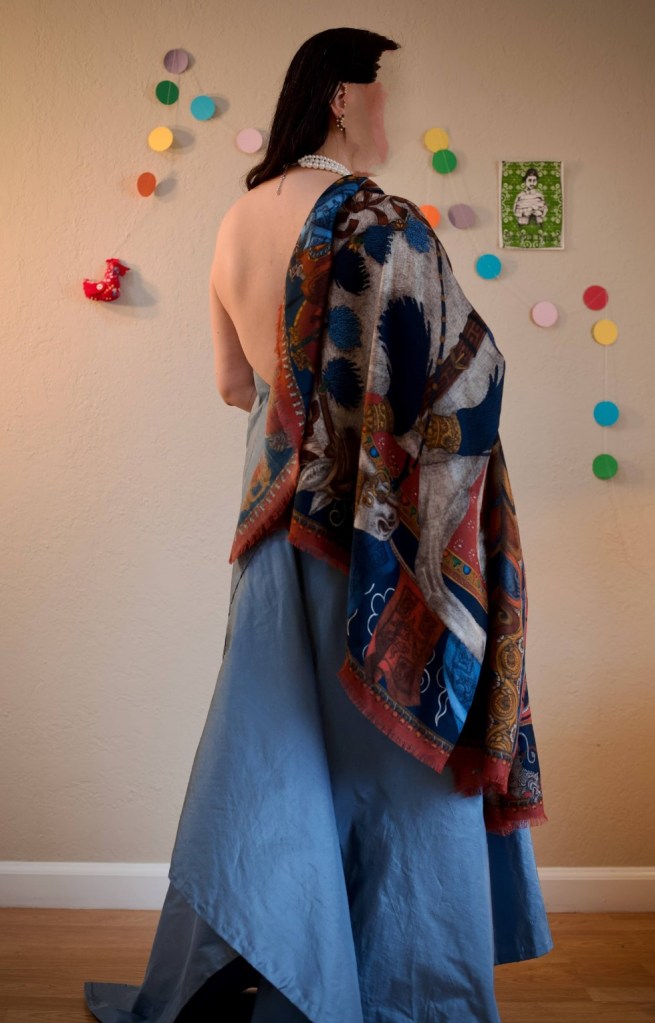
To ring in the Lunar year of the horse, this silk dress is draped in a wool scarf depicting the windhorse. One may chant a Tibetan prayer to bring good fortune in the new year:
“May the windhorse of perfect power and strength rise!
Dralas and wermas of the universe,
Come and swarm inside the body of the great being Gesar
Like bees in a fragrant lotus,
And raise the windhorse that grants me the power to accomplish everything I wish!”*
*Mipham Rinpoche, The Heart-Essence of Good Fortune.
 hardlyplaying.blog