
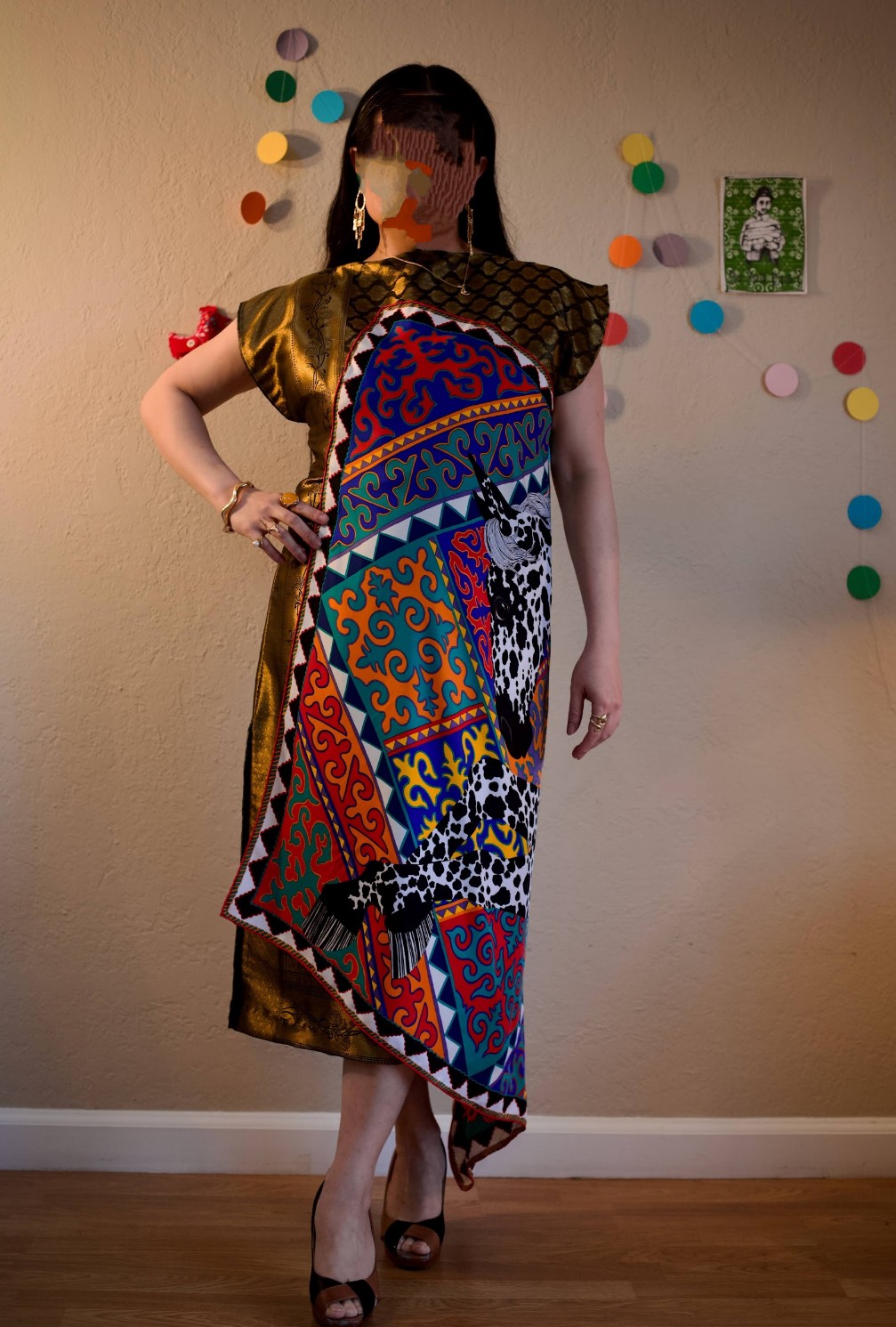
From fish to cephalopods, from insects, birds, to mammals, the world of spotted species has always attracted human attention, standing out to us as beautiful and eye-catching. Paradoxically a primary reason for spotting is that it provides excellent camouflage in the wild, particularly in grasslands and forests. The spots mimic the sunlight dappling through leaves or tall grass, helping the animal blend in with its background. In certain species such as lions, babies wear patterns for protection only to lose them later in life. In contrast, baby seals born on pack ice are pure white and develop spots only when they leave the ice for rocky beaches.
Such an example of distinct species evolving similar traits is called convergent evolution. Not only for spots, but species from entirely different ancestors develop common features over time, such as wings in bats and birds, thumbs in giant pandas and primates, or camera-like eyes in humans and octopus. It supports the evolutionary theory that species adopt strategies, in many instances similar ones, to survive in their own unique environments.
The English mathematician Alan Turing, in his 1952 paper The Chemical Basis of Morphogenesis, described how such widely varied patterns in nature could arise naturally from a homogeneous, uniform state. He proposed a mechanism for how patterns evolved from initially homogeneous biological systems. In a simple example, two substances called “morphogens”, meaning “producers of form”, spread by diffusion and react with each other to change their concentrations, self-organizing into a stable pattern of spots or stripes from almost any initial condition. The theory, called a reaction-diffusion theory of morphogenesis, has become a prototype model for pattern formation. Patterns such as fronts, spirals, targets, hexagons, and stripes are found in various types of reaction-diffusion systems in spite of discrepancies in the local reactions. Such patterns have come to be known as “Turing patterns”.
Beside the wonder working of evolution, specific trait development can also be accomplished through artificial selection, as Charles Darwin noted in his On The Origin of Species, “Slow though the process of selection may be, if feeble man can do much by his powers of artificial selection, I can see no limit to the amount of change, to the beauty and infinite complexity of the co-adaptations between all organic beings, one with another and with their physical conditions of life, which may be effected in the long course of time by nature’s power of selection.” Such selective breeding results in the manifold varieties of domesticated animals for desirable forms and functions. For example, horse breeding goes back millennia, with the Arabian horse being the first breed documented by the Bedouin tribes of the Middle East. In central Asia, the Akhal-Teke was also bred since ancient times for war and racing. Historical conflicts between the Middle East and Europe gave rise to cross-breeding over time to produce faster, lighter, and nimbler horses. By the Middle Ages, a hot-blooded breed was developed in England to use for racing as a sport. Called the Thoroughbred horse, it endowed a well-chiseled head on a long neck, lean body, and long legs, giving it superior agility and speed.
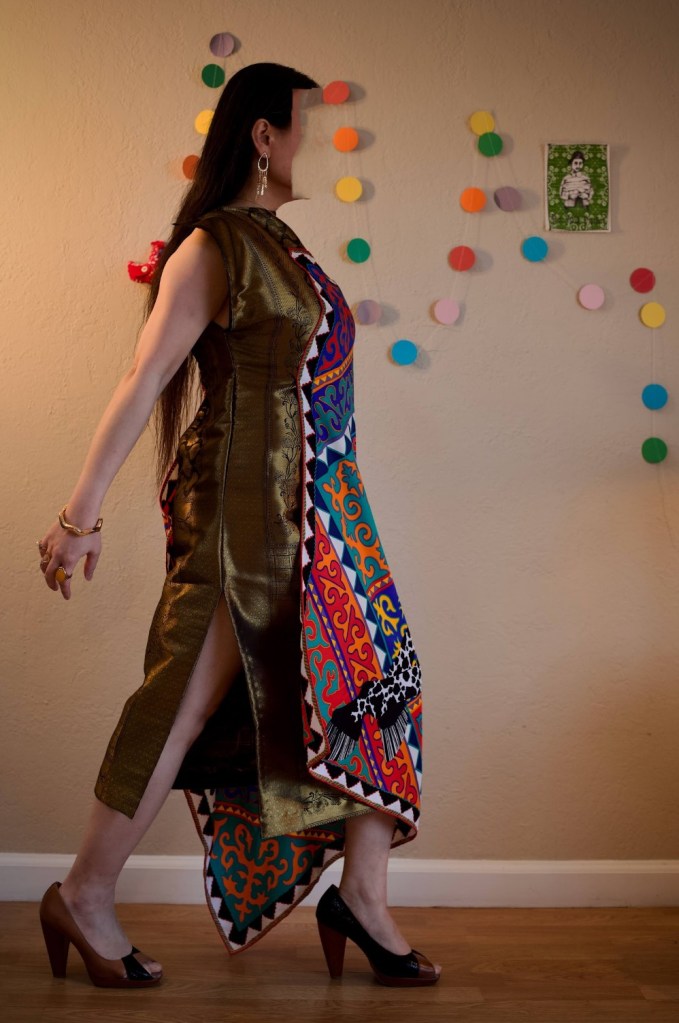
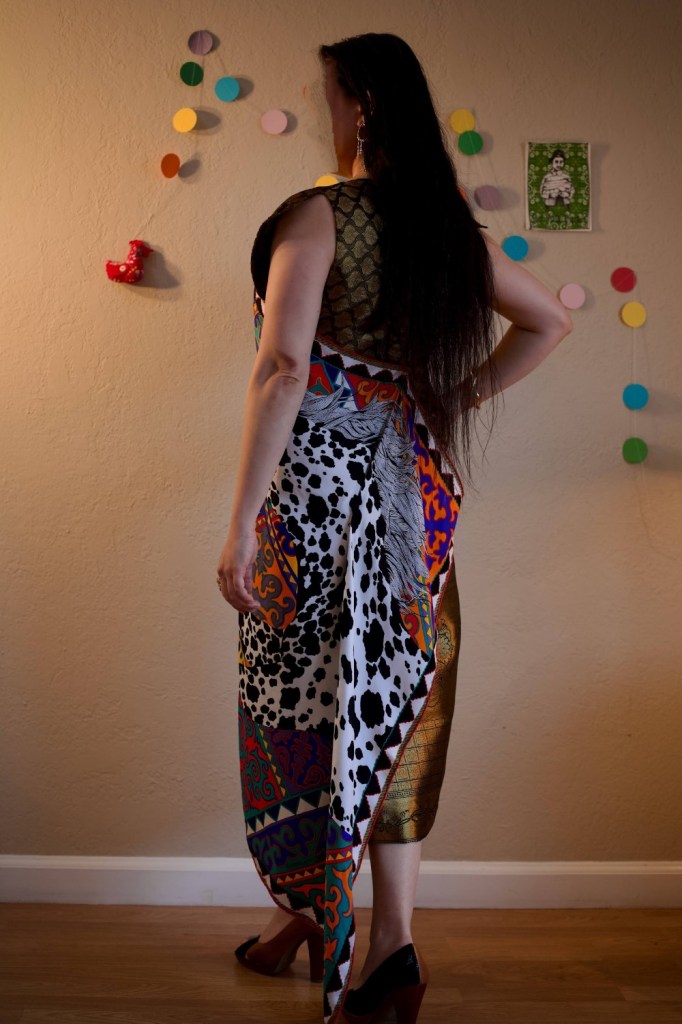
Others were bred for looks, such as the Appaloosa featured on this dress. The horse is best known for its colorful spotted coat pattern, also known as the leopard complex. Depictions of spotted horses have been found in prehistoric cave paintings in Europe, and artworks featuring domesticated spotted horses appeared since ancient Greece and Han Dynasty China. The Appaloosa’s color pattern is genetically the result of various spotting patterns overlaid on top of one of several recognized base coat colors. Appaloosas have an eightfold greater risk of developing blindness, a side effect from the leopard complex.
 hardlyplaying.blog