
“Except ye become as little children, ye shall in no wise enter into the kingdom of God.”
– Matthew 18:3
When I was a child, I knew of Finland as the garden of the Snow-Queen. In Hans Christian Andersen’s story, a little girl named Gerda rode a reindeer, passing Lapland to reach Finland in order to find her friend Kay. Then I thought it was an imaginary fairy-land; I didn’t know that it was real, inhabited by a real people called the Sámi.
During the last Ice Age, all of Scandinavia had lain beneath ice. The first traces of human occupation were found approximately 10,000 years ago, indicating this region to be finally habitable. In modern-day Finland, the Komsa Stone Age culture, believed to be the ancestors of the Sámi people, began around 6,000 BC. It is hypothesized that the predecessor of the Komsa culture came from central and Uralic Russia, as the languages of the Sámi and many of the modern inhabitants of the Urals can be traced to a common ancestor. Linguistic evidence also indicates that as early as 4,000 years ago, the Sámi and their forebears had contacts with numerous Indo-European language speakers, including those of Iranian, Balto-Slavic, and Germanic languages.
Throughout history, the Sámi had been called by different names. The 2nd-century Roman historian Cornelius Tacitus, in his most celebrated work Germania, was the first to write of these people: “The Fenni live in astonishing barbarism and disgusting misery: no arms, no horses, no household; wild plants for their food, skins for their clothing, the ground for their beds; arrows are all their hopes; for want of iron they tip them with sharp bone. This same hunting is the support of the women as well as of the men, for they accompany the men freely and claim a share of the spoil; nor have their infants any shelter against wild beasts and rain, except the covering afforded by a few intertwined branches.” The 6th-century Byzantine historian Procopius of Caesarea called them the Scrithiphini, meaning the “skiing Finns.” In History of the Wars, he wrote of their way of life as nomadic hunters: “But among the barbarians who are settled in Thule, one nation only, who are called the Scrithiphini, live a kind of life akin to that of the beasts. … For the forests, which are exceedingly large, produce for them a great abundance of wild beasts and other animals, as do also the mountains which rise there. And they feed exclusively upon the flesh of the wild beasts slain by them, and clothe themselves in their skins, and since they have neither flax nor any implement with which to sew, they fasten these skins together by the sinews of the animals, and in this way manage to cover the whole body. And indeed not even their infants are nursed in the Lapps way as among the rest of mankind. For the children of the Scrithiphini do not feed upon the milk of women nor do they touch their mother’s breast, but they are nourished upon the marrow of the animals killed in the hunt, and upon this alone. Now as soon as a woman gives birth to a child, she throws it into a skin and straightway hangs it to a tree, and after putting marrow into its mouth she immediately sets out with her husband for the customary hunt.” Today we know from modern science that consuming the flesh of wild beasts provides essential vitamins and nutrients to stay nourished in these harsh winter conditions. For example, vitamin C, which is available in fresh fruits and vegetables, which are hard to come by in these areas, can be obtained from eating the raw liver and heart of sea and land animals, such as whales and reindeers.
Not until the 8th century was there the first written evidence of the Sámi as reindeer hunters. In the History of the Langobards, Paul the Deacon wrote: “The Scritobini, for thus that nation is called, are neighbors to this place. They are not without snow even in the summer time, and since they do not differ in nature from wild beasts themselves, they feed only upon the raw flesh of wild animals from whose shaggy skins also they fit garments for themselves. They deduce the etymology of their name according to their barbarous language from jumping. For by making use of leaps and bounds they pursue wild beasts very skillfully with a piece of wood bent in the likeness of a bow. Among them there is an animal not very unlike a stag, from whose hide, while it was rough with hairs, I saw a coat fitted in the manner of a tunic down to the knees, such as the aforesaid Scritobini use, as has been related.” In his description of “leaps and bounds with a piece of wood bent in the likeness of a bow”, the animal “not very unlike a stag” was undoubtedly the reindeer. In 870 AD, King Alfred the Great of England received a visit from a Viking chief Ottar, who lived in Norway. Alfred recorded Ottar’s account of the tribute he received from the Sámi, which included walrus tusks, bird-down, bearskins, and seal hide for making into ship’s rope. In addition, he had six hundred of the tame animals which they called reindeer. This record shows the Sámi being the only indigenous people who kept reindeers on a large scale, which must have been used as pack animals in addition to paying taxes and tributes.
As their way of life had completely adapted to the harsh, non-arable environment of the Arctic, the Sámi were largely left alone until the 19th century. Then from the 19th until the mid 20th century, Scandinavization policies forced these people to abandon their language, their culture, and their way of life to assimilate with the rest of Scandinavia, in this respect not so dissimilar from other indigenous peoples across the world. While Christian missionary work began as early as the 13th century, aggressive conversion efforts started in the 1700’s. Along with churches, boarding schools, starting in the 19th century, forbade usage of the local language. The strongest pressure took place from 1900 to 1940, when proof of knowledge of the Norwegian language and a registered Norwegian name were required to buy or lease state lands for agriculture in Finnmark. Today, the Sámi, like other indigenous peoples, are proactive in improving public awareness of their heritage and forming constituents in government to protect their rights and interests, undoubtedly with plenty of challenges and setbacks along the way.
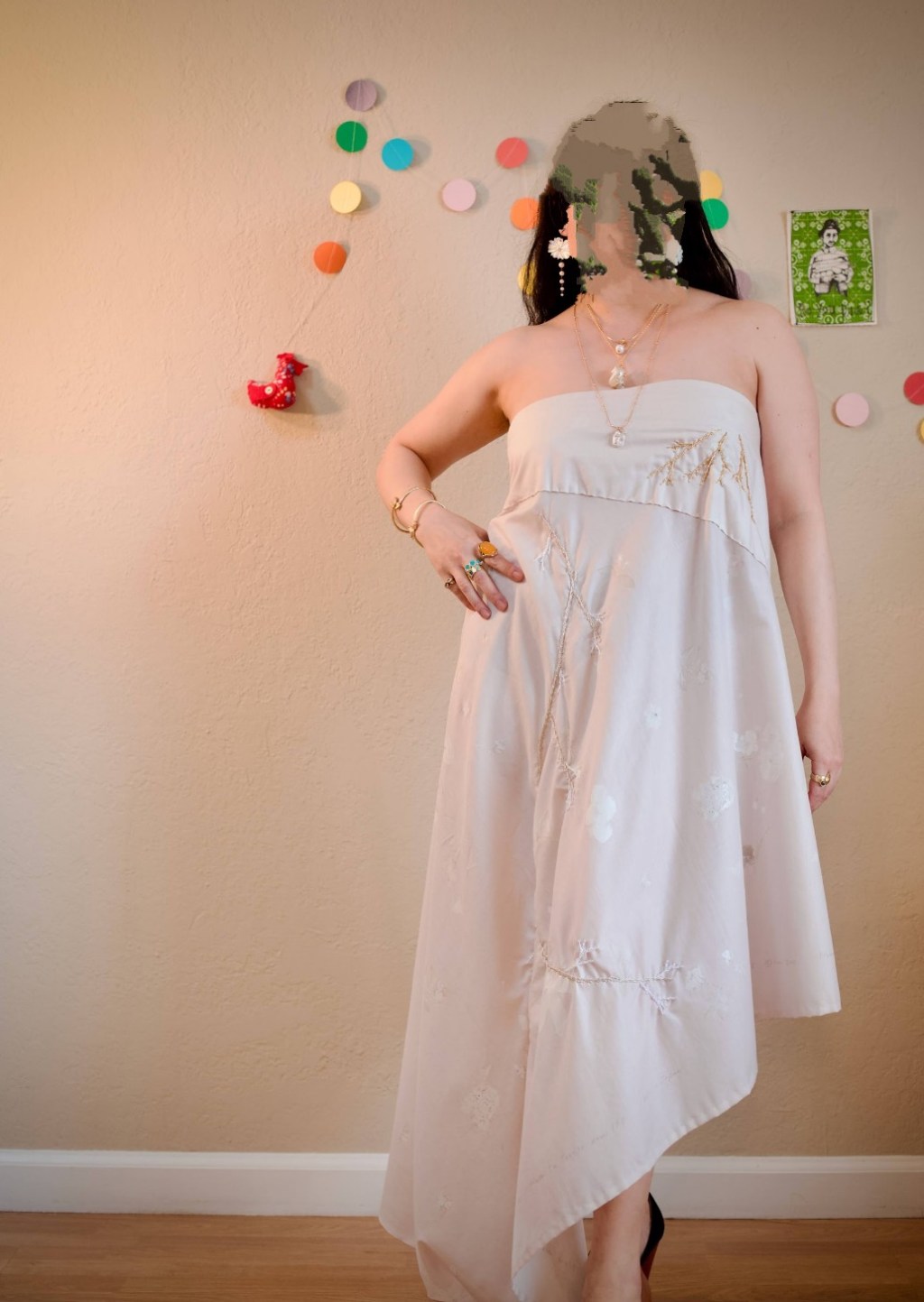
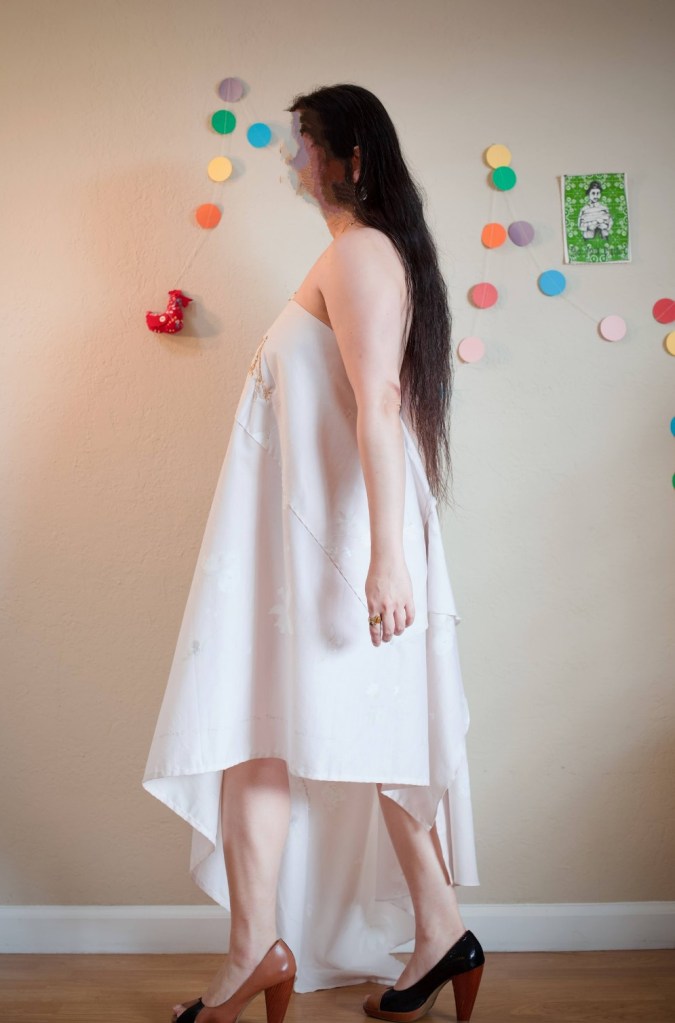
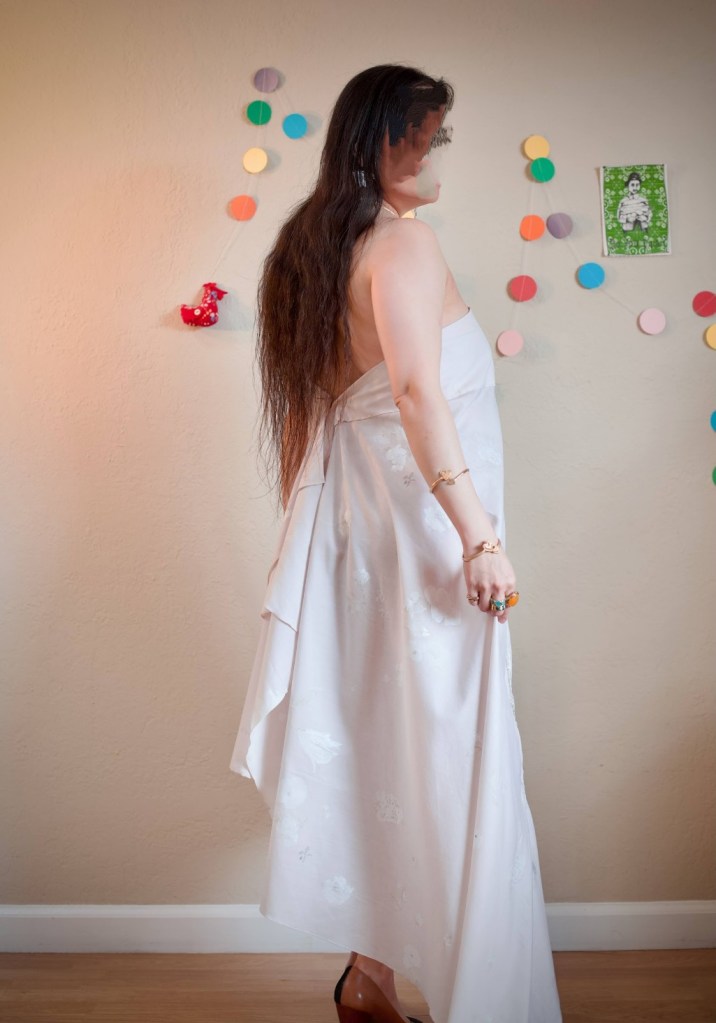
This dress is embroidered with a white and gold branching motif to symbolize the garden of the Snow-Queen. There she sat in the middle of a frozen lake, which was broken into a thousand identical pieces. She used to say that she sat in the mirror of Understanding, and that it was the only and the best one in the world.
 hardlyplaying.blog