Precedingly named New Amsterdam, the city of New York was settled by Dutch traders in 1624 before being ceded to the English in 1667. After the opening of the Erie Canal in 1825, it surpassed Boston as America’s business capital. By 1870, soaring real estate values in lower Manhattan pushed buildings up into the air, turning the city into the world’s densest collection of skyscrapers by the early 20th century. As the city has earned its fame as a world business center, it has also grown into a prominent cultural hub, housing an astounding number of ethnic enclaves coming from all over the world. As early as 1646, 18 languages from across Europe were spoken in New Amsterdam. By the 1700’s, the slave trade brought many Africans to the city, making up a fifth of its residents. The later half of the 1800’s saw eight million immigrants from northern Europe. Then, over the next 60 years, another twelve million immigrants would arrive through Ellis Island.
If one comes to Paris to find themselves, New York is where one comes to be somebody else. Casted onto a bronze plaque inside the Statue of Liberty is the 1883 poem The New Colossus by Emma Lazarus, which reads: “
’Keep, ancient lands, your storied pomp!’ cries she
With silent lips. ‘Give me your tired, your poor,
Your huddled masses yearning to breathe free,
The wretched refuse of your teeming shore.
Send these, the homeless, tempest-tost to me,
I lift my lamp beside the golden door!’ “
Yet, what is not explicitly said – is that it is often not with the first generation of immigrants, but the second, the third, and even further down to finally realize the hope of the American Dream. Often, the first generation of immigrants are exploited and discriminated against, and find themselves to become the backbone of the nation’s economy so that one day, their children and grandchildren could finally breathe free.

Between 1820 and 1860, the Irish constituted over one third of all immigrants to the United States. In the 1840s, they comprised nearly half of all immigrants to this nation. In time, the sum total of Irish-Americans exceeded the entire population of Ireland. New York City boasted more Irishmen than the city of Dublin in Ireland. Irish immigrants often entered the workforce at the bottom of the occupational ladder and took on the menial and dangerous jobs avoided by other workers. Many Irish American women became servants or domestic workers, while many Irish American men labored in coal mines and built railroads and canals. Railroad construction was so dangerous that it was said, “[there was] an Irishman buried under every tie.” Worse yet, ill will toward Irish immigrants because of their poor living conditions and their willingness to work for low wages was often exacerbated by religious conflict. Anti-immigrant and anti-Catholic sentiments in the 1840’s produced groups such as the Nativist American Party, which fought foreign influences and promoted “traditional American ideals.”
The great arrival of Italian immigrants began in the 1880’s, totaling to more than four million by the 1920’s. The vast majority were farmers and laborers looking for a steady source of work – any work. Many went to work on the growing city’s municipal works projects, digging canals, laying paving and gas lines, building bridges, and tunneling out the New York subway system. In 1890, nearly 90 percent of laborers in New York’s Department of Public Works were Italian immigrants. The cramped urban way of life came as an enormous shock to many Italians. In Italy, many rural families had slept in small, cramped houses; however, they spent most of their waking hours outdoors, working, socializing, and taking their meals. In New York, they found themselves confined to a claustrophobic indoor existence, using the same small room for eating, sleeping, and working, as a substantial number worked at home performing piecework – that is, doing work that paid them by the piece, such as stitching together garments or hand-assembling machinery. As these jobs were allotted to women and children, they could go for days without seeing sunlight. Amidst the economic depression in the late 19th century, Italian immigrants were blamed for taking American jobs. Catholic churches and charities were vandalized and burned, and Italians attacked by mobs. In the 1890s alone, more than 20 Italians were lynched.
The capital of Jewish America at the turn of the 20th century was New York’s Lower East Side, as hundreds of thousands from Eastern Europe settled there on arrival. By the year 1900, the district was packed with more than 700 people per acre, making it the most crowded neighborhood on the planet. The reformer Jacob Riis described a visit to a typical tenement building occupied by Eastern European Jewish families, “I have found in three rooms father, mother, twelve children, and six boarders. They sleep on the half-made clothing for beds. I found that several people slept in a subcellar four feet by six, on a pile of clothing that was being made.” More than one-half of all Eastern European Jewish immigrants worked in manual occupations, predominantly in the garment industry. The Jewish neighborhoods of New York were home to countless tiny, airless sweatshop factories, where women, teenagers, and children worked long hours cutting, sewing, and finishing clothing for pennies per piece. In 1892, a reporter for The Century visited some of the garment workers of New York, “[They] toil from six in the morning until eleven at night. Fifty cents is not an unusual compensation for these murderous hours. Trousers at 84 cents per dozen, 8 cents for a round coat, and 10 cents for a frock coat, are labor prices that explain the sudden affluence of heartless merchant manufacturers, and the biting poverty of miserable artisans.” Not only were the sweatshops unpleasant and exploitative, they were lethally dangerous. In the Triangle Shirtwaist factory fire of 1911, nearly half of the 146 workers killed were Jewish teenage girls.
In 1922, Broadway debuted Anne Nichols’ Abie’s Irish Rose, which portrayed the love story between a wealthy Jewish man and an Irish Catholic woman, reflecting a progressive outlook toward the Irish and Jewish populations in the country. But in reality, Congress enacted the Immigration Act of 1924, which set quotas for immigration from Eastern and Southern Europe, in addition to barring immigration from Asia. As different waves of immigrants arrive over time, the story of New York is the story of America. Today it is Latin Americans. An estimated fourteen million Hispanics currently reside undocumented, or illegally, staffing farms, restaurants, and construction industries across the country.
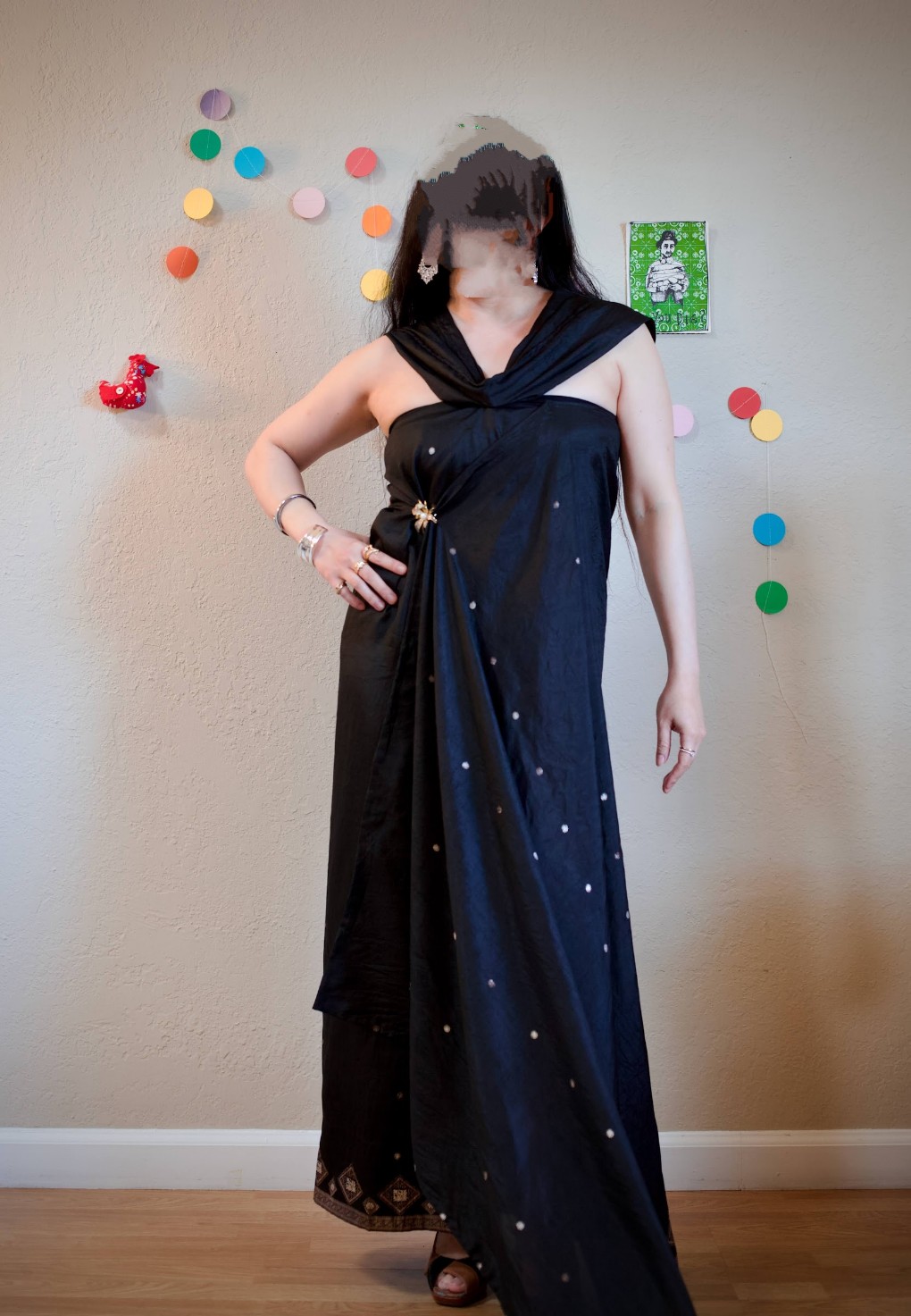
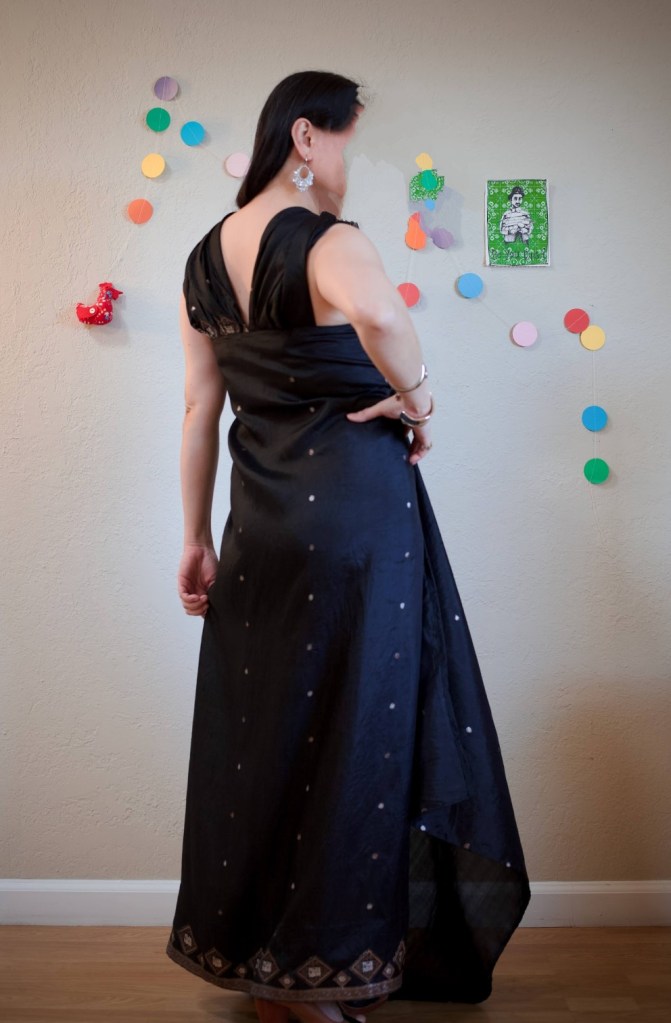
This black silk dress is inspired by that which Holly Golightly wore while windowshopping at Tiffany in the early morn in Breakfast at Tiffany’s. Holly, originally a farm girl from rural Texas, transformed herself into a New York café society girl hoping to marry rich. The movie is about her love story with Paul Varjak, a writer hoping to make a name for himself while being bankrolled by another wealthy socialite. In the end, they came to realize that all they had were each other, and a no-name cat. To leave everything behind to start anew in a strange land is not for the weak of heart. We come without a name to ourselves, but hope keeps us marching on, so that one day, our children may make a name for themselves.
Bibliography
Library of Congress, Immigration and Relocation in U.S. History.
 hardlyplaying.blog