
Standing as a crossroad between the Hellenistic world and the East, the city of Alexandria in Egypt is a testament to Alexander the Great as a visionary leader, who envisioned a unified world by establishing cities and transplanting populations between continents. It was recorded by the philosopher Plutarch that one night, Alexander recalled Menelaus’ words in Homer’s Odyssey: “There is there an island, set in the ever-surging deep, off the coast of Egypt, and men call it Pharos; it is as far out to sea as a hollow ship can run in a full day, if a shrill stern wind is blowing it along. There is on it a harbour, well-sheltered, where men can draw dark water and launch their trim ships again on to the open sea.” Then an old man appeared in his dream to say:
“An island lies, where loud the billows roar,
Pharos they call it, on the Egyptian shore.”
Thus the king rose up to begin his voyage to Pharos without delay.
With the intention to rival Athens and Carthage, Alexandria was designed by the best of Greek architects and engineers at the time. Following Aristotle’s vision of the ideal city, it followed a grid system where streets were angled to take advantage of the sea breeze, all the while to shelter citizens from strong winds. A new canal was built to link the city to the Nile for its water supply, where Alexander’s hydraulic engineer, Crates of Olynthus, oversaw the construction of its sewer system. The new canal was used to replenish underground cisterns by leveraging the yearly flood to fill the cisterns at the end of summer. Within six centuries of the city’s founding, the cisterns consisted of thousands of underground chambers, all built of stone, and Alexandria would be referred to as “the city of one thousand cisterns,” where every house had an underground chamber with a cistern for fresh water. The system remained in use until water storage evolved in the 19th century.
As a student of Aristotle, Alexander had planned for the city a library in dedication to the muses, who were the nine inspiring goddesses of literature, science, and art. Ptolemy I, who succeeded Alexander, would give Demetrius of Phalerum the task of creating the library. It was named Mouseion, which means “the seat of Muses”, the origin for the word “Museum”. Books were housed in the main halls, known as the bibliothekai, where papyrus scrolls bulged from the rectangular shelves of the ceiling-high wooden cabinets. The rolls were stacked on top of one another like logs, so that tens of piled circles were visible in each shelf and each could be pulled out with ease. Scrolls were organized by subject and labeled with clay. Above the shelves, an inscription read, “the place of the cure of the soul.” The 4th-century writer Epiphanius recorded that Ptolemy I wrote letters to “every king and prince on earth,” asking them to send books “by poets and prose writers and orators and philosophers and physicians and professors of medicine and historians and books by any others.” Soon, knowledge was overflowing the Mouseion, thus Callimachus of Cyrene was tasked with cataloging its enormous volume of scrolls. He revolutionized the organization of books, which were done in alphabetical order, a practice that became a model in Europe and the Arab world. Also a prolific poet, Callimachus championed the epigram poetry format. In his prologue to the Aetia, he cited the god Apollo told him to “keep the Muse slender,” or to keep it short.
By the early 3rd century BCE, the Mouseion had attracted the greatest minds of the world. For 700 years, until the 4th century AD, scholars came to Alexandria en masse, making monumental discoveries and integrating knowledge across the continents. In astronomy, Aristarchus of Samos was the first to advocate for the heliocentric theory, which proposed a sun-centered universe. In 245 BCE, Eratosthenes posited that the earth was round instead of flat. He computed the circumference of the earth with remarkable accuracy. By the 2nd century AD, Claudius Ptolemy’s Geography would serve as an atlas and a guide to mapmaking for the next millennium and a half, influencing the Islamic Golden Age and the Age of Discovery, and inspiring a young Christopher Columbus to explore the world. In mathematics, Euclid wrote the Elements, whose foundational concepts for geometry are still widely in use today. Then there was Ctesibius, who invented the “hydraulis” in the 3rd century BCE, a musical organ that required a light touch of the keys to drive pressurized air out of a water cistern and through the pipes to make a sound. It would eventually be developed into the pipe organ. The 1st century AD saw Heron’s invention of the aeolipile, the first steam engine. He mounted a sphere on a boiler that, using nozzle, produced a rotary motion as the steam escaped.
By the 4th century AD, Hypatia, daughter to the mathematician Theon, would become one of the most prominent mathematicians. The 6th-century philosopher Damascius wrote that “she had greater genius than her father; she was not satisfied with his instruction in mathematical subjects; she also devoted herself diligently to all of philosophy.” After inheriting her father’s school, the young philosopher would put on her cloak, walk through the middle of town, and publicly interpret Plato and Aristotle. Socrates, a contemporary of Hypatia, described her as having “extraordinary dignity and virtue.” “She was so beautiful and shapely,” wrote Damascius.
As conflicts worsened between religious fractions within the city, having much influence on public figures and leaders worked against her. Hypatia was derided as carrying out the work of the devil. In March 415, a Christian mob seized her while she was riding her chariot, dragged her into the church, formerly the Caesareum, and brutally murdered her. Her body was then dragged through the streets before being thrown into a fire. Her horrifying death signified changing times. The poet Palladas wrote of her:
“I look on you and kneel in reverence,
And on your writings, when I see the sign
Of Virgo entering her starry House:
For your work touches heaven, HYPATIA,
You sacred ornament to literature,
Pure shining star of teaching that is wise.”
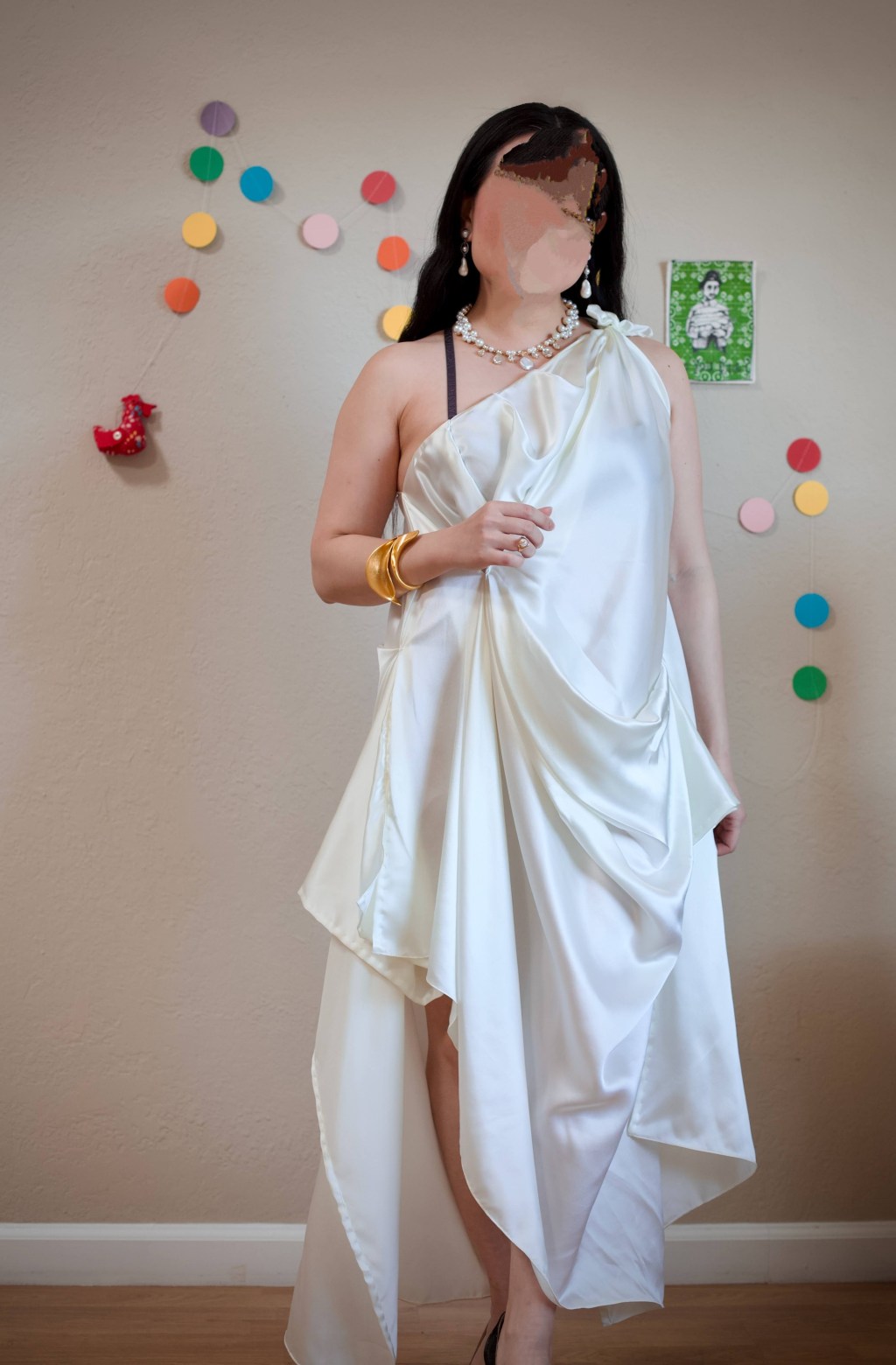
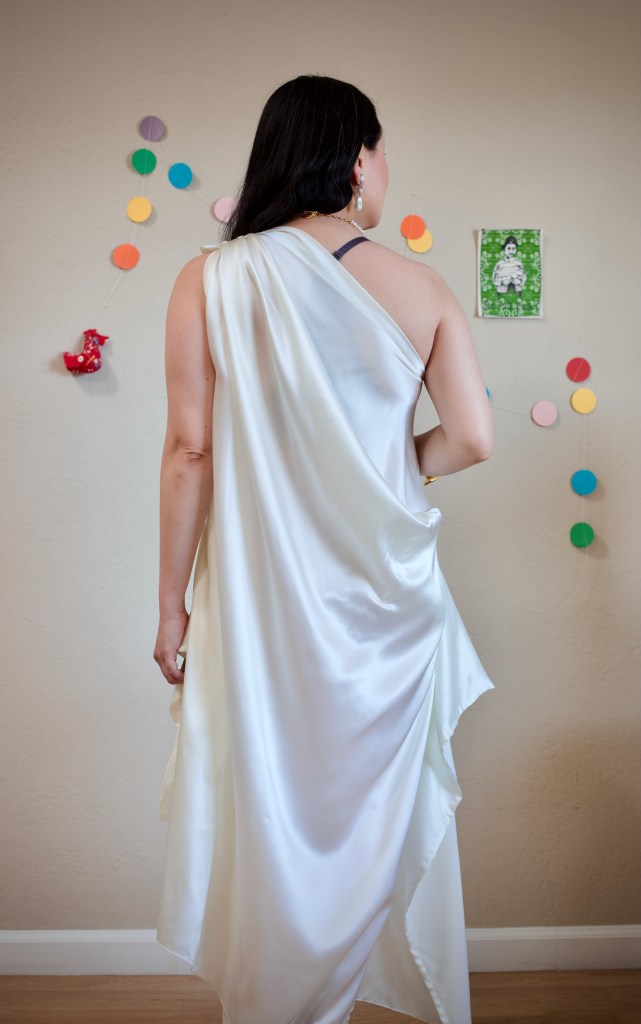
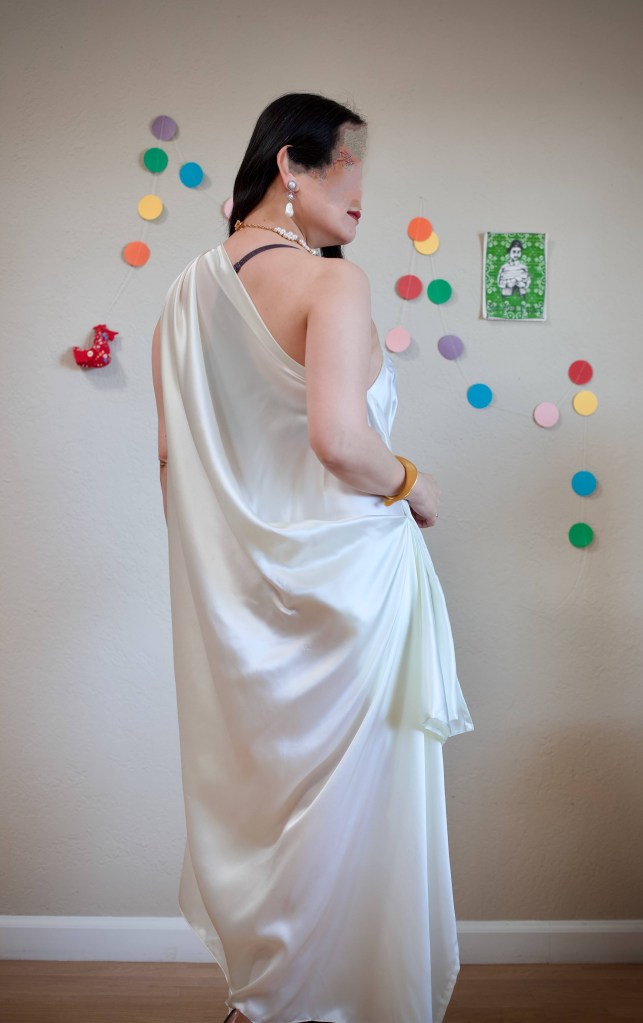
In the Vatican City, Raphael’s 16th-century fresco School of Athens depicts the scholars of antiquity gathering under one roof. Plato and his student Aristotle take central positions. On the far right stand Claudius Ptolemy and Plotinus. Among all the men stands the only woman, Hypatia, who gazes directly at us. Crafted from two silk rectangles, this dress is inspired by her white robe.
Bibliography
Islam Issa, Alexandria: The City that Changed the World.
 hardlyplaying.blog