
Considered the greatest Russian poet, Alexander Pushkin is to Russian letters what Leonardo da Vinci is to Western European art. He is regarded as the founder of modern Russian literature, the inventor of the modern Russian language, who bridged the gap between the literary Russian of the past and the vernacular. To the Russian people, he is their favorite bard, who could write verses on par with Byron and speak in accents purely and earthy Russian in the same breath.
Pushkin was born into nobility in Moscow, entrusted to nursemaids and French tutors, and spoke mostly French until the age of ten. He was acutely aware of his disposition among the Russian aristocratic and ruling class, who lived “the flower of French cuisine: and pâté, Strasbourg’s deathless glory,” and whose primary language of communication was not Russian, but French. Of this fact he wrote satirically:
“I see another problem looming:
to save the honour of our land
I must translate – there’s no presuming –
the letter from Tatyana’s hand:
her Russian was as thin as vapour,
she never read a Russian paper,
our native speech had never sprung
unhesitating from her tongue,
she wrote in French… what a confession!
what can one do? as said above,
until this day, a lady’s love
in Russian never found expression,
till now our language – proud, God knows –
has hardly mastered postal prose.”
These lines about Tatyana come from Eugene Onegin, generally acknowledged to be Russian literature’s first genuine novel in verse, and may be the best-known of Pushkin’s works in English translation. Like a Shakespearean play, the novel reads like a catalog of references to the Western canon of literature, showcasing technical sophistication, rich allusions, remarkable digressions into autobiography, contemporary social commentary, literary intertextuality, and a brilliant combination of parody and irony that one, no doubt, must be Russian themselves to fully appreciate. The Soviet playwright Sigizmund Krzhizhanovsky contrasted the ending of the Shakespearean tragedy comedy to that of Eugene Onegin: where Shakespeare rushed the comic hero ahead of his time and then toward his death, slowed him down, in Eugene Onegin, neither death nor marriage consummated the plot – the tragic heroine ended up taking herself out of time, and the comic hero had no choice but to withdraw. As romance, the plot is “hinged” to a piece of furniture and then suspended, like the other ritualistic or cyclic rhythms prominent in the play.
But what I love most about the novel is its depiction of winter. It is said that one does not know the Russian soul until they have lived a Russian winter, and in Eugene Onegin, life pulses with winter’s heart beats. To open the novel, Pushkin quoted Prince Vyazemsky’s First Snow: “To live, it hurries, and to feel it hastes.” In winter’s beauty the author described Tatyana’s beauty of innocence, yet shadowed by a terrible depth:
“She loved the balcony, the session
of waiting for the dawn to blush,
when, in pale sky, the stars’ procession
fades from the view, and in the hush
earth’s rim grows light, and a forewarning
whisper of breeze announces morning,
and slowly day begins to climb.
In winter, when for longer time
the shades of night within their keeping
hold half the world still unreleased,
and when, by misty moon, the east
is softly, indolently sleeping,
wakened at the same hour of night
Tatyana’d rise by candlelight.”
In the river that glitters beneath its icing-sliver, one may learn how to fall:
“a red-foot goose, weight something fearful,
anticipates a swim, in stead
tries out the ice with cautious tread,
and skids and tumbles down;”
how to be alone:
“in your lonely homestead, moping,
you’ll read: here’s Pradt, here’s Walter Scott!
to pass the evening. No? then tot
up your accounts, and raging, toping,
let evening pass, tomorrow too –
in triumph you’ll see winter through!”
And under all that magnificent hoar-frost silvering the plain, winter brings death in the end. To open chapter six, which depicts the deadly duel between Eugene and Lensky, Pushkin quoted Petrarch’s The Complete Canzoniere:
“There is a part of the world frozen,
always beneath the ice and cold snow,
so far is it from the sun’s path:
the day there is clouded and brief,
and bears a people that death does not grieve,
the natural enemies of peace.”

So it is in winter that one may be born, learn to be wise, and meet their fate.
“The sky breathed autumn, time was flowing,
and good old sun more seldom glowing;
the days grew shorter, in the glade
with mournful sound the secret shade
was stripped away, and mists encroaching
lay on the fields; in caravan
the clamorous honking geese began
their southward flight: one saw approaching
the season which is such a bore –
November stood outside the door.”
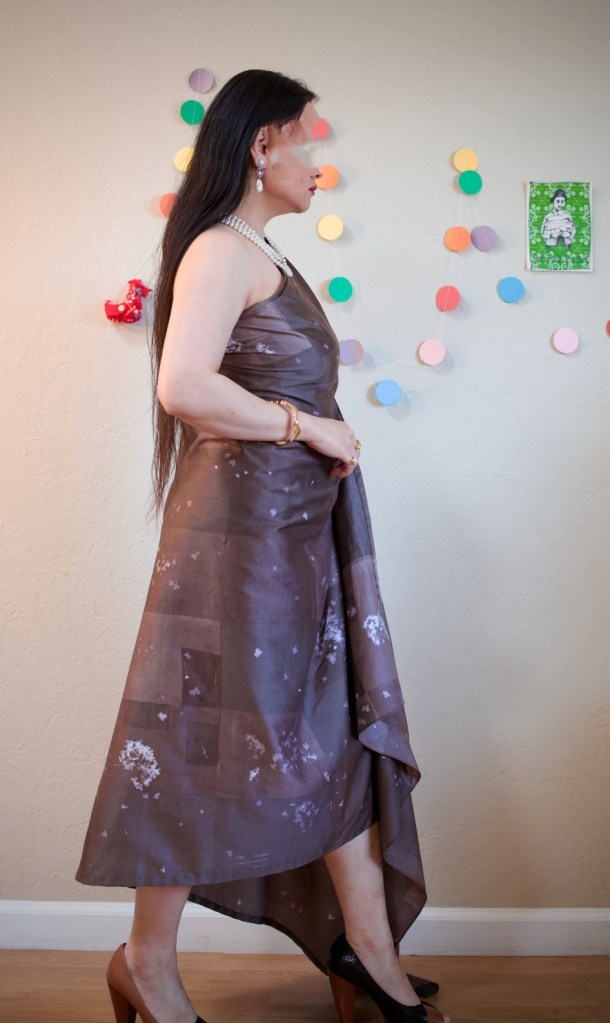
I saw this piece of cloth and thought of November: its mosaic of brown shadings, the cyanotype of white flowers, bearing resemblance to a flurry of snow, yet bringing nostalgia of a floral past.
Bibliography
A.S. Pushkin, Eugene Onegin. Translation by Charles H. Johnston.
 hardlyplaying.blog