
In the early 19th century, a school of landscape painters, later coined the Hudson River School, flourished alongside the American conservation movement. Influenced by the European Romantic era, the Hudson River School celebrated and idealized nature above that made by man. Founded by the English émigré Thomas Cole in 1825, its beginning was marked by dramatic forms and vigorous technique, reflecting the British aesthetic theory of the Sublime, which focused on the experience of awe and terror inspired by power and vastness. Following Thomas Cole’s death in 1848, Asher Brown Durand became the dean of American landscape painters and exemplified the fresh ideal of naturalism for Hudson River School’s second-generation painters.
In loosening the rigor of the Sublime and embracing plein-airism, Asher Durand sought to recreate nature as a reflection of the Divine. In his series of essays, Letters on Landscape Painting, he asserted that the simple truths of Nature constituted the true Religion of Art. “To obtain truthfulness is much more difficult than to obtain the power of telling facile falsehoods, that one need not wonder that some delusive substitute occupies the place which Nature should hold in the artist’s mind.” Durand argued that all art at variance with Truth was unworthy and vicious, and that art was only worthy when it impressed the same feelings and emotions experienced in the presence of Reality. “True Art teaches the use of embellishment which Nature herself furnishes, it never creates them.” These paintings have become the model landscapes to support the Pleistocene Savanna Hypothesis, which proposes that human interactions with landscapes that offered survival advantages have evolved our preferences for them, thus hardwiring our circuits to find such natural sceneries beautiful.

Durand was a close friend to the American poet William Cullen Bryant and often quoted Bryant to reflect his view of nature in art. He wrote in one of his letters that by far, his most valuable study had been:
“Go forth, under the open sky, and list
To Nature’s teachings, while from all around
Earth and her waters, and the depths of air –
Comes a still voice -”
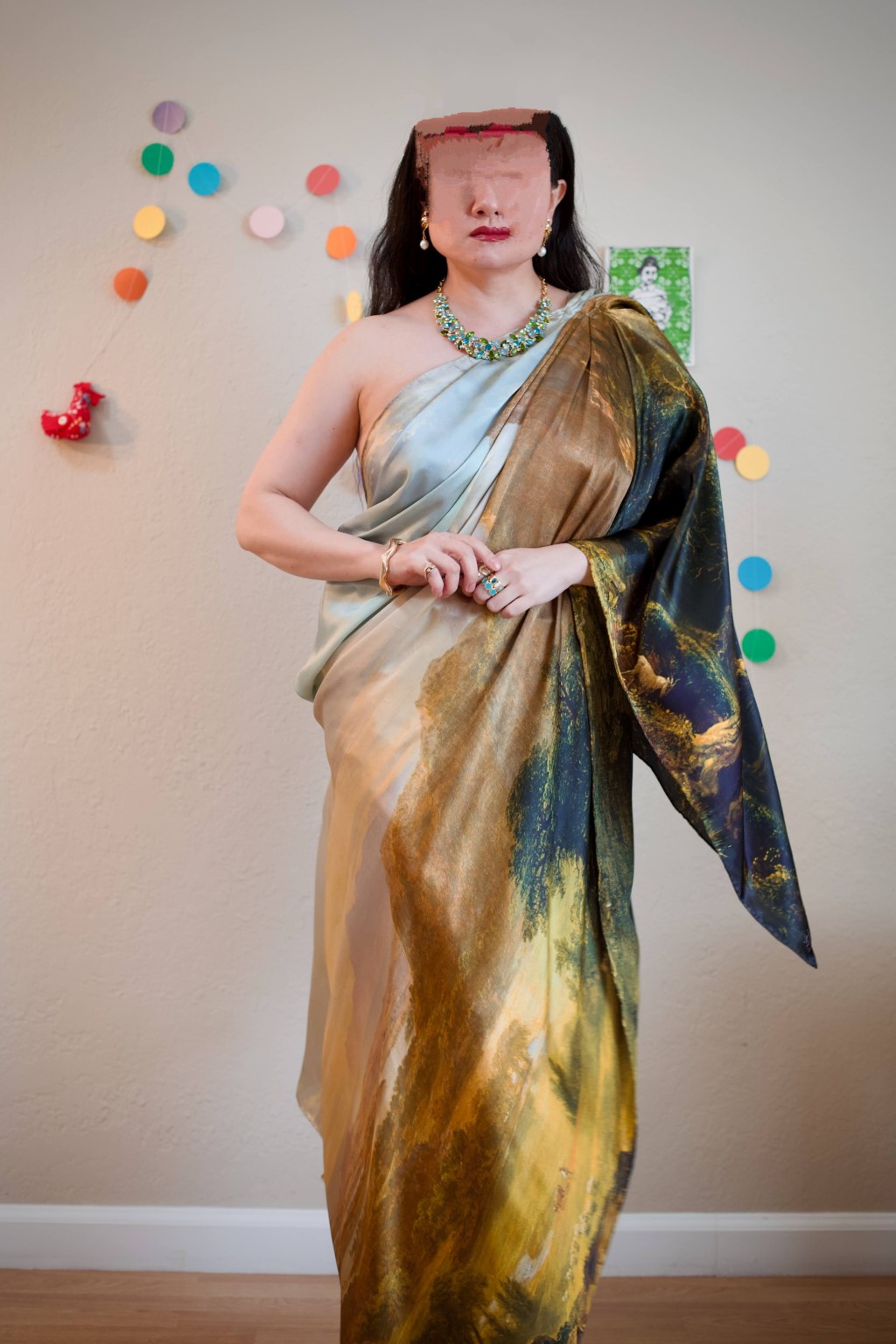
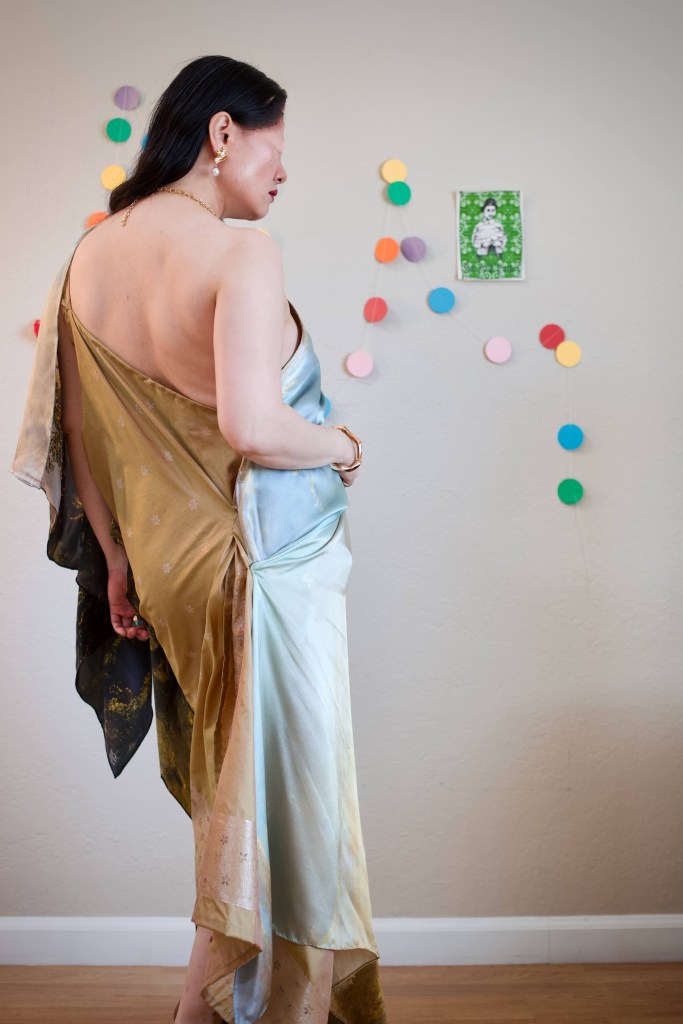
These verses are from the poem Thanatopsis – its title derived from the Greek words “thanatos” and “opsis”, which means “a meditation on death.” Writing the poem between the age of 17 and 22, Bryant was initially doubted to be its authentic author. Then associate editor of the North American Review was quoted to say of the poem, “No one, on this side of the Atlantic, is capable of writing such verses.” The following lines depict the view from the cemetery that inspired Durand’s painting Landscape – Scene from “Thanatopsis”, which is featured on the silk scarf adorning this dress:
“The hills
Rock-ribbed and ancient as the sun, – the vales
Stretching in pensive quietness between;
The venerable woods – rivers that move
In majesty, and the complaining brooks
That make the meadows green; and, poured round all,
Old Ocean’s gray and melancholy waste, –
Are but the solemn decorations all
Of the great tomb of man. The golden sun,
The planets, all the infinite host of heaven,
Are shining on the sad abodes of death,”
In elaborate detail is the old tree, “ancient as the sun”, with a view stretching across the green valley to hug the meandering river that flows into the ocean. Above the water, the sky is suffused in a soft, glowing light, the sort of divine light bathing the entire landscape, a painting style which would come to be known as “luminism.” In its attention to the quality of light, luminism is relatable to the Impressionism art movement, which began in the later years of 19th-century Europe, as both sought to achieve a vibrant and luminous effect in lighting. The difference resided in techniques – while Impressionist painters employed bold, broken brush strokes, Hudson River School painters made use of meticulous blending of color such that the brush strokes appeared invisible.
In both the painting and the poem expresses such melancholic beauty that it brings tears to our eyes. It is a perspective on death that carries a peaceful, poetic connotation like a pleasant dream, what the poet Edgar Allan Poe wrote of Bryant in The Poetic Principle: “The rhythmical flow, here, is even voluptuous – nothing could be more melodious. The intense melancholy which seems to well up, perforce, to the surface… The impression left is one of a pleasurable sadness.”
“All that breathe
Will share thy destiny. The gay will laugh
When thou art gone, the solemn brood of care
Plod on, and each one as before will chase
His favorite phantom; yet all these shall leave
Their mirth and their employments, and shall come
And make their bed with thee.”
 hardlyplaying.blog