In 1307, the Italian poet Dante Alighieri wrote The Convivio, a sort of encyclopedia of general knowledge of his time. In its second volume he paid tribute to his lifelong muse Beatrice Portinari, who lived “in heaven with the angels and on earth with [his] soul.” Proceeding to discuss the heavens, Dante allegorized them to the sciences, corresponding the first seven to the sciences of the Trivium and the Quadrivium, namely Grammar, Dialectics, Rhetoric, Arithmetic, Music, Geometry, and Astrology. Thus accordingly, the planet Jupiter may be compared to Geometry.
In his justification for comparing Jupiter to Geometry, Dante provided two reasons. One was that it moved between Mars and Saturn, who were antithetical to its fine temperance. Consequently Ptolemy said that Jupiter was a star of temperate constitution between the cold of Saturn and the heat of Mars. Similarly Geometry moved between two things antithetical to it, namely the point and the circle. As Euclid said, the point was its beginning and the circle was its most perfect figure, which must therefore be conceived as its end. Therefore Geometry moved between the point and the circle as between its beginning and end, and these two were antithetical to its certainty; for the point could not be measured because of its indivisibility, and it was impossible to square the circle perfectly because of its arc, and so it could not be measured exactly. The other reason was that among all the stars Jupiter appeared white, almost silvery, and Geometry was furthermore most white insofar as it was without taint of error and most certain both in itself and in its handmaid, which was called Optics.
Euclid, whom Dante referenced in his reasoning, was the mathematician of 3rd-century BC Alexandria. Geometry was revolutionized by Euclid, whose Elements is widely considered the most successful and influential textbook of all time. The study and knowledge of geometry had been recorded since the 2nd millennium BC, but Euclid arranged them into a single, coherent, logical framework in the 13 books that comprised the Elements. The mathematician E. T. Bell described geometry to be “with a literature much vaster than those of algebra and arithmetic combined, and at least as extensive as that of analysis, geometry is a richer treasure house of more interesting and half-forgotten things, which a hurried generation has no leisure to enjoy, than any other division of mathematics.” It was said that when one of his students asked what was in it for him to learn geometry, Euclid responded, “Give this young man fifty cents, since he must make a gain out of what he learns.” The Greek philosopher Proclus recounted a story in which King Ptolemy I asked Euclid if there was a shorter way to learn geometry than through his Elements, to which he replied, “There is no royal road to geometry.”
The Elements was widely studied in ancient Greece, but not in ancient Rome, thus was not translated into Latin during the antiquity era. Its last surviving record was produced by Theon of Alexandria in the 4th century AD. Then it became obscure until the 8th century, when the Arabs received it from the Byzantines and translated into Arabic. Although known in Byzantium, the Elements was lost to Western Europe until 1120, when the English monk Adelard of Bath translated it into Latin from an Arabic translation. By the Renaissance’s era, Theon’s Greek edition was recovered and translated into Latin in an edition published in Venice.
In the Renaissance’s vision, Geometry was a part of the classical Trivium and Quadrivium, often presented by a pair of compasses. Raphael’s School of Athens depicted Euclid drawing diagrams with a compass in front of an audience, while Frans Floris portrayed the personification of Geometry, who was a woman holding a compass upon a globe to illustrate mapmaking. By the end of the 18th century, William Blake, in his opposition to the Newtonian view of the universe, painted a naked Newton fixing his eyes upon a compass to write on a scroll. The scroll appeared to flow from his own head, thus recalling Proverbs 8:27, “When he prepared the heavens, I was there: when he set a compass upon the face of the depth.” In his annotation to his engraving of Laocoön, Blake wrote, “Art is the Tree of Life. Science is the Tree of Death.”
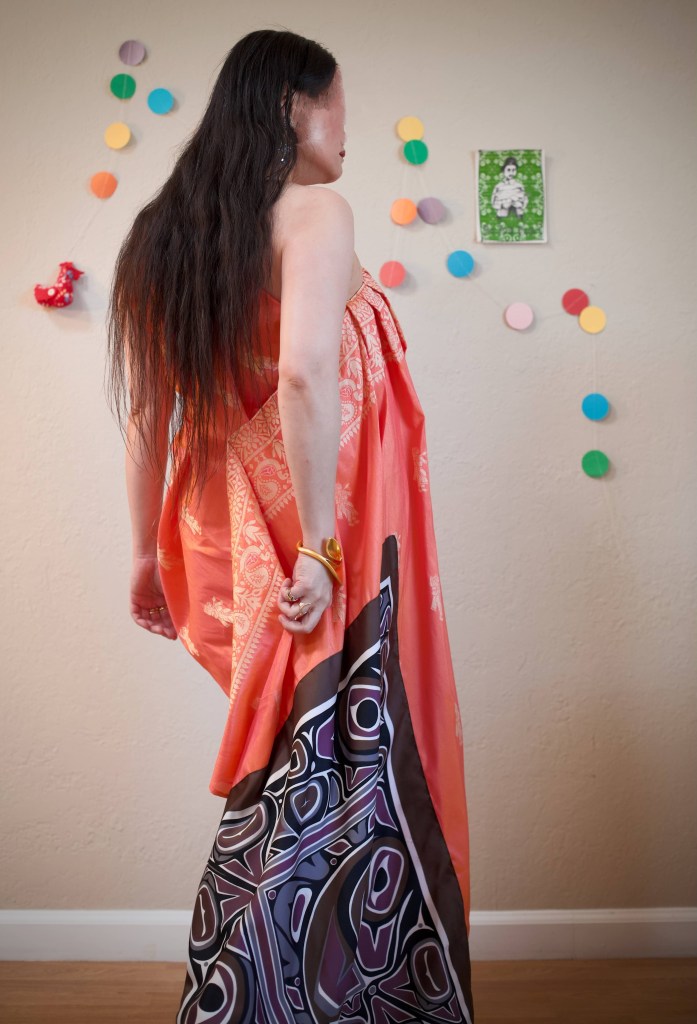
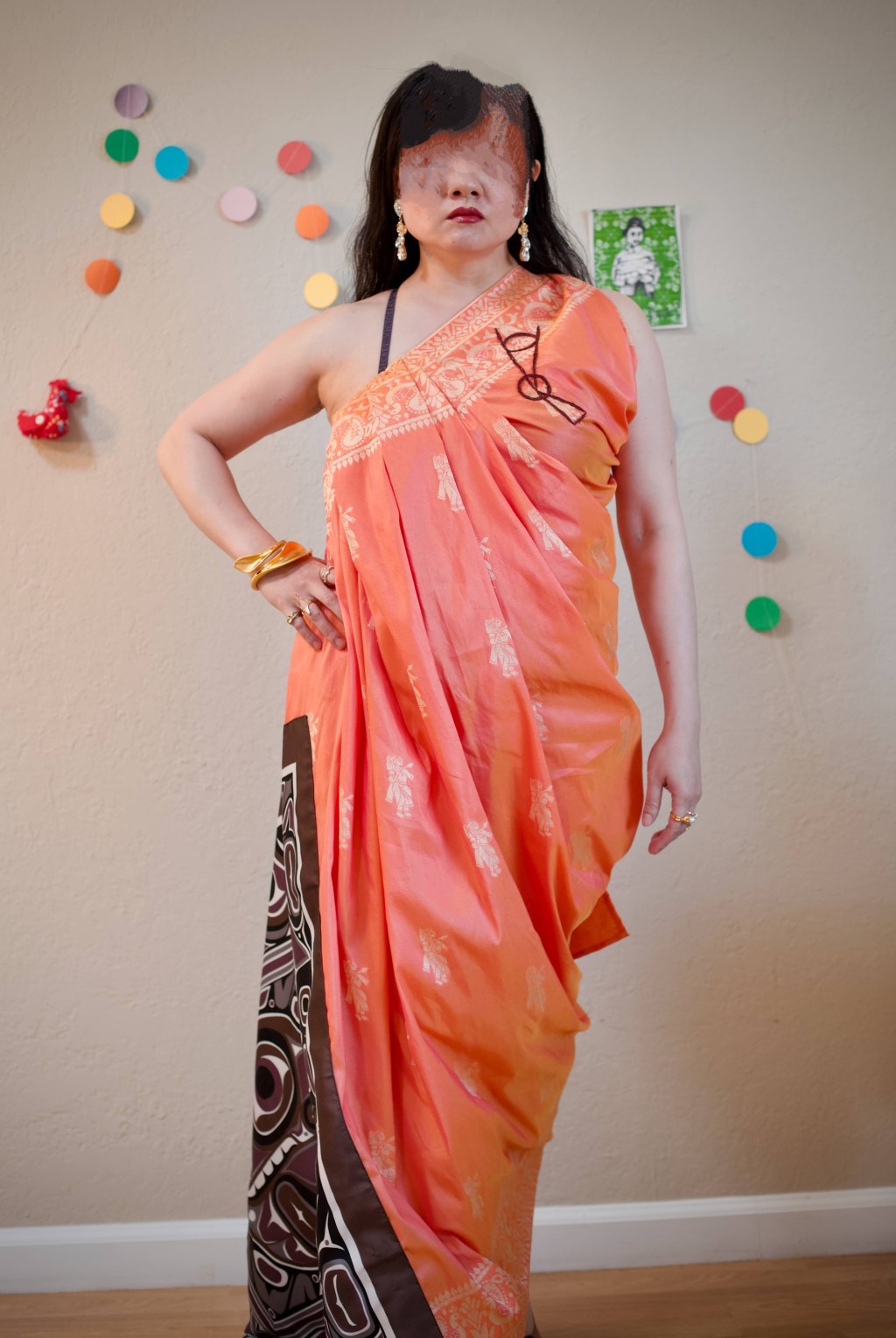
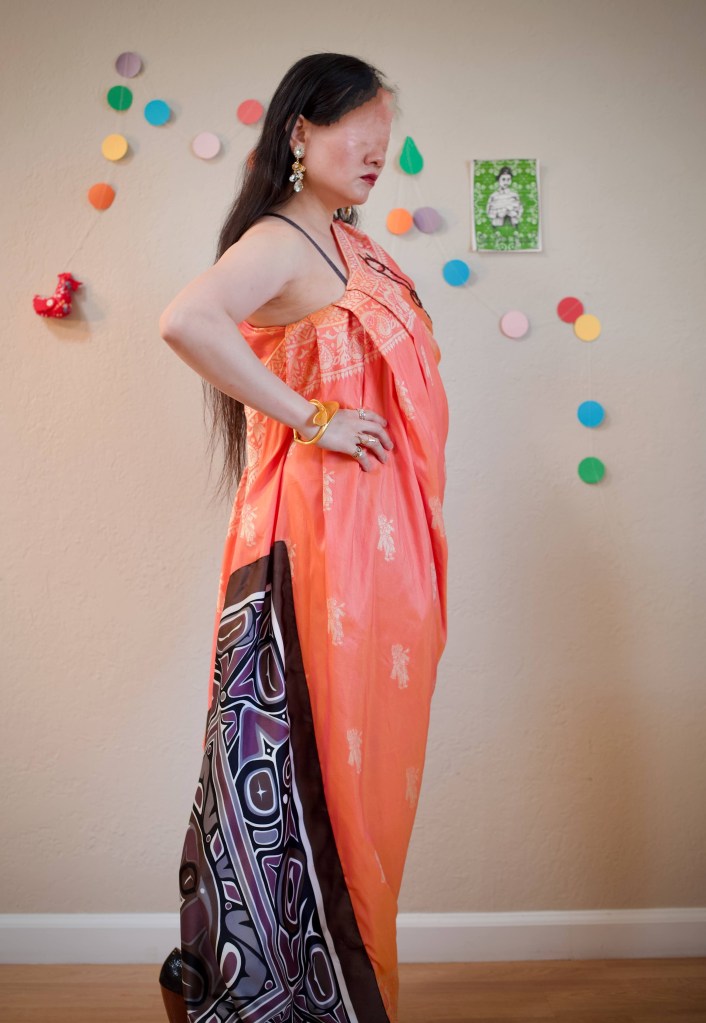
Today Euclidean geometry is still widely used and taught in school as a part of the standard curriculum. As Euclid’s greatest legacy, his Elements is considered the second most frequently translated, published, and studied book in history, only after the Bible. As for the planet Jupiter, cutting-edge technologies in telescopes have revealed that it is not silvery white, but in fact, is of orange and brown layers. To represent Jupiter, this dress is embroidered with a motif to symbolize Geometry. It is adorned with a vintage scarf to represent the Great Eye of Jupiter, which is a gigantic, ancient, high-pressure storm on the planet’s southern hemisphere.
 hardlyplaying.blog