While the global calendar in use for official activities is the solar calendar, which keeps track of the Sun’s position relative to the stars, many parts of the world also maintain another calendar, which keeps track of the Moon’s phases. The moon makes a complete orbit around the earth in 28 days, but it takes 30 days, a period known as the lunar month, to return to the same lunar phase as seen from the earth. The word moon is derived from the Germanic word mēnōn, which comes from the Proto-Indo-European mēnsis, meaning month. It is also the origin of the words menstrual and measure.
The act of measuring, the beginning of all mathematical activities, was recorded as early as 3500 BCE by the Sumerian civilization in Mesopotamia, modern-day Iraq. Writing first began as pictographs, soon changed into cuneiform scripts carved onto clay tablets. In 2334 BCE, the Akkadian king Sargon conquered the region and continued the Sumerian traditions. His daughter, Enheduanna, high priestess of the moon god, Nanna, is believed by scholars to be the world’s first recorded author. During the time she lived and stretching into the next century, Mesopotamian mathematics evolved from a proto-mathematical stage of metrological numeration systems to the adoption of the sexagesimal place-value number system, and continued to flourish in the Babylonian period. The poetry written during this era, which came in the form of temple hymns, depicts how their cultural practices deeply intertwined with mathematical development. Temple Hymn 42, dedicated to Enheduanna and Nisaba, the Sumerian goddess of writing and mathematical calculations, reads:
“True woman, pure as the soapwort, sprout of the holy reed.
She measures the heavens above
and stretches the measuring cord on the earth.”[1]
The true woman, who had gone through purification rites to become as pure as soapwort, who was born from the reed, the holy plant out of which the writing implement was made, could then perform the mathematical act of measuring the heavens above and the earth. The ability to measure a straight line was done by stretching a cord horizontally or hanging a cord vertically, weighted by a load – a plumb line. Therefore, those who were engaged in such measurements were said to ‘‘stretch the measuring cord on the earth.’’
Temple Hymn 8, which depicts the celebration of the Moon god Nanna in the city of Ur, where Enheduanna presided as high priestess, reads:
“In the gipar, the priestess quarters shining like the sun,
your princely shrine of pure divine powers marks the passage of days.”[1]
The gipar, a cluster of buildings in which the high priestess had her quarters, was described as ‘‘shining like the sun.” The following mention of “marks the passage of days” suggests alignment computation between the solar and lunar calendar. Archaeological digs in Ur have unearthed tablets showing calendrical calculations from before 2334 BCE and a more complete description of 12 months and a 13th intercalary month by 2050 BCE. In Ur, the akiti was a celebration of the triumph of Nanna, and particularly important was the akiti of the seventh lunar month, when Nanna would begin having visible superiority over the sun, Utu.
In East and Southeast Asian cultures, the eighth lunar month, when the full moon is at its brightest, is observed as the harvest moon festival. The mid-autumn festival originates from China, with its lunisolar calendar introduced under the Zhou dynasty in 1046 BCE. To celebrate this holiday, the Vietnamese tells the legend of the Moon Boy:
Once upon a time, there was a woodcutter. One day as usual, he took his axe into the forest. Near a stream he was startled to find a tiger’s den with four cubs. He rushed to the den and swung his axe at the cubs, just as the tigress was returning. Hearing her terrifying roar behind him, the woodcutter only had time to drop his axe to climb up the tree. The tigress was enraged to find her cubs dead. But then, she quietly went to a nearby tree, taking a few leaves to bring back to her den. As she fed them to the cubs, they miraculously came back to life. After the tigress took her cubs away, the woodcutter climbed down and dug up the Miracle Tree to carry it home with him.
On the way home, the woodcutter saw an old beggar lying dead on the grass. After being fed the leaves, the old man came back to life. Being told of the Miracle Tree, he exclaimed in astonishment, “This must be the Miracle Tree of Life,” he said, “It’s a gift from heaven to save mankind. But you must remember to only feed it pure water, otherwise it shall return to the sky.” Thus the woodcutter planted the Miracle Tree by the East corner of his garden, daily feeding it pure water from his well.
One day while crossing the river, the woodcutter saw a dead dog floating on the water. After being brought back to life, the dog stayed, thus the woodcutter gained a clever friend. Another time, a wealthy man from a neighboring village begged the woodcutter to save his daughter who just drowned. Once saved, the daughter asked for her father’s permission to wed the woodcutter, thus the woodcutter gained a beautiful wife.
They lived together in peace and harmony, until one day, when a gang of bandits passed by the village. Hearing that the woodcutter possessed a power to bring the dead back to life, they played him a vicious prank. After murdering his wife, they dug out her gut and threw it down the river. Without the gut, the Miracle Tree was of no use. The woodcutter’s dog, being a loyal friend, offered his own gut to revive the woman. Surely enough, the wife came back to life, now with the dog’s gut. The woodcutter then took some clay to mold it into a gut for his dog, and the dog, miraculously, was revived too. Husband and wife, man and animal, became even more attached to each other than before.
But since then, the wife was no longer the same, now appearing scatterbrained and careless. The woodcutter said to her many times, “if you have to piss, piss on the West side, not on the East side, otherwise the tree would fly up into the sky.” But she seemed to have lost her nerves; her husband’s words went into one ear, out the other. Sooner rather than later, she pissed on the Miracle Tree while her husband went into the forest. Just as the tree lifted its roots violently off the ground, the woodcutter returned. He rushed to hang on to his tree, but the tree kept rising; no force could stop it. Both Tree and man flew all the way up to the moon.
From then on, the woodcutter lived on the moon with his precious tree. Every year, the tree only dropped one leaf onto the sea, but the sharks were always there waiting for it. Looking up at the moon now, one can see the silhouette of a man underneath a tree. We say it’s the Moon Boy sitting underneath the banyan tree.
The Moon Boy legend has, too, inspired generations of Vietnamese poets and writers. The poet Tản Đà wrote his ode to the Moon Boy, Want to see Luna:
An Autumn Night has fallen
Half a lifetime’s come even
The cinnamon has ripen
And I’ve been waitin’
for the banyan tree’s invitation
To meet a friend, or
drown in sadness
Steep a breath of cloud
sown the seed of joy
The eighth full moon –
Lean on me, and
laugh all the way down.[2]
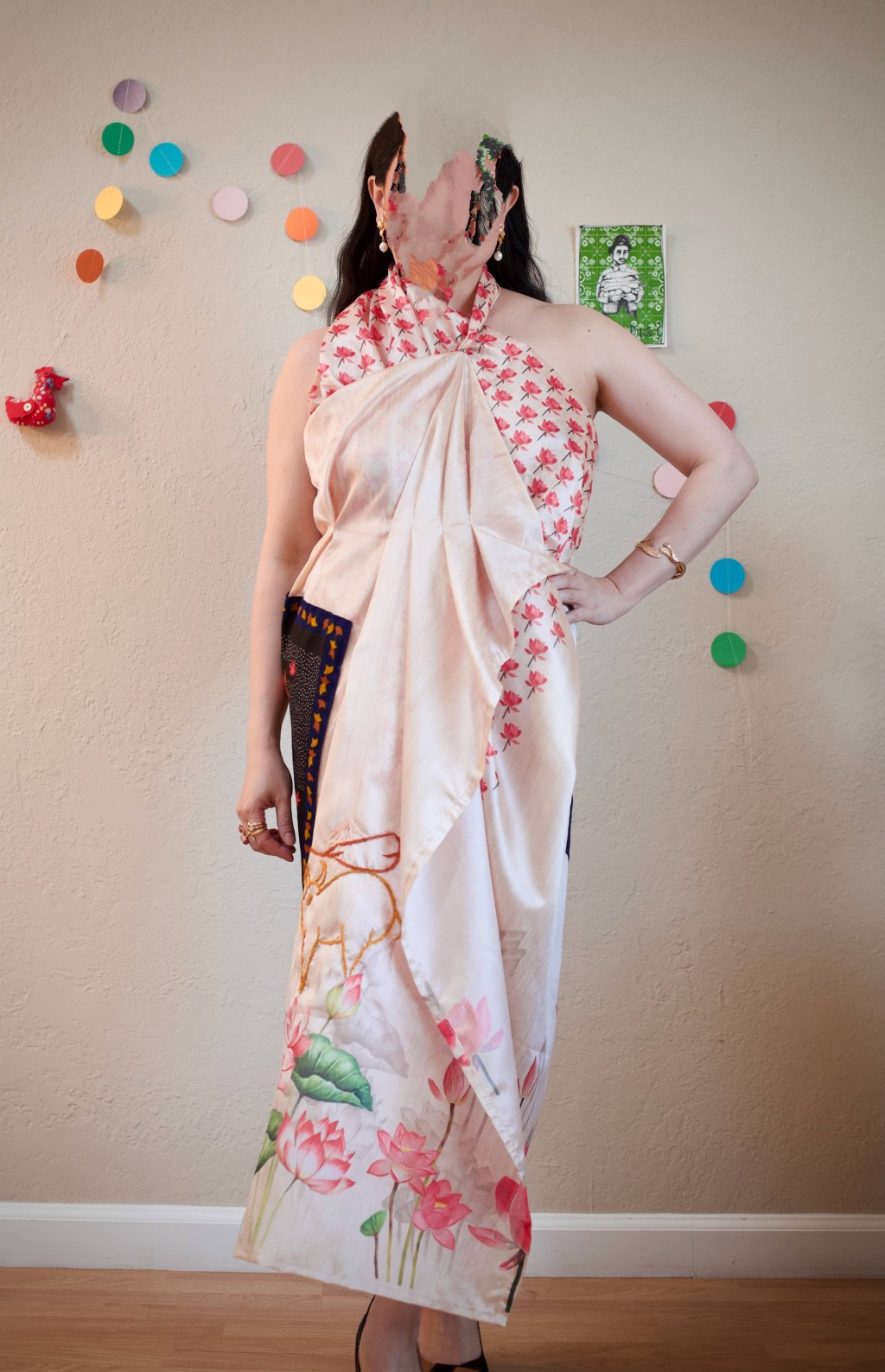
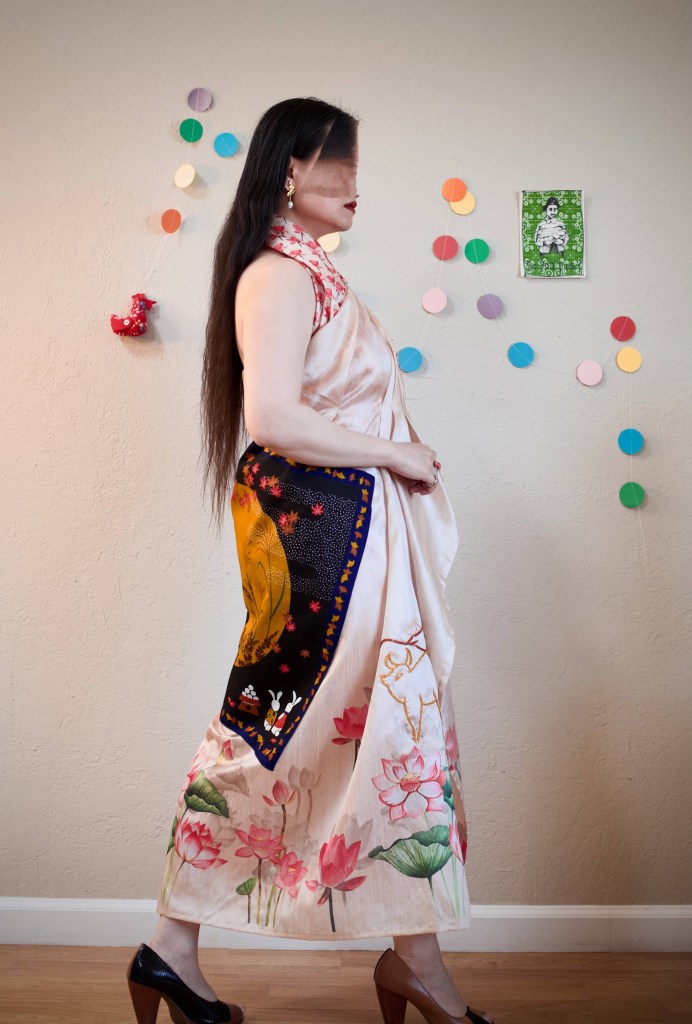
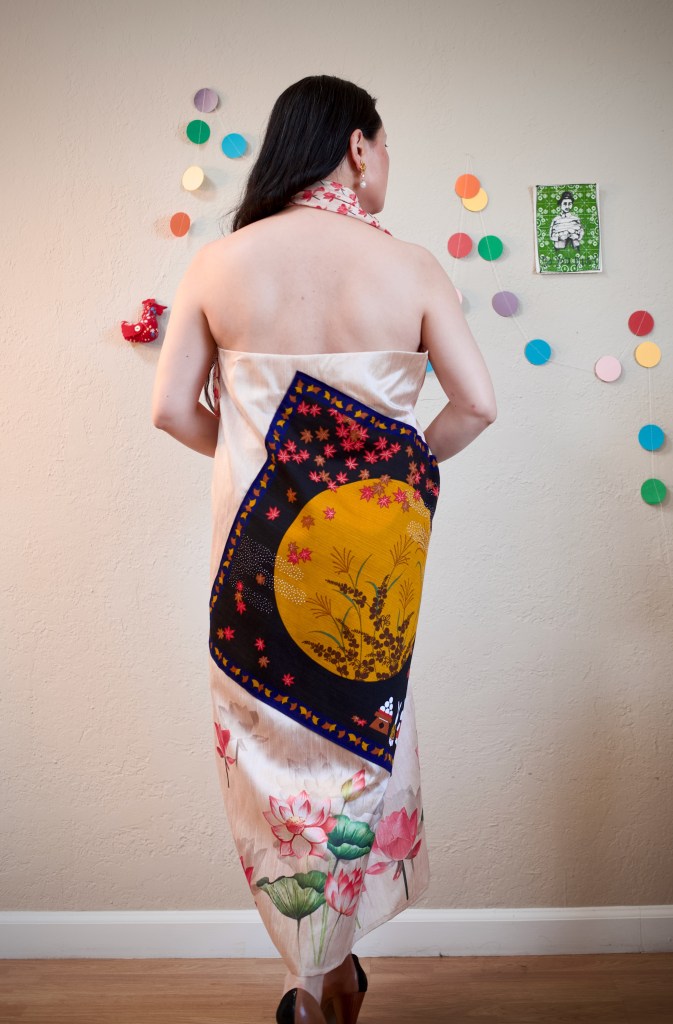
Inspired by his poem, I have crafted this dress, embroidered with the motif of a boy, lolling on his water buffalo while daydreaming of Luna, who is depicted on a furoshiki cloth adorned at the back of the dress.
[1] Sarah Graz, Enheduanna: Princess, Priestess, Poet, and Mathematician.
[2] Tản Đà, Muốn làm thằng Cuội
Đêm thu buồn lắm chị Hằng ơi
Trần thế em nay chán nửa rồi
Cung quế đã ai ngồi đó chửa
Cành đa xin chị nhắc lên chơi
Có bầu có bạn can chi tủi
Cùng gió cùng mây thế mới vui
Rồi cứ mỗi năm rằm tháng tám
Tựa nhau trông xuống thế gian cười.
 hardlyplaying.blog