
Across cultures since ancient times, mercury has been a substance of fascination and immense utility. Being liquid and shiny, it was commonly known as quicksilver and was associated with the fastest planet, which was named after the Roman god Mercury. In Greek mythology, Mercury is equivalent to the god Hermes, who was the “soul guide,” escorting souls to the Underworld. In similar tradition, Greek alchemy considered mercury the spirit, acting as a bridge between the soul and the body.
The Greek philosopher Aristotle, in De Anima, likened the soul to atom – a complex of atoms within the body. Soul-atoms were spherical in shape, extremely minute and mobile, like specks of dust in the air seen in the sunbeams entering through our windows. He recounted the story, told by Democritus, about Daedalus who endowed the wooden Aphrodite with motion, simply by pouring in quicksilver, for the soul in fact moved the body in the same way that it moved itself.
In China, mercury was thought to help maintain good health and prolong life. In 246 BC at the age of 13, Qín Shǐ Huáng Dì, ascending to the throne as First Emperor of a unified China, commanded the construction of his own mausoleum at Li Shan, “famed for its jade mines, its northern side was rich in gold, and its southern side rich in beautiful jade.” The tomb was designed to represent the heavenly constellations above and the features of the land below. In his Records of the Grand Historian, The Chinese historian Sima Qian wrote that mercury was used to simulate the hundred rivers, the Yangtze, Yellow River, and the great sea, and set to flow mechanically. Ironically, it was also mercury that eventually killed him. As the emperor believed in a medicine that could make him eternal, a medicine with a small dose of mercury was prescribed to him, gradually poisoning him to death.
The Chinese also loved cinnabar, which is how mercury is most commonly found in nature. It is mercuric sulfide embedded in ores that occur in granular crusts or veins associated with volcanic activity and hot springs. It has the color of blood, of which the Chinese used to paint lacquer, a type of tree resin found in southern China, which hardens when exposed to oxygen and humidity to become a natural plastic. In Latin, it was sometimes mistakenly known as minium. Pliny, in Natural History, wrote of this mistake being owed to the name ‘Indian cinnabar,’ “for that is the name the Greeks give to the gore of a snake crushed by the weight of dying elephants, when the blood of each animal gets mixed together, as we have said; and there is no other colour that properly represents blood in a picture.” Minium, as we know, is red lead made by heating white lead. The word miniature, which comes from the Latin verb miniare, ‘to color with minium,’ describes an illustration to decorate an ancient or medieval illuminated manuscript, which was usually small in size.

As early as 500 BC, mercury was used to make amalgams, which is an alloy of mercury with another metal. It was especially effective in purifying gold and silver. By mixing mercury with crushed ore, even the finest gold particles could be collected. The amalgam was then heated in a distillation retort to recover the mercury for reuse, leaving behind the gold. Being valued as a dense substance, it was also used to stabilize the hydrometer, of which invention dates back to Archimedes, who was tasked to determine the gold content of the crown of Hiero II of Syracuse. The mercury deposited into the bulb at the bottom acts as a ballast to lower the hydrometer’s center of gravity, allowing it to float upright for accurate readings on the scale.
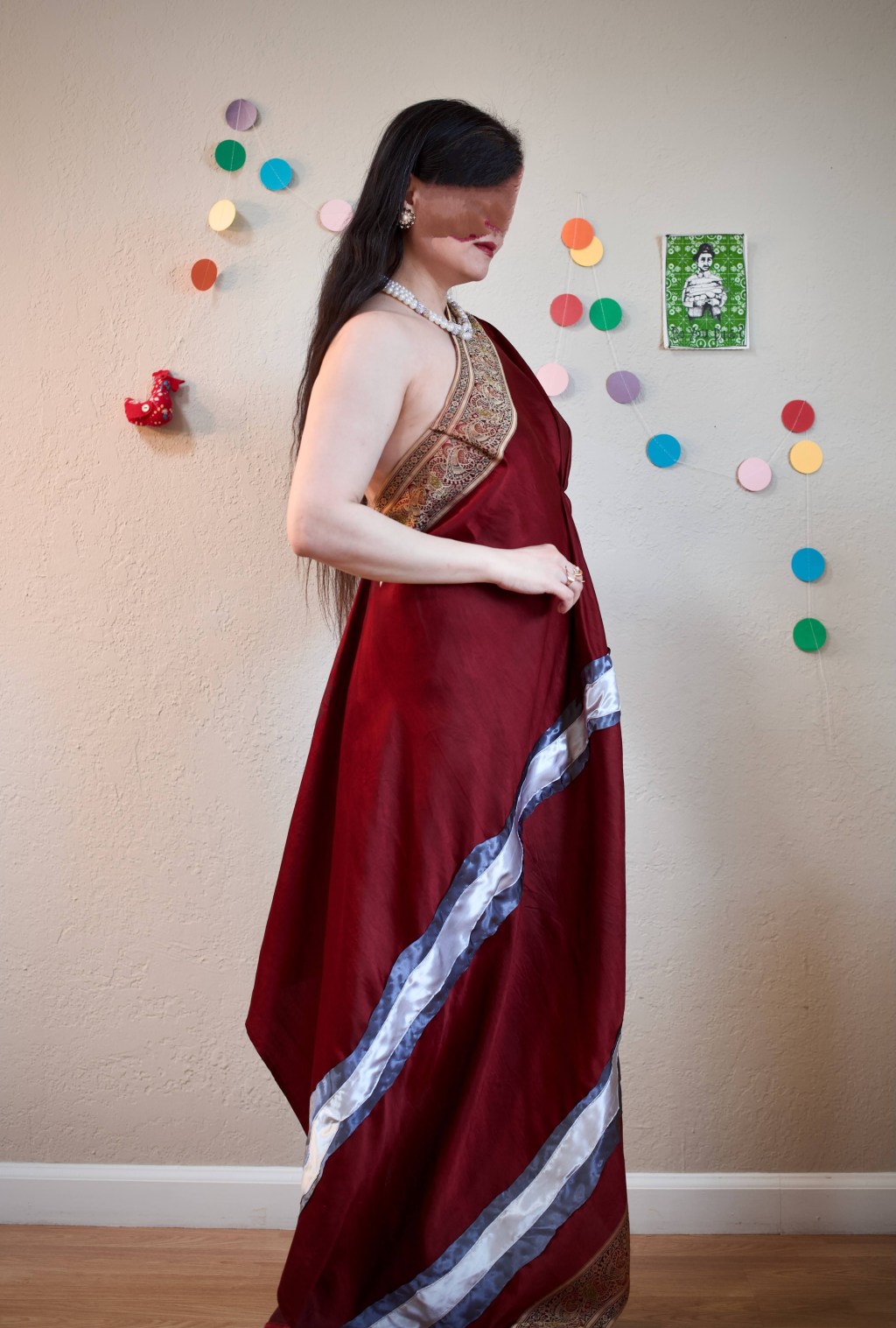
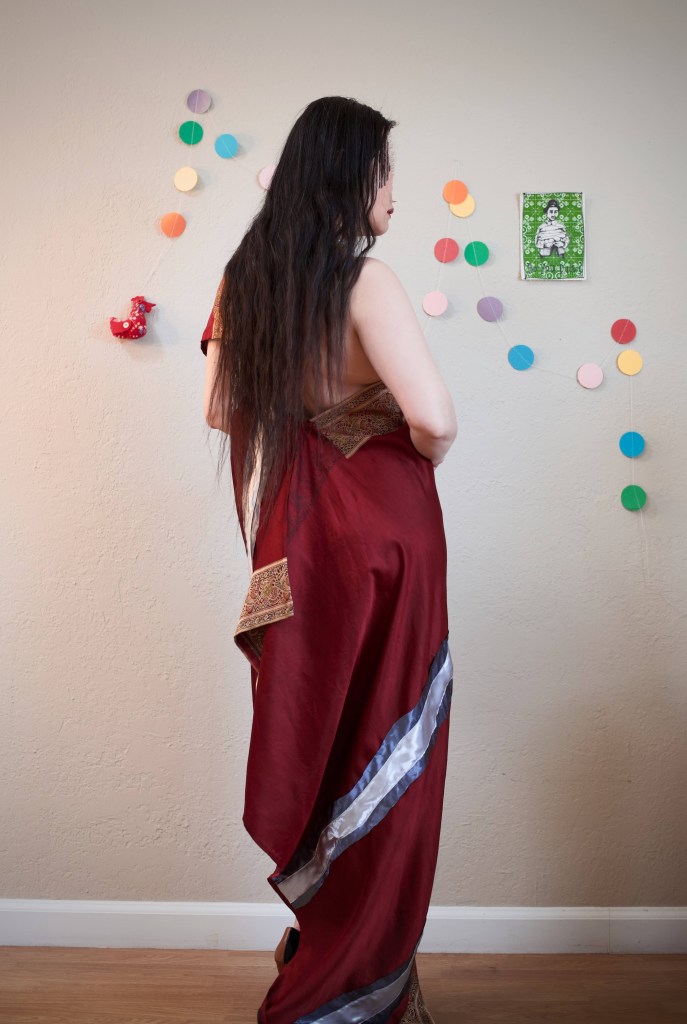
Today mercury usage is being gradually phased out due to safety concerns. Perhaps one day, what to be known of this prima element will be the planet named after it, and the myths and legends it inspired alongside the vein of progress – like how once upon a time, alchemists believed that mercury was essential in creating the philosopher’s stone, that it could be transmuted into gold, how it was revered for its color and spiritual qualities, and how it became instrumental in scientific and artistic endeavors. Inspired by mercury, this dress is crafted from a silk rectangle and adorned with patchworks to represent flowing streams of quicksilver. The base silk comes from a vintage sari.
 hardlyplaying.blog