The Venetian Giovanni Battista Tiepolo is considered one of the greatest painters of 18th-century Europe, the first master of the Grand Manner, and among the most original artists of his time. His art unites ancient history, myths, and legends into masterpieces of imagination and theatrical interpretation, standing as an exemplification of “pictorial intelligence”, which explores concepts and ideas from the image and its compositions, colors and tones, lights and shades. The British art historian Michael Levey, in his book Painting in XVIII Century Venice, called Tiepolo the “presiding genius” of his age. More than any other, he made his city aware that it was a capital of art, a privileged place where beauty was created. In his hands Venice’s palaces, churches, fables, and allegories became glorified and theatric, creating an opera-like atmosphere. Here he is likened to the Roman poet Pietro Matastasio: “Dreams and fables I fashion; and even while I sketch and elaborate fables and dreams upon paper … I so enter into them that I weep and am offended at ills I invented. But am I wiser when art does not deceive me?”
Among few other artists of his century, Tiepolo achieved international fame, as half of Europe exhibited his artworks during his lifetime. During a visit to Venice in 1761, Jean-Claude Richard de Saint-Non noted that “a large number of palaces and churches are filled with the works of Tiepolo.” Anyone who climbs the staircase of the Residenz at Würzburg to see Tiepolo’s universe unfolding on the vault is fully aware of participating in one of Europe’s most exalting aesthetic experiences. Over the grandiose staircase designed by the German architect Balthasar Neumann, the vast ceiling depicts Apollo and the continents. In this fresco, the ceiling opens onto a light-filled sky inhabited by the Olympian gods, while on the periphery are vignettes symbolizing the Four Continents, with figures shown as though standing on the cornice. The oval reception room depicts local legends, with dazzling stucco work framing the frescoes, sometimes feigning curtains drawn back to reveal the scenes, other times seamlessly transforming painted figures into three dimensions in sculpted relief.
The Venetian art historian Antonio Zanetti, in his book Della Pittura Veneziana e Delle Opere Pubbliche de’ Veneziani Maestri, observed that Tiepolo imbued his works with a “beauty and a sun that are perhaps without parallel.” The word chosen for beauty was “vaghezza”, denoting a “certain bright, luminous tones, broad strokes, good taste in the drawing, bands of light and shadow.” Tiepolo, then, was the painter of light in the age of Enlightenment, when the science of optics made great strides with Newton’s experiments in refraction, revealing the composite nature of the colors of light. Apollo, the sun god, illuminates in Tiepolo’s Olympus, as Levey wrote, “The god himself, beautiful, beneficent, radiant, indeed the essence of illumination and enlightenment in the world, became for Tiepolo more than a myth. It is as though in Apollo he sees the source of his power as an artist.” It is notable that the artist arrived at such stunning effect not by employing rare and beautiful colors, but through the chiaroscuro technique, juxtaposing between dark and light.

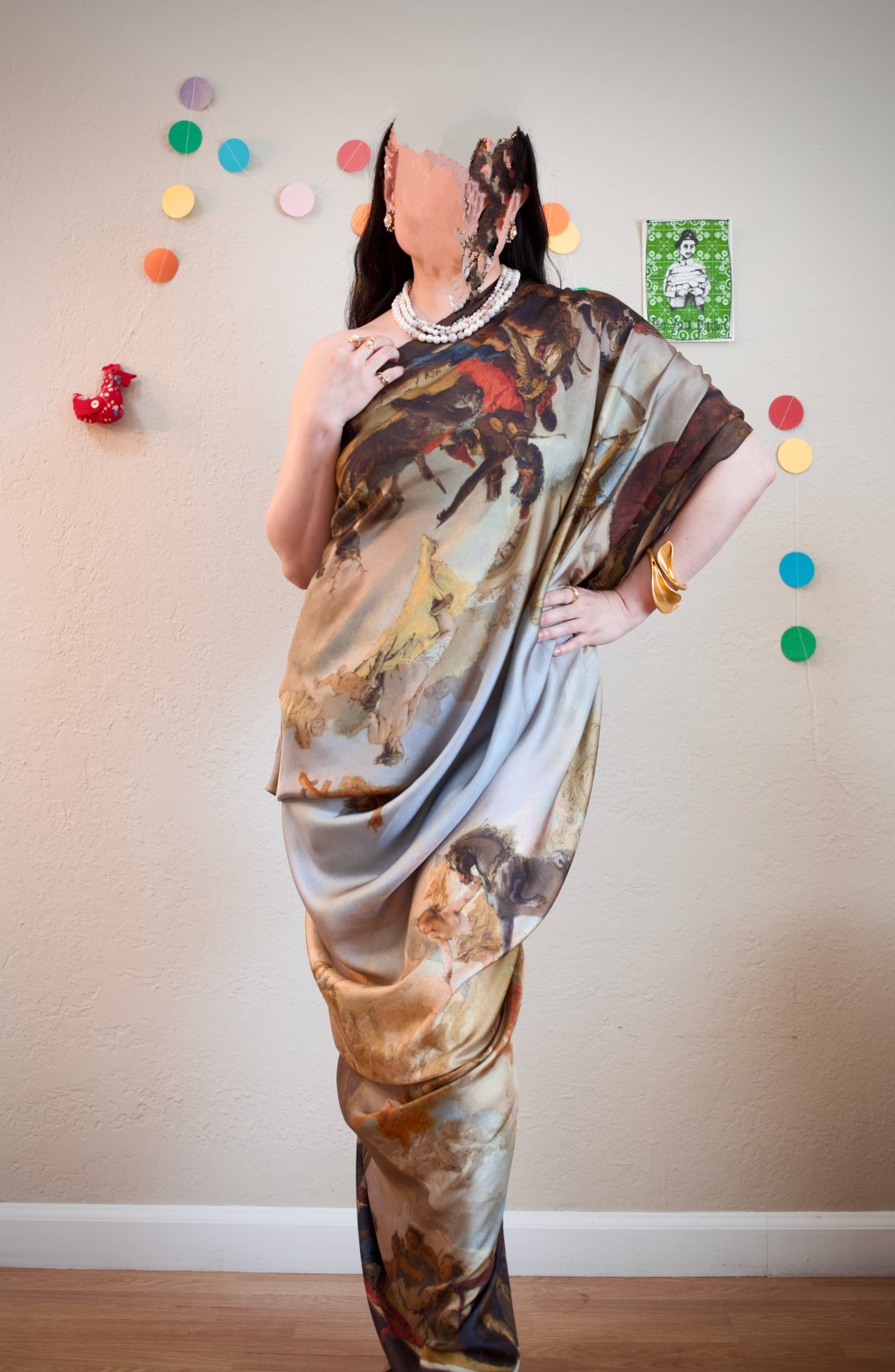
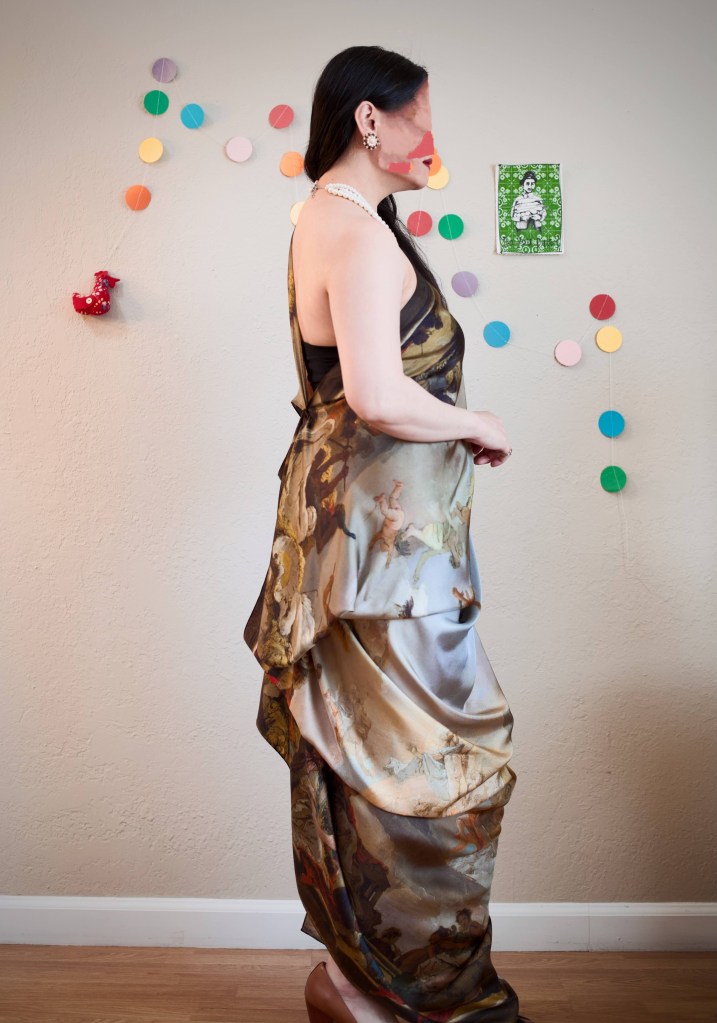
This dress is crafted from a silk rectangle, featuring Tiepolo’s preliminary sketch of the Allegory of the Planets and Continents that he would paint over the vault of the Würzburg Residence. The painting depicts Apollo about to embark on his daily journey across the sky. Deities surrounding the sun god to symbolize the planets include Venus, Mars, Mercury, Jupiter, and Saturn. Allegorical figures at the four edges personify Africa, the Americas, Asia, and Europe: the ebonized matron of Africa atop her camel, the elephant and chinoiserie of Asia, the feathered headdresses of the Americas, and Europe, spanning from Greece and Rome to Emperor Frederick Barbarossa, to bishops, cardinals, and princes. Here all of the artist’s favorite themes are in evidence: the fierce physiognomy of wanton old men, a self-portrait, an idealized portrait of the patron, Chronos, Apollo, and the Muses.
To see Tiepolo’s artworks is to be aroused and heightened in the mind while the eyes wander endlessly in a labyrinth of vast images in between airy spatial intervals. From the perspective of taste, it is to satiate curiosity, so as Montesquieu wrote, “Our soul is meant to think, which is to perceive. Now such a being must be endowed with curiosity: since all objects are in a chain where each idea both precedes and follows another, it is impossible to wish to see one object without desiring to see another one, and if we did not feel desire for the latter, we would not take pleasure in the former… Therefore one sure means of always pleasing the soul is to present it with many objects or with a greater number than it had expected to see.”
Bibliography
Exhibition “Giambattista Tiepolo, 1696-1770”, The Metropolitan Museum of Art, January 24 – April 27, 1997.
 hardlyplaying.blog