
The Tang Dynasty, which ruled China until the 10th century, marked a high point in Chinese civilization, entering China into a golden age of cosmopolitan culture, new technologies, and a flourishing economy. Their territory reached far and wide, with the southern border reaching past An Nam territory, now Việt Nam. Under the Tang, An Nam thrived as a trading outpost, transporting goods from the southern seas into Yunnan via the Red River. It was also considered the greatest age for Chinese poetry, giving birth to two of China’s most famous poets, Li Bai and Du Fu. Vietnamese classical literature harks back to this period as well. Among the most famous Vietnamese poets, Hồ Xuân Hương and Ngân Giang wrote their poetry following the classic Tang format. A Vietnamese folk poem references Chang’an, the Tang’s capital city, which was the world’s most populous city at the time:
“Still a jasmine flower, even if not fragrant.
Still a man of Chang’an, even if not elegant.”
During this time, the people in this Southern region produced a type of ceramic called Yue ware, a reference to the Yue people who used to inhabit the area, though what’s left of the Yue had assimilated with the rest of China by this point. It was highly valued as tribute for the imperial court. A particularly refined form was the Mi-se Yue ware, of very fine clay and workmanship. It was described as “secret green-ware only fit for a king.” The Tang poet Lu Guimeng wrote his poem Mise Yueqi, depicting its jade-like glaze:
“The misty scenery of late autumn appears when the Yue kilns are open,
The thousand peaks have been despoiled of their bright color for the decoration of the bowls.”
The poet Xu Yin of the Five Dynasties described the method behind the creation of the secret celadon:
“Like bright moons cunningly carved and dyed with spring water;
Like curling disks of thinnest ice, filled with green clouds;”
For hundreds of years after, people would wonder what it looked like. Lacking any visual evidence, scholars had believed it was just a term for fancy Tang exportware. Then came the discovery of the Famen tomb in 1987. With the entire inventory of the tomb carved on 2 black stone steles, they finally saw what mi-se looked like. Against the presumption of its color, which was thought to be a bright green jade, it was actually a shade of brownish green, a fading hazy autumnal green.
Unsurprisingly the discovery of the actual mi-se imbued a tinge of disappointment. What’s with all the fanfare for some faded brownish pottery? Within this puzzlement highlights the difference in aesthetic perspective between East and West. While jade comes in two types, nephrite and jadeite, jadeite is treasured by the West for its deep bright green lustre, with the most prized, called “imperial,” being likened to emerald. In the East, the jade of choice is nephrite, which comes in a variety of colors, with the most prized in China being a creamy white hue called “mutton-fat.” Within the green nephrite variety, what is considered bright green also underlines the difference in perspective of the range of the color green in the East. Most celadons get their green color from a glaze made with 2% iron, while a glaze of 6% iron gives them a black color. Mi-se gets their “bright” green from a glaze of 3% iron, which shifts their color toward brownish green on the green-to-black scale.
As the poet Xu Yin had likened the color of mi-se to green clouds, in these opaque and dull characteristics express the preferred aesthetic of the East. In In Praise of Shadows, Jun’ichirō Tanizaki wrote, “The Chinese love jade. That strange lump of stone with its faintly muddy light, like the crystallized air of the centuries, melting dimly, dully back, deeper and deeper — are not we Orientals the only ones who know its charm? We cannot say ourselves what it is that we find in this stone. It quite lacks the brightness of a ruby or an emerald or the glitter of a diamond. But this much we can say: when we see that shadowy surface, we think how Chinese it is, we seem to find in its cloudiness the accumulated sediment of the long Chinese past, we think how appropriate it is that the Chinese should admire that surface and that shadow. It is the same with crystals. Crystals have recently been imported in large quantities from Chile, but Chilean crystals are too bright, too clear. We have long had crystals of our own, their clearness always moderated, made graver, by a certain cloudiness. . . . We do not dislike everything that shines, but we prefer a pensive shadow to a thin transparence.”
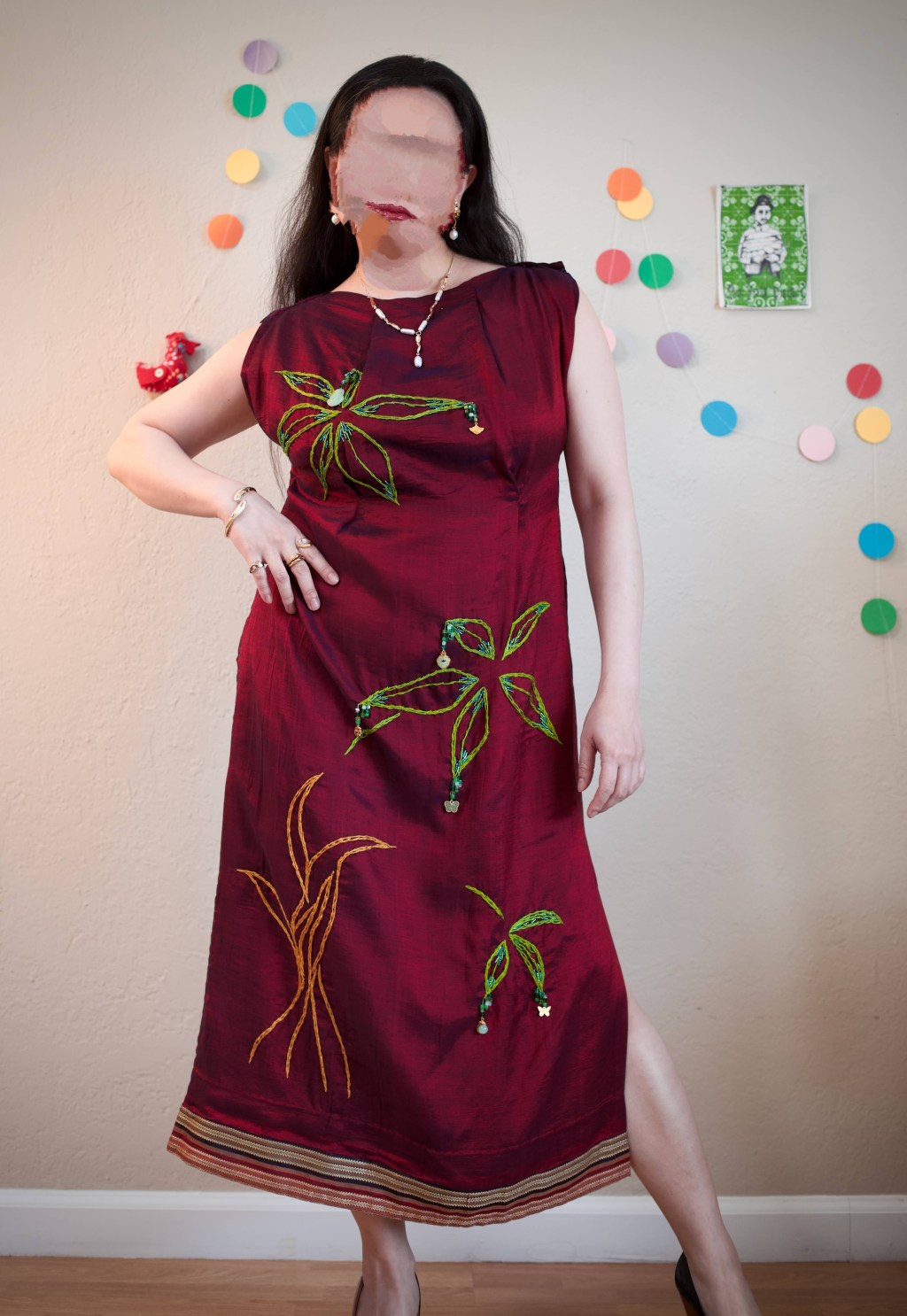
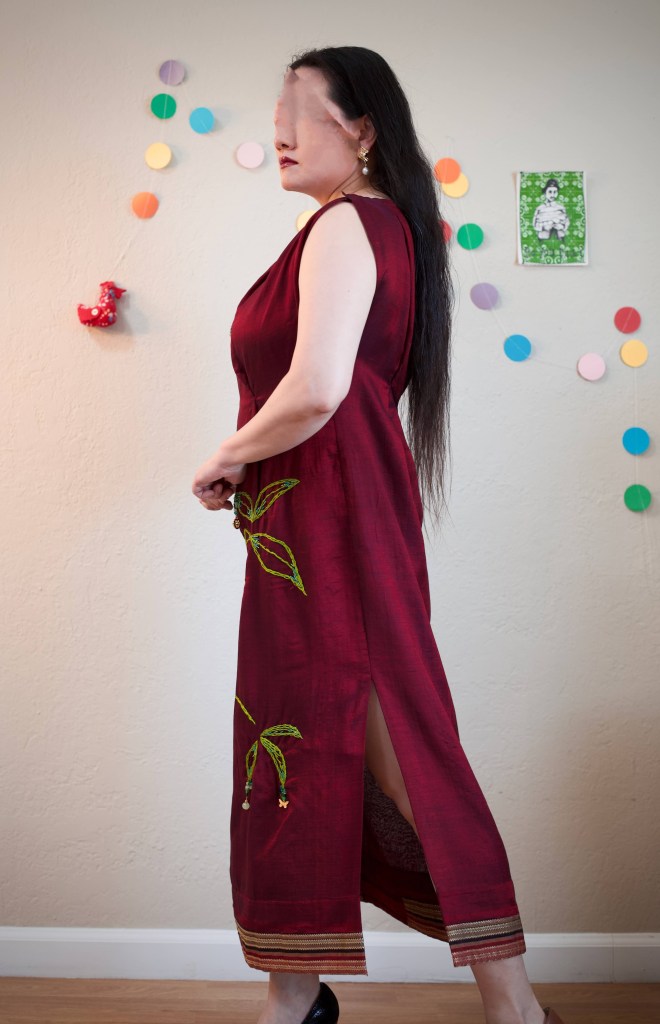
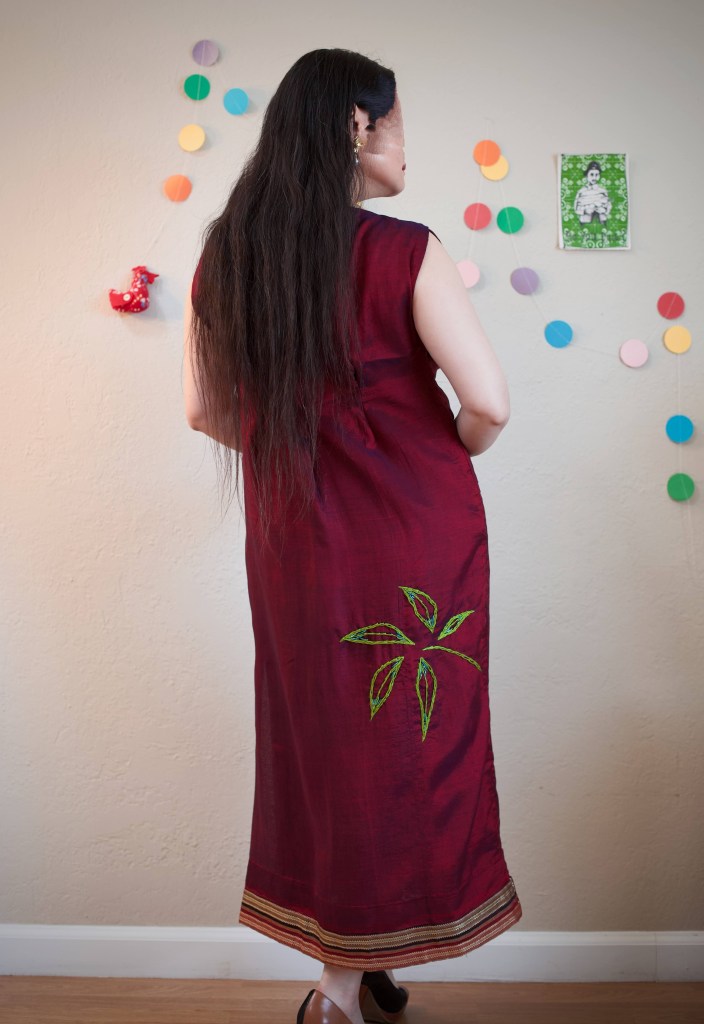
This dress is crafted from 2 silk rectangles, which come from a vintage sari. Inspired by jade, it is adorned with a money tree motif and decorated with green jade beads and glass beads. Chinese legend has it that the money tree is a holy tree, bringing money and fortune to the people. It is a symbol of affluence, nobility, and auspiciousness.
 hardlyplaying.blog