

“And I looked, and, behold, a whirlwind came out of the north, a great cloud, and a fire infolding itself, and a brightness was about it, and out of the midst thereof as the colour of amber, out of the midst of the fire.”
– Ezekiel 1:4
Traded between the continents as early as 12,500 years ago, a cuneiform inscription on an obelisk erected by a king of Nineveh told of amber coming from the sea of the North:
“In the sea of the changeable winds,
his merchants fished for pearls;
In the sea where the North Star culminates,
they fished for yellow amber.”
Known as Baltic gold, amber is a little lighter than seawater. On stormy winter nights, lumps of amber break off the seabed to float up to the surface. In an autumn storm of 1862, 2 tons of amber were cast onto shore. Locals fish them out of the water with huge nets, which is why the ancient English name for amber is scoop-stone. An ancient Lithuanian tale told of a mermaid named Jūratė who lived under the Baltic Sea in a beautiful amber castle. She fell in love with a handsome fisherman, Kastytis. But when the thunder god, Perkūnas, found out that the goddess had fallen in love with a mortal man, he furiously struck the amber castle, smashing it into millions of pieces. Large blocks of amber washed ashore came from the palace walls, the amber chips were her tear drops, and one could still hear her sad voice in a stormy sea.
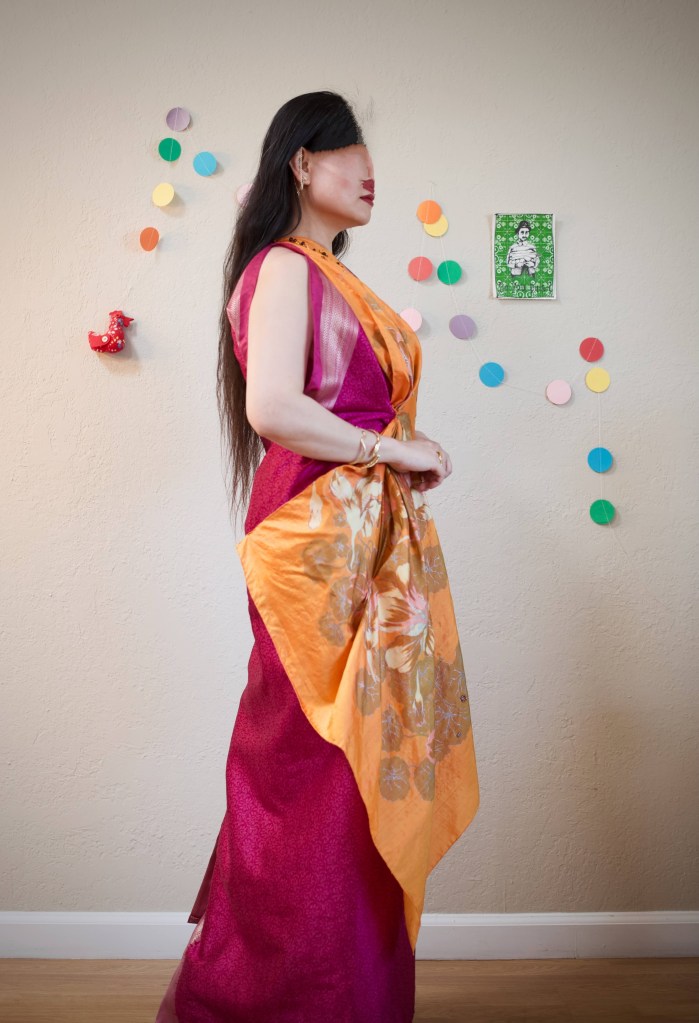
Amber comes from resin-bearing trees once clustered in forests millions of years ago. They have long been extinct, and there has been no definitive conclusion on the type of tree despite decades of study. Most likely they were of an evergreen variety. Many evergreens ooze resin as a self-healing mechanism, but for it to be an amber forest, something extraordinary must have happened. There would have been resin hanging on branches, pooling onto the forest floor, syrupy and intoxicatingly fragrant. Over millions of years, the resin solidified and fossilized into amber. About 15 million years ago, some of it was washed from the rocks and transported by rivers and glaciers to be dropped near a vast seabed. Amber is among the best preservers of natural history. As the resin dripped into pools on the forest floor, it trapped many different wild lives along with it and preserved them to near perfection, as if it were a time machine.
The Greeks called amber elektron, which means the sun. The Greek historian Nicias believed it to be “a liquid produced by the rays of the sun; and that these rays, at the moment of the sun’s setting, striking with the greatest force upon the surface of the soil, leave upon it an unctuous sweat, which is carried off by the tides of the Ocean, and thrown up upon the shores of Germany.” In Greek mythology, Phaethon, the son of the sun god, Helios, fell into the river Eridanus in his death. His sister thus cried tears of amber, giving the river its rich amber deposit. In his book De Magnete of 1600, the English physicist William Gilbert coined the term “electricus,” meaning “like amber,” to describe the phenomenon of static electricity produced by amber when rubbed. The word “electricity,” deriving from Gilbert’s electricus, was printed for the first time in Sir Thomas Browne’s Pseudodoxia Epidemica of 1646: “Crystal will calefy into electricity; that is, a power to attract strawes and light bodies, and convert the needle freely placed.”
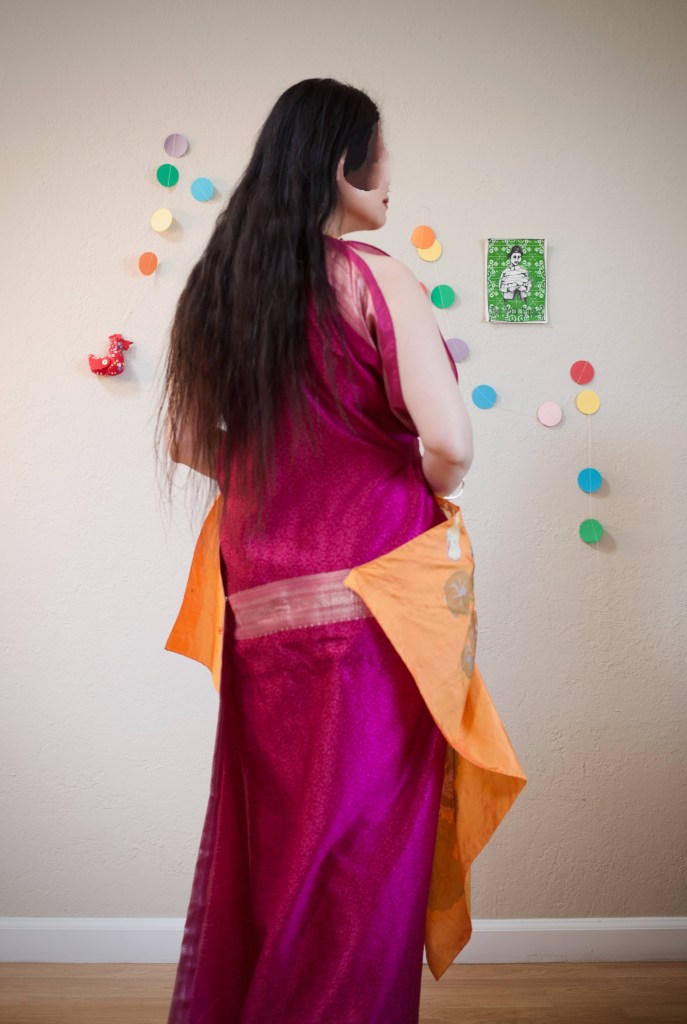
As if one were not sufficiently obsessed with amber, a chamber decorated entirely in amber was gifted to Peter the Great of Russia in 1716 to forge a Russo-Prussian alliance against Sweden. Looted during World War II, it has been reconstructed at the Catherine Palace in Pushkin. On the other side of the trenches, an amber-sculpted altar inside St. Bridget’s Church in Gdańsk features the emblem of Poland as a memorial to the Soviet massacre of Polish officers at Katyń during WWII. Inspired by amber’s richness and all that it symbolizes, amber beads are strung and embroidered onto an orange-hued vintage silk scarf to adorn the base dress in deep purple.
 hardlyplaying.blog