

Long before any other societies appeared on earth, there were termites. In the shadow of dinosaurs, the earliest termites formed the first social networks. To make the most of food resources in a nutrient-poor habitat, these insects evolved to feed each other portions of their waste through a process called proctodeal trophollaxis. These symbiotic associations gradually formed the fundamental requirements for termite sociality.
Once termites shifted from eating solely wood to supplementing their diet with soil, the species exploded in diversity and colony development. They’ve become amazing architects, building mounds so high that elephants use them as scratching posts. Instead of just a reproductive queen, termites have a reproductive royal pair, the king and queen, who stay in the colony to produce offspring. Caste specializations developed, separating soldiers from workers. Workers care for their young, clean and build tunnels. Soldiers are a defining feature of all termites and are lethally effective against invaders. Adept at chemical warfare, they can produce a variety of defensive chemicals from toxic to sticky substances. Accordingly their heads evolved large glands and nozzles to spray them during combat. Other soldiers evolved snapping mandibles, using built-up elastic energy to make powerful strikes.
Second to the sociality game were ants. They may have been behind the termites, but with more than 14700 extant species, they are ten times as diverse as eusocial bees, and are the most studied for their social behaviors and colony formations. Worker ants choose their own tasks and switch tasks as they age. Younger ants stay close to the center of their colony, taking care of the queen and their young. Older ones work on jobs that move them farther away. Together as a colony, they make complex decisions such as labor division, finding the best nesting site, where to forage, and colony relocation. The coordination of individuals is achieved through odor trails of semiochemicals, making ants true masters of chemistry.
Such impressive behaviors at both individual and colony levels have made these insects among the key tests for evolutionary theory study, in particular of the relationship between the parts and the whole. For example, when army ants stage swarm raids, they may retrieve tens of thousands of prey items over distances as far as 200 meters. Teams are formed to carry disproportionately heavy items, and to carry the exact weight of the original item so that it is not fragmented during prey carriage. Mathematical models developed with their data are not only useful in biology-related fields, but also in other areas such as computer science. For example, army ants form traffic lanes in their movement that is optimum for congestion avoidance, and harvester ants systematically leave their colony searching for food, return at a rate correlating with its availability, then no longer depart if foragers do not return for an extended period, resembling the Transmission Control Protocol algorithm to manage internet traffic congestion.
For their colony performance appears vastly complex over each individual’s behaviors, these insects have also influenced emergent system study. The Greek philosopher Aristotle described the emergent system as “the totality is not, as it were, a mere heap, but the whole is something besides the parts.” In Emergent Evolution and the Social, William Morton Wheeler hypothesized that collective behavior may experience “emergent evolution”, whereby the evolution of colony traits differ from evolutionary changes in individual traits. If so, how would emergent behaviors evolve and drive individual behaviors and vice versa? For example, ant colony changes in size over time affect individual ant’s task allocation, and each ant knows to adapt to it through a network of antennal contacts. When an ant touches another’s antenna, it can smell its counterpart’s job, as ants who do different tasks smell differently. How it decides which task to perform depends on how often it smells the different types of worker ants throughout the day.

An emergent system is called “weak” when the system’s performance can be attributable to the interactions among its components. The economy is a complex system, but ultimately can be explained by the sum of its parts, the accumulative result of the interactions between individual entities. In contrast, it is “strong” when the whole is other than the sum of its parts, such as the human brain’s consciousness, which is irreducible to an aggregation of neuron interactions. In this aspect, the concept of strong emergence has inspired ideas and speculations for intelligence systems, such as artificial intelligence having its own consciousness.
“To see a world in a grain of sand
And a heaven in a wild flower,
Hold infinity in the palm of your hand
And eternity in an hour.”
– William Blake, Auguries of Innocence
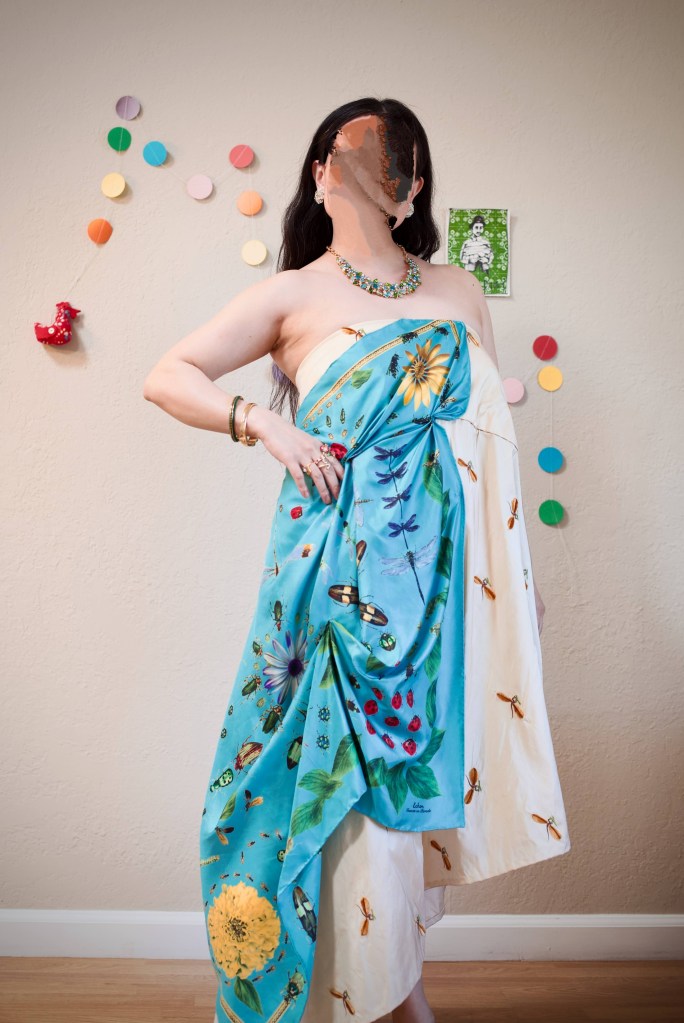
Being the first animals to colonize land, insects maintain the fabric of life on earth. They sustain a vast community of animals, microbes, fungi, and plants, who feed directly on the colonies and the waste they produce. Without them, life on earth would not exist as we know it. A silk rectangle embroidered with dragonfly motifs makes the base of this dress. Adorned atop is a silk square covered with many insect assemblies.
 hardlyplaying.blog