
“And why take ye thought for raiment?
Consider the lilies of the field, how they grow;
they toil not, neither do they spin.”
– Matthew 6:28
In his Sermon on the Mount, while speaking to his followers upon their anxiety about clothing, Jesus evoked the image of the flower lily. Particularly notable is his skillful word play – by using the verbs “toil” and “spin” to describe the flower as an analogy for spinning thread, a labor-intensive activity for making cloth.
Jesus’ words went on to inspire numerous works in art and literature. John Keats quoted them at the opening of his poem, Ode on Indolence:
“
‘They toil not, neither do they spin.’
One morn before me were three figures seen,
With bowèd necks, and joinèd hands, side-faced;
And one behind the other stepp’d serene,
In placid sandals, and in white robes graced;”
The three figures mentioned are perhaps a hark back to the three wise men who visited Jesus after his birth, bearing gifts of gold – a symbol of kingship and virtue, frankincense – of prayer and deity, and myrrh – of death and suffering. In his Ode on Indolence however, the three figures visiting Keats were revealed to be Love, Ambition, and Poetry.
The lilies mentioned were of the field, as in “of the wild”, as opposed to the garden variety. In Jesus’ days, it would have meant any flower. In present days, the lily family comprises hundreds of varieties, including lilium and tulip varieties. Additionally, plants known as “lily” account for another hundreds of varieties, including water lily varieties. Scientifically known as Nymphaea, it comes from the Greek word “numphé”, or nymph, the female spirit associated with forests, springs, and rivers. Legend had it that the flower was born from a nymph who died of love for Hercules. Thriving in shallow water, the water lily is of an ancient lineage predating those of most other flowering plants. Prized by the Egyptians since thousands of years ago, Egyptian wall reliefs show women enjoying the scent of water lily flowers. Of the two Egyptian favorites, the blue water lily opens in the morning and closes in the afternoon, while the white water lily opens in the evening and closes in the morning. Both actually come in a variety of hues.
More than a thousand years ago, the Maya peoples of Mesoamerica utilized water lilies to tell the cleanliness of their reservoirs, as the flower thrives where water is clean. Additionally, the lily pads’ bluish undersides restrict the passage of light, preventing build-up of algae, as well as evaporation. The plant also provides food and cover for dragonflies and fish, helping to control pests population. The association of clean water, water lilies, and royal power is amply illustrated in Maya iconography, being depicted on their stelae, monumental architecture, murals, and portable items.
But if there was one person obsessed with the water lily, it must be the Impressionist painter Claude Monet. For three decades, from the late 1890s until his death in 1926, he painted a Water Lilies series of almost 300 paintings of his water garden. Monet hired a head gardener and five assistants to maintain his gardens in Giverny. He was extremely demanding, insisting that faded blossoms be removed continually. One gardener was assigned the sole task of upkeeping the water garden, which required daily removal of all traces of weeds and debris, dusting the lily pads, and trimming them into shapely clusters. Upon the mirror-like surface of the pond, with his water lilies and the reflection of light and passing clouds, the artist could observe and capture the finest nuances of color affected by the subtle dances between light and shadow. And in that fleeting moment, he could render “instantaneity,” that from the same light spreading everywhere.
When Jesus was juxtaposing the flower to cloth making, one could infer that his words were meant for his female audience, as spinning thread had traditionally been women’s work. That the flower “neither toil nor spin, yet Solomon in all his glory was not arrayed like one of these,” must be opined by Solomon. Because the poet Emily Dickinson must have disagreed when she wrote:
“To be a Flower, is profound
Responsibility —”
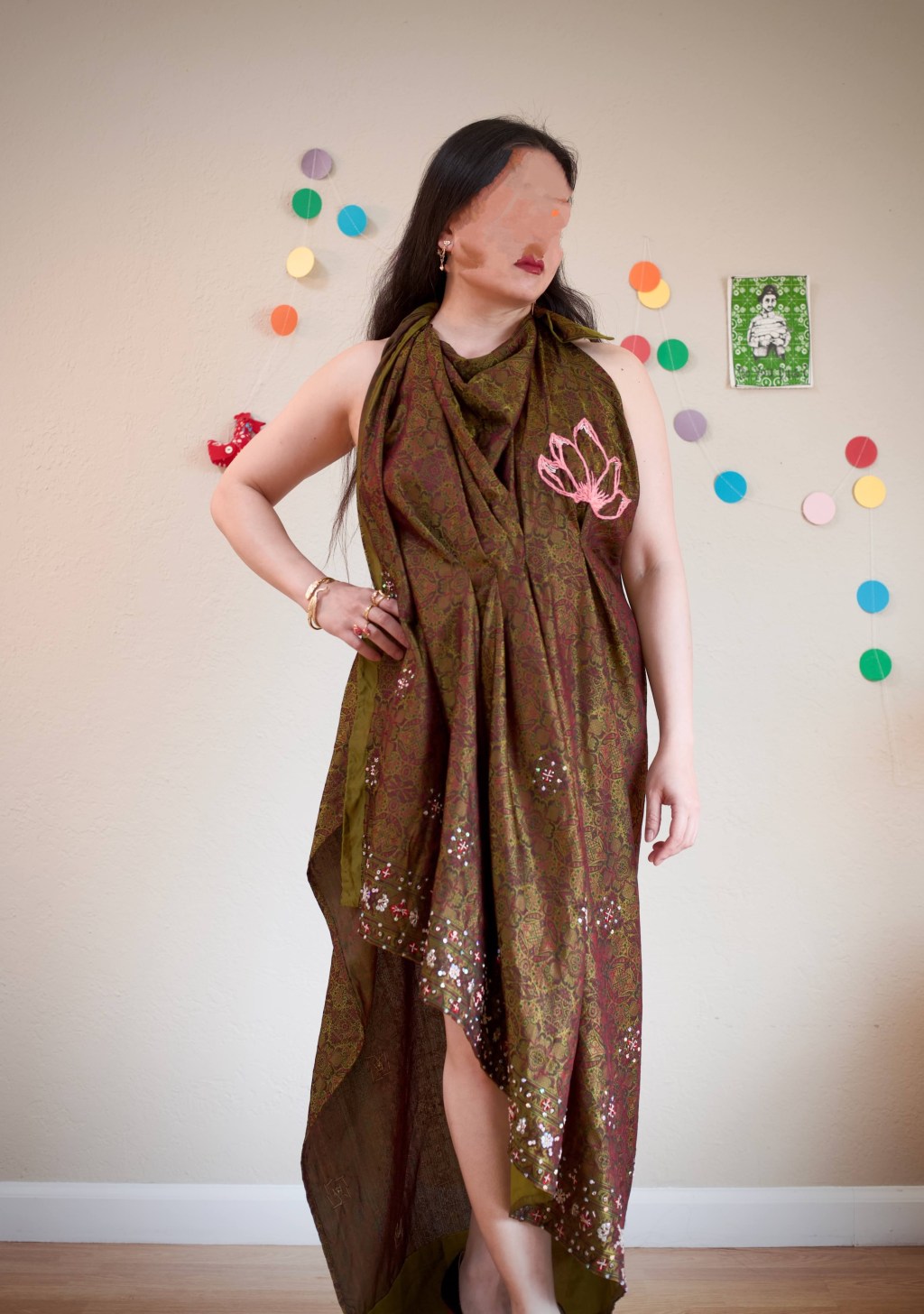
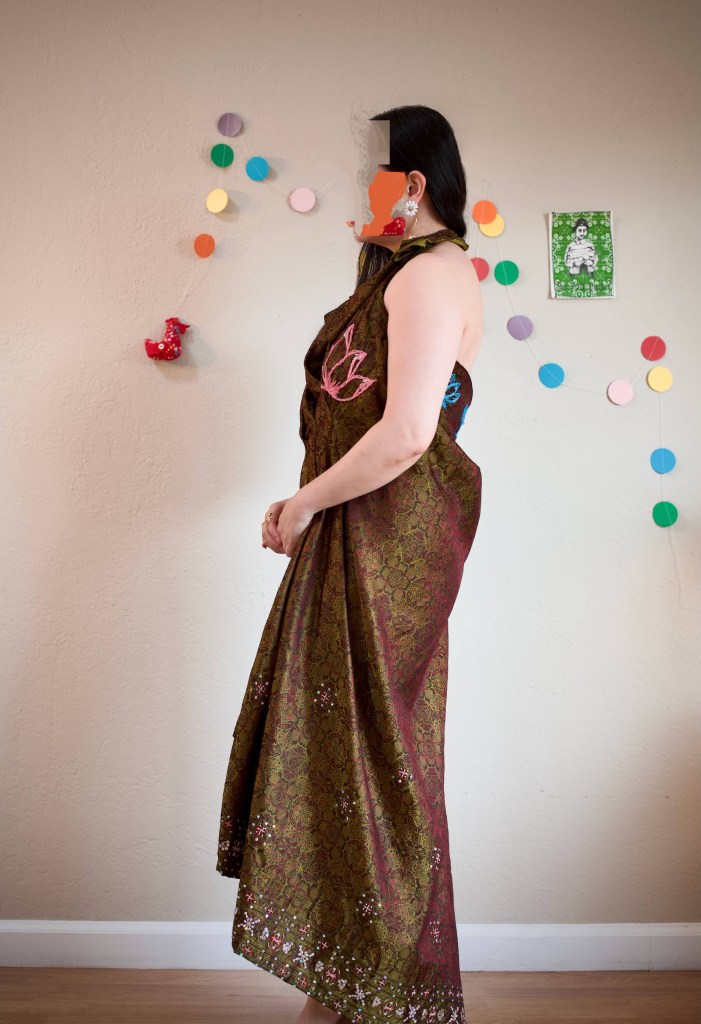
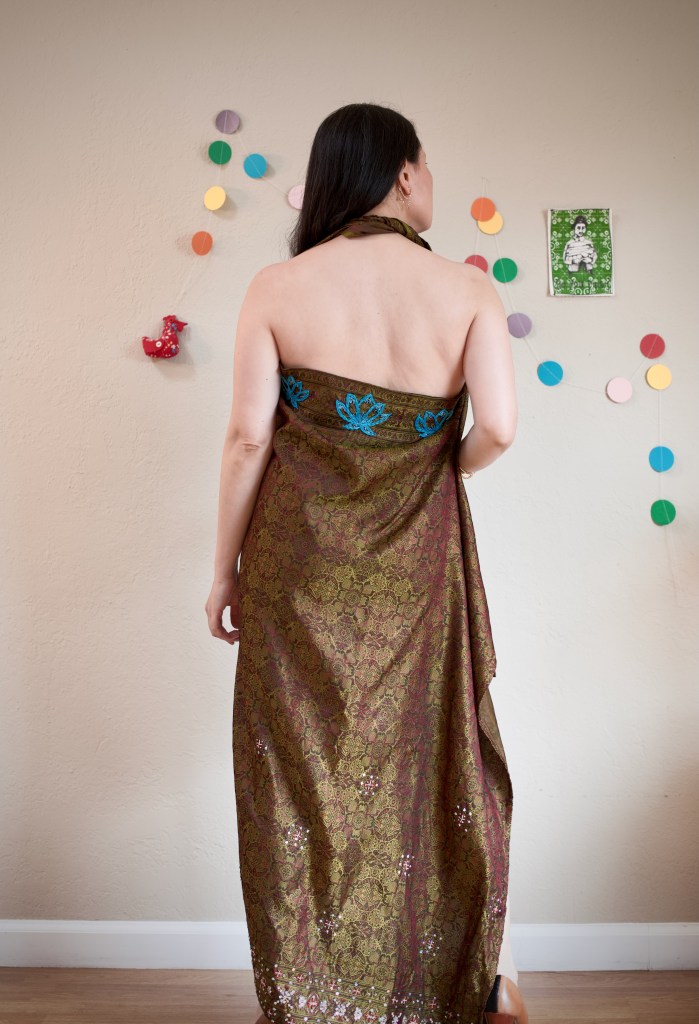
To her eyes, bloom is only what is seen, while all the effort behind the glory is concealed. It was not until the 20th century that we could figure out how flowers bloomed at all. And to my eyes, they are the poetry of life. For the water lily flower whose beauty is likened to royalty, I have crafted this dress in a deep green hue to represent the forest and springs and adorned it with pink and blue water lily embroidery motifs. The cloth for this dress comes from a vintage silk sari.
 hardlyplaying.blog