
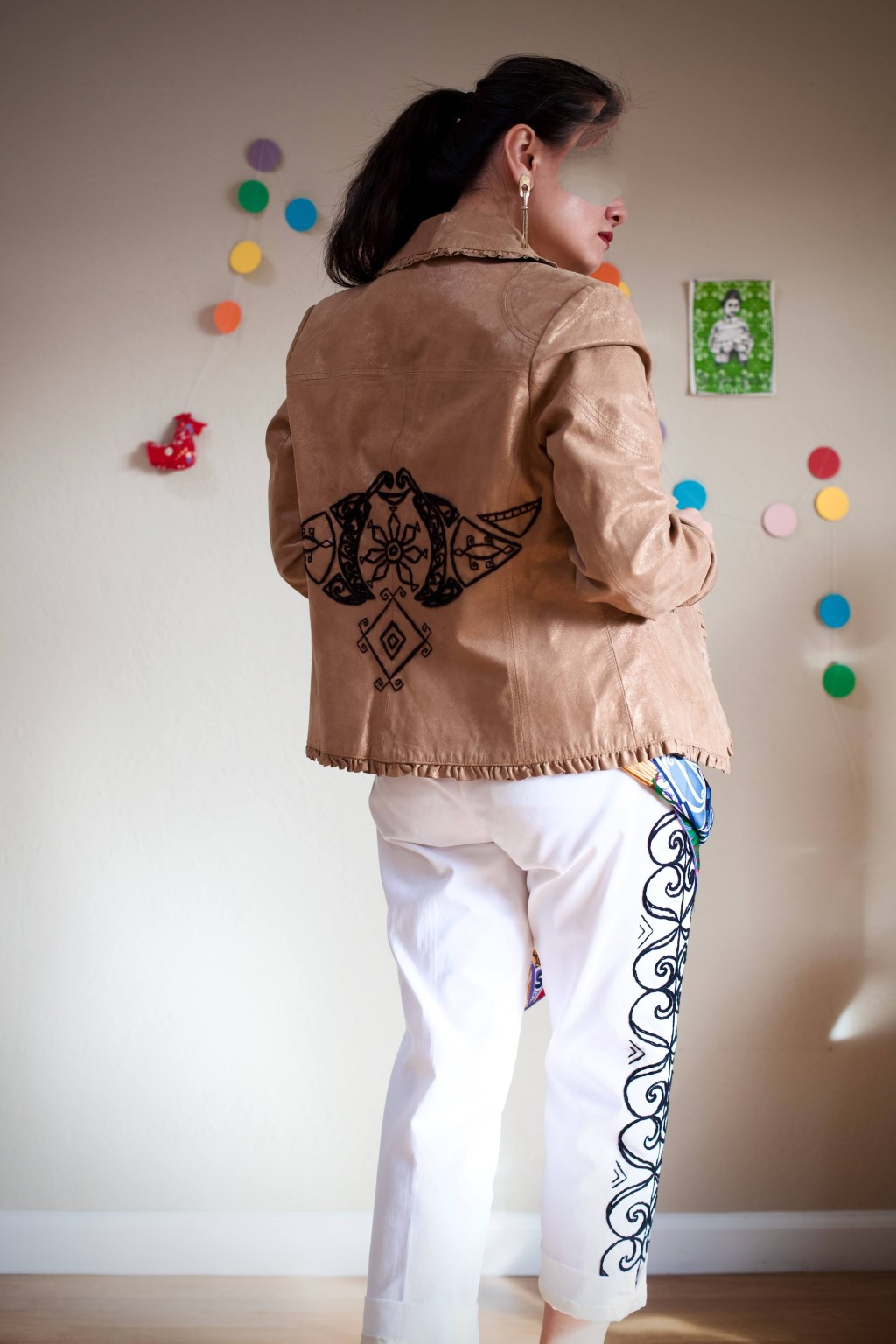
Blackwork is the term for impressing design patterns onto the skin with black, sometimes red, color pigments, including temporary dyes such as henna and tattooing dyes such as soot. Produced with combs, needles, and cutting tools, using techniques such as hand-tapped, hand-poked, skin-cut, and skin-stitched, numerous societies practice blackwork to express cultural identities, rituals, histories, and beliefs. Particularly for women, it has become a medium to convey beauty, womanhood, and desire.
Among the most popular usage of blackwork is to indicate transition into womanhood. In Micronesia, hand tattoos signify puberty; the design is then worked up to the forearms to indicate marriageability, and then the legs for maturity. Women tattoo the pubic area for their husband and the lower abdomen after giving birth to help prevent sagging. As only women could wear tattoos in Fiji, designs were created by women, who were referred to as the wise ones, the healer, and her counterpart as the expert tattooer. Lip tattoos were considered beautiful, so that men may desire to kiss them. To invoke the “Spirit of the Land Breeze” when sailing home, the Fijian navigators would chant:
“Come, Come, O Spirit from the ladies of the west;
O ladies with the black mouths [tattoos], give us a fair wind.”
In India, when a Baiga girl reached eight years of age, she received a “V” mark tattooed at the center of her forehead, at puberty – a peacock on the breast and turmeric root on the arm, and after marriage – flies, men, and magic chain on her back, a flower on her knee, and fish-bones on her legs. A Baiga man once said, “When she is well tattooed, then our sinful eyes declare her beautiful. A light-colored girl needs it; how lovely she looks when she wears bangles that match the line of tattooing!” When a Baiga woman was asked about the significance of her tattoos, she replied, “Desire! If you buy bangles, they will break. But if you are tattooed, it will last forever.” Another said they were like “a jacket that can never be taken off. These marks are the only things that are certain to go with us to the grave and beyond it.”
For the Ainu people of Japan, tattooing was also exclusive to females and was customarily performed by grandmothers or maternal aunts who were called “Tattoo Aunts”. As the skin was cut and blood wiped away with a cloth saturated in a hot ash wood, soot taken with the fingers from the bottom of a kettle was rubbed into the incisions, the tattooist would then sing a verse from an epic poem, “Even without it, she’s so beautiful. The tattoo around her lips, how brilliant it is. It can only be wondered at.” Ainu lip tattoos were believed to repel evil spirits from entering the body through the mouth, causing sickness or misfortune. They also indicated maturity and marriageability, and assured a place with her ancestors afterlife.
Apart from lip tattoos, Ainu women wore other tattoos on their arms and hands consisting of curvilinear and geometric designs. Certain motifs, such as the braid pattern, are also used in textile weaving structures. Their sacred garment, the upsor-kut, or the girdle, is composed of three, five, or seven plaited cords, woven with flax or hemp, closely resembling the tattoo motifs on their arms. Double-stranded braid-like brackets were embroidered around the neck, front openings, sleeves, and hem on the earliest Ainu salmon skin and elm bark garments to keep evil spirits from entering the body’s openings. These original designs were usually dark blue similar to the color of tattoo pigment.
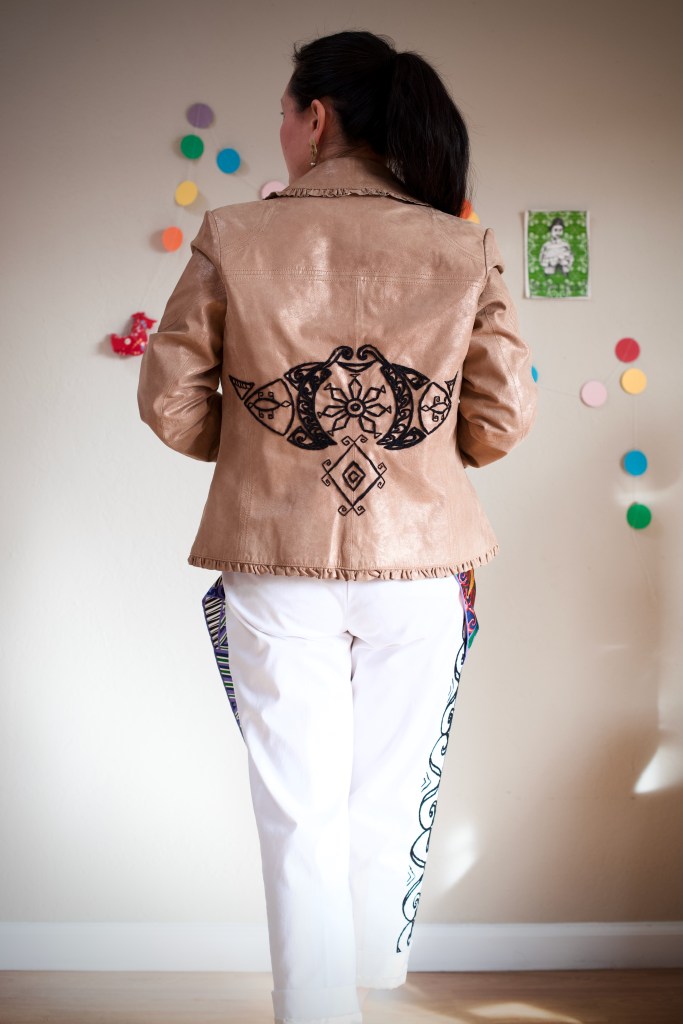
Inspired by Polynesian tattooing motifs, I have designed my own to embroider onto this vintage leather jacket. The grand motif is that of the stingray, an expression for freedom and elegance. At the center of the stingray is an emblem for the octopus, symbol of navigation and its tentacles for the eight directions. One among the eight is the lawig motif, which includes the morning star as a way-finding star. Circling the octopus are water waves, embodying the sea. At the wings are turtle and seashell motifs, indicating protection. The overall design represents the adventure to discover new lands, a metaphor for the adventure to find new ideas and novelty.
Bibliography
https://larskrutak.com
 hardlyplaying.blog