
Tattoos have been practiced for millennia across the world as a form of cultural and historical record. In ancient Egypt and Nubia, women tattooed on their thighs the image of Bes, a deity associated with fertility and childbirth. For the Ainu people of Japan, the tattoo was a symbol of beauty, a talisman, and an indispensable tool to prepare their body for after death. For the Indigenous North Americans, it was a form of identity, connecting the person to their tribe.
Yet historically, tattoos have also been considered a taboo. “Ye shall not make any cuttings in your flesh for the dead, nor print any marks upon you,” reads the Old Testament Book of Leviticus. It is seen as an insult to God’s creation in Christianity and also forbidden for many Suni Muslims. In ancient China, tattoos were considered a barbaric practice associated with the Yue people who resided in present-day southern China and northern Việt Nam. They were seafarers known for their body tattoos and fine swords. In ancient Greece and Rome, it was a form of identity for slaves, criminals, and prisoners of war. This practice has continued into modern times and is still used to identify gangs and mafias today.
The word tattoo, originated from the Polynesian word “tatu”, entered Europe with the publication of Captain Cook’s voyages in the 1770’s. It means drawing, and may represent a doubling of the verb root “ta”, meaning to strike or make a cut. Tattoo practices of the Austronesian peoples are among the most impressive and well known worldwide, helping to repel taboo, another word of Polynesian origin introduced into English by Captain Cook, and bring it into popular culture. It is theorized that Austronesian peoples, including Filipinos, Indonesians, and Polynesians, all originated from Taiwan. That all of them have strong tattoo traditions, along with the striking correlation between Austronesian languages and the use of the hand-tapping tattooing method, suggests that Austronesian peoples inherited their tattooing traditions from their ancestors established in Taiwan and mainland China’s southern coast.
Oceanic peoples flaunt spectacular tattoos. Samoans are known for buttocks designs; Tahitians tattoo curved lines on their thighs, stars or circles on their chests and arms; Maoris chisel their faces with deep swirling incisions. Getting tattoos is a ceremonial event as important as birth and death. Nicholas Thomas, a specialist in Oceanic art, emphasized the teeming nature of tattoos in Marquesans, where a “fear of the void” invades the skin. “The most striking feature of Marquesan tattooing is the sheer multiplication and density of designs. Marquesan men were warriors, and the elaboration of tattoos acted as a shield: given the movement of the body, and the structured but unstable organization of motifs, the warrior invests himself with a form of visual armor that distracts and ideally disorients his opponents.” Being tattooed is to modify the appearance of the skin, wrapping the body in a new, artificial skin. In their symbolic nature, tattoo images protect parts of the body seen as unstable and taboo, for example: a series of eyes with evil-averting properties or the turtles as a shell-protected animal. In Samoa, the final tattoo to be applied to the body covers the navel, seen as to consummate the closure or armature of the body, and replaces the physical trace of natural birth. The Maoris of New Zealand elevate skin decoration to the status of masterpiece. Men are adorned from waist to knee, women on lips and chin. The pattern of skillful, complex lines reveal a person’s intrinsic identity. For example, facial designs indicate lineage, social position, and status within the tribe. As late as the 19th century, these designs were still used as signatures for documentation purposes.*
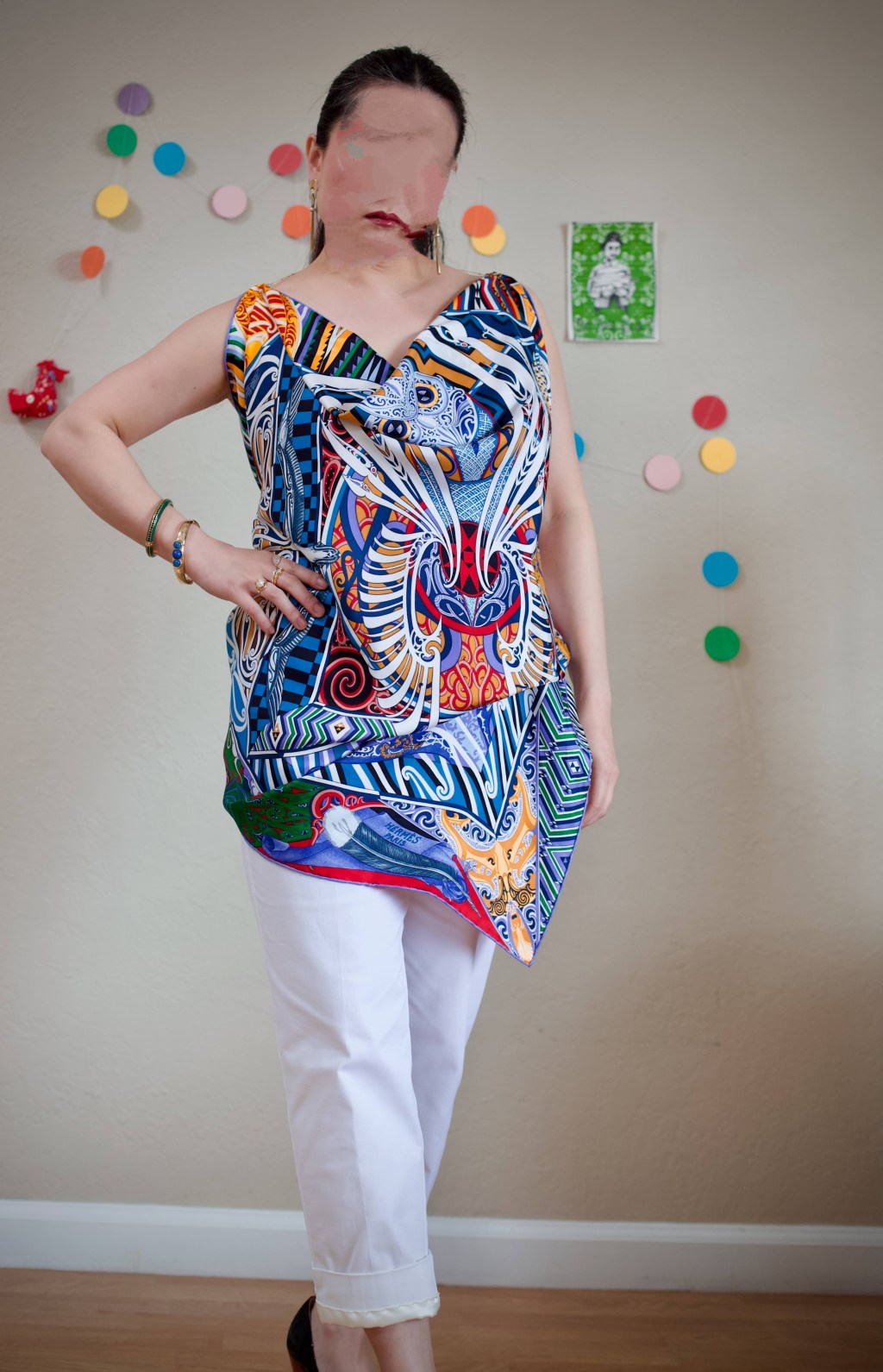
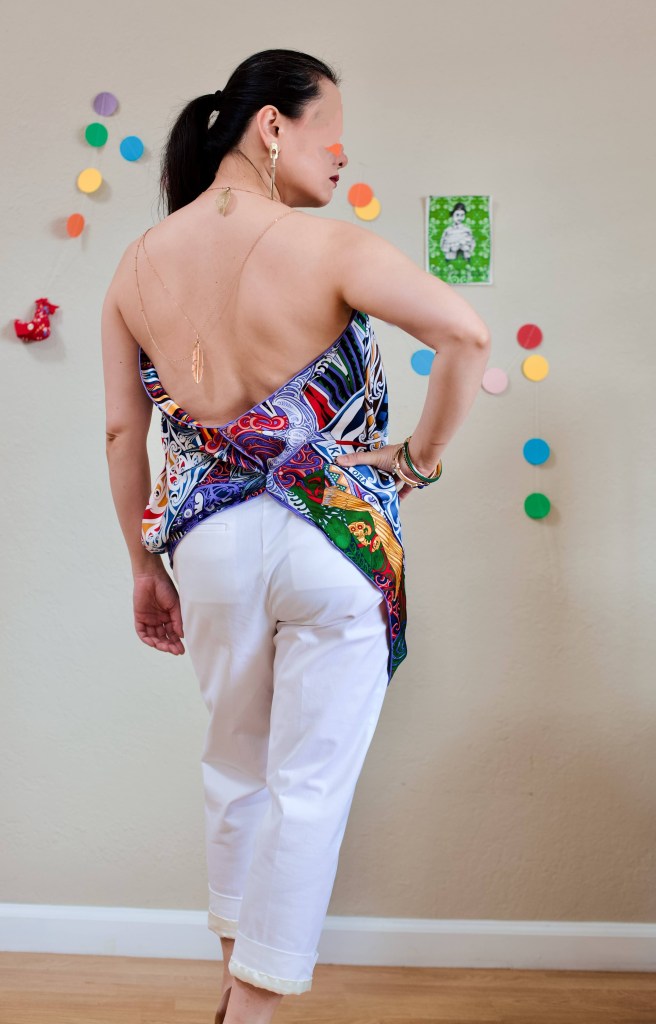
Identity aside, tattoo designs also include cultural artifacts, such as the one on this silk scarf, titled Kawa Ora, meaning a house opening karakia, which is the most important ceremony imbuing life into a new house. Karakia is a ceremonial custom with ritual chants for the opening of new houses. The Maori tattoo artist Te Rangitu Netana took inspiration from his culture to design the scarf: an owl, the messenger between the material and spiritual worlds, rises above the four walls that make the house of the tribe’s meeting place. The north wall represents the stairway of knowledge and a connection to the universe. The south wall represents creation and water, with rain filling the oceans. The east wall depicts light and the giant eagle on whose back the Maori have journeyed. The albatross tears portrayed on the west wall symbolize the suffering of the Maori people. The central circle represents a giant octopus, symbol of navigation, and its tentacles, the eight directions of the Maori compass, in a spirited crossing of cultures.
*Bérénice Geoffroy-Schneiter, Ethnic Style.
 hardlyplaying.blog