
“Who can find a good woman?
She is precious beyond all things.”
Prov. 31:10
A masterpiece of the world’s heritage, the Taj Mahal is considered the greatest achievement of Indo-Islamic architecture. Its rhythmic architectural combination of solids and voids, concave and complex, light and shadow is perfectly symmetrical and harmonious. Its elements of lush green scape, marble, red sandstone, and inlaid jewels showcase its ever changing tints and moods. The Taj glows pink at dawn, milky white at dusk, and sparkles at night when its jewels reflect the moonlight with a better gleam. So exquisite is the workmanship that it has been described as “designed by giants and finished by jewellers”. Built in 1631 by the fifth Mughal Emperor, Shah Jahan, it was a monument to his wife Mumtaz Mahal. The English poet, Sir Edwin Arnold, wrote of the Taj, “Not a piece of architecture, as other buildings are, but the proud passions of an emperor’s love wrought in living stones.”
Mumtaz came from a noble family of Persian origin. Her grandfather had immigrated into India impoverished, but improved their fortune from employment by the third Mughal Emperor Akbar the Great. She was described as modest, candid, straightforward, yet bemusedly self-possessed. She was well-versed in Arabic and could compose poetry in Persian. Even during her lifetime, poets would extol her beauty, grace, and compassion. Her husband, the Emperor Shah Jahan, found her “in appearance and character elect among all the women of the time,” and gave her the title Mumtaz Mahal, meaning the exalted one of the Palace. Mumtaz was portrayed as having no aspirations to political power, in contrast to her aunt, the Empress Nur Jahan, the chief consort of Emperor Jahangir, who had wielded enormous power in the previous reign. However, that the Emperor placed complete trust in her gave her great influence, and she served as his close confidant and trusted adviser, accompanying him on his military campaigns. Historians went to unheard length to document their intimate and erotic relationship.
Mumtaz Mahal died while giving birth to their 13th child. Similarly court historians chronicled Shah Jahan’s grief at her demise at length. The emperor was reportedly inconsolable. He went into secluded mourning for a year. He gave up listening to music and wearing jewellery and perfumes for two years. When he appeared again, his hair had turned white, his back bent, and his face worn. Legend had it that in his final years, Shah Jahan would stare at the Taj while lying on his bed through a diamond fixed in the wall of the Agra Fort. He was laid to rest beside Mumtaz, his casket being the only asymmetrical object in the Taj.
While brides have traditionally brought dowries as offers of marriage, in rare instances, she leaves a fortune for her tribe. Such is the story of Princess Huyền Trân, daughter to Trần Nhân Tông, the third Emperor of the Trần Dynasty of An Nam, now Việt Nam.
In 1279, the Yuan Dynasty had won a decisive victory over the Song Dynasty in the Battle of Yamen. As Kublai Khan took complete control of China, the fifth Khagan-Emperor of the Mongol Empire was now eyeing to expand southward, to the territories of An Nam and Champa. Having battled the first Mongol invasion 27 years before, the Trần saw the need to form alliance with Champa and sent troops and ships to aid Champa’s war against the Mongol in 1283. After victories against the second and third Mongol invasion into An Nam, Trần Nhân Tông passed the throne to his son, instead turning his life toward Buddhism. Having founded a monastery and being ordained as a monk, he travelled across the country to spread Buddhist teaching and then went on a long expedition to Champa, a Hindu nation at the time. It was here that he promised his daughter Huyền Trân to King Jaya Simhavarman III of Champa.
No one knew why he did it, particularly in lieu of recent victories against Mongol invasions. The historian Ngô Sĩ Liên wrote in The Complete Annals of An Nam, “In the past, Liu Shi, because the Xiongnu had repeatedly caused suffering on the frontier, took a commoner’s daughter as a princess and married her to the Chanyu. Confucian scholars had criticized marriage of different races, but if the intention was to bring peace to the people, it could still be explained. Liu Shi, because Huhanye Chanyu came to pay his respects and asked to be the son-in-law of the Han, gave him Wang Qiang; so it is at least explainable. As for Nhân Tông, what was his reason for marrying his daughter to the Lord of Champa?” The next spring, the King of Champa sent a delegation carrying gifts to ask for the princess’ hands, but the court disapproved of the marriage. Then in 1305, intending to depose Queen Tapasi for poisoning his 17th concubine’s son, the king offered An Nam two provinces Vuyar and Ulik, today from Quảng Trị to Thừa Thiên-Huế, in exchange for the princess.
In June of 1306, Princess Huyền Trân wedded the king and was crowned Queen Paramecvari. She was determined to learn Cham language and customs. She studied Cham music and founded a female musical and dance company to improve understanding and respect between the two cultures. History records that “The princess was as wise as a scholar.” The king commented, “My beautiful white camellia, you both surprise and move me.” He took her to visit the ancient capital of Champa and invited her to attend court. However, the king died the next year, just after she gave birth to their son. A delegation from An Nam attended the king’s funeral and took the queen with them. She left without her son by the sea route. It would take them a year to return home. It was recorded that they feared the queen would be burned along with the king following Hindu’s sati custom. Historians have since disputed this claim, because she was his third wife, and not his first.
If the court did not follow Nhân Tông’s decision, Huyền Trân clearly understood her father’s intention. Historically, the two nations frequently engaged in conflicts. But seeing the ambition and power of the Great Yuan, the emperor must have anticipated an already weakened Champa at risk of surrendering to China, which, if realized, would become an intolerable risk for An Nam. He thus saw the need for the two nations to join forces to stand against the greater enemy. Unfortunately the final events of this saga worsened their relationship. The two nations continued to battle each other. The Kingdom of Champa went into decline and ceded all of their land to Việt Nam by the early 19th century. That Việt Nam today has doubled its territories all began with the marriage exchange of princess Huyền Trân.
And what became of princess Huyền Trân? -following her father’s will, she became a nun. She received the Bodhisattva precepts and was given the dharma name Hương Tràng. At her death in 1340, her monastery became Hổ Sơn Temple. The yearly festival to honor her is held at Huyền Trân Temple on Ngũ Phong Mountain in the City of Huế.
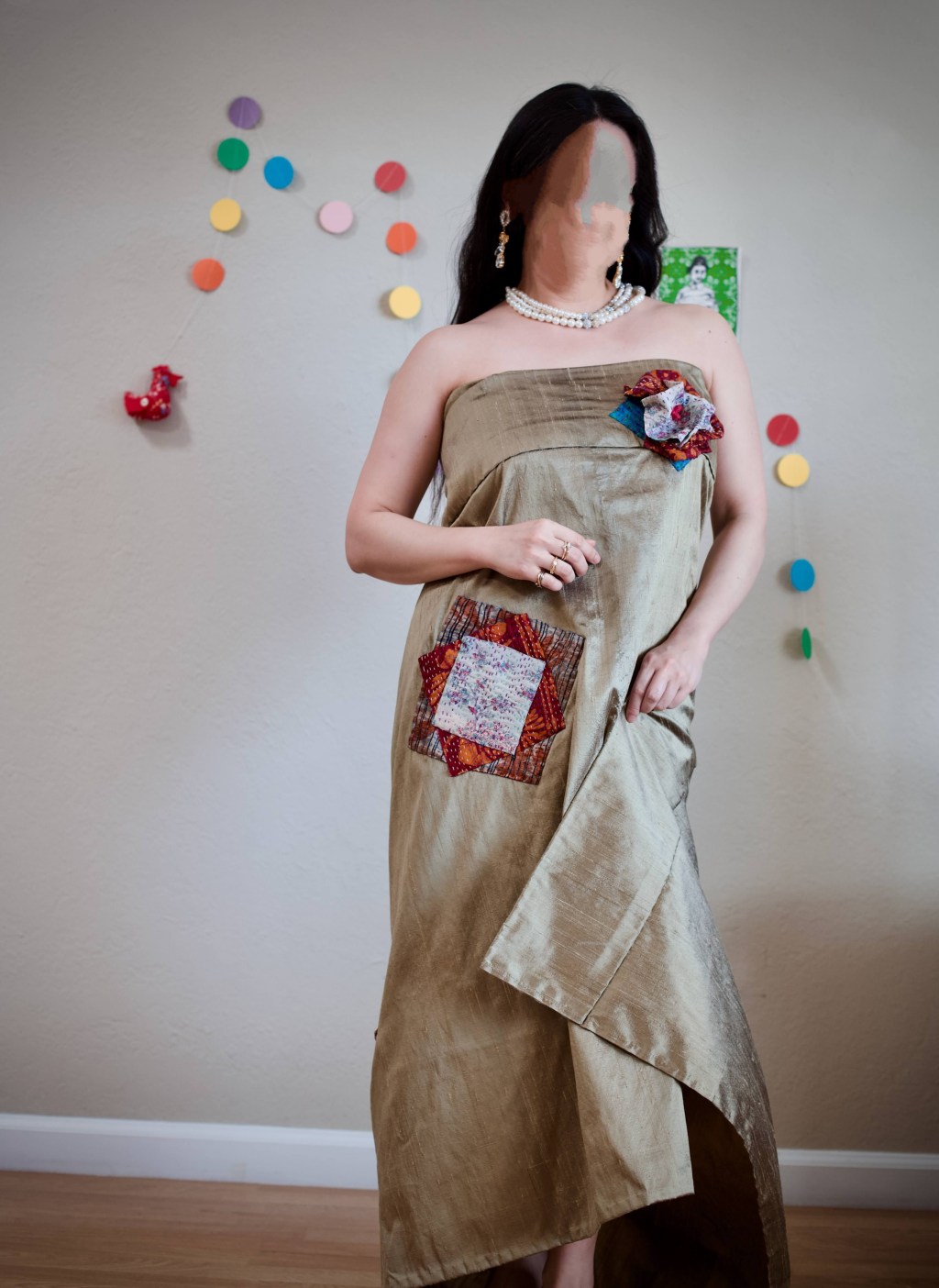
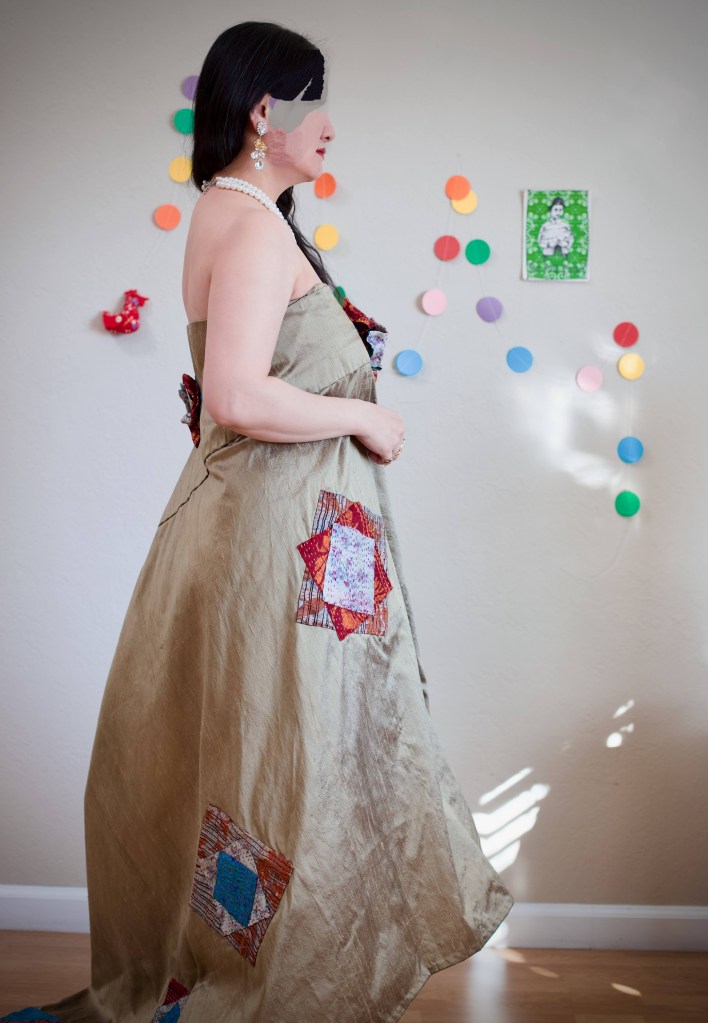
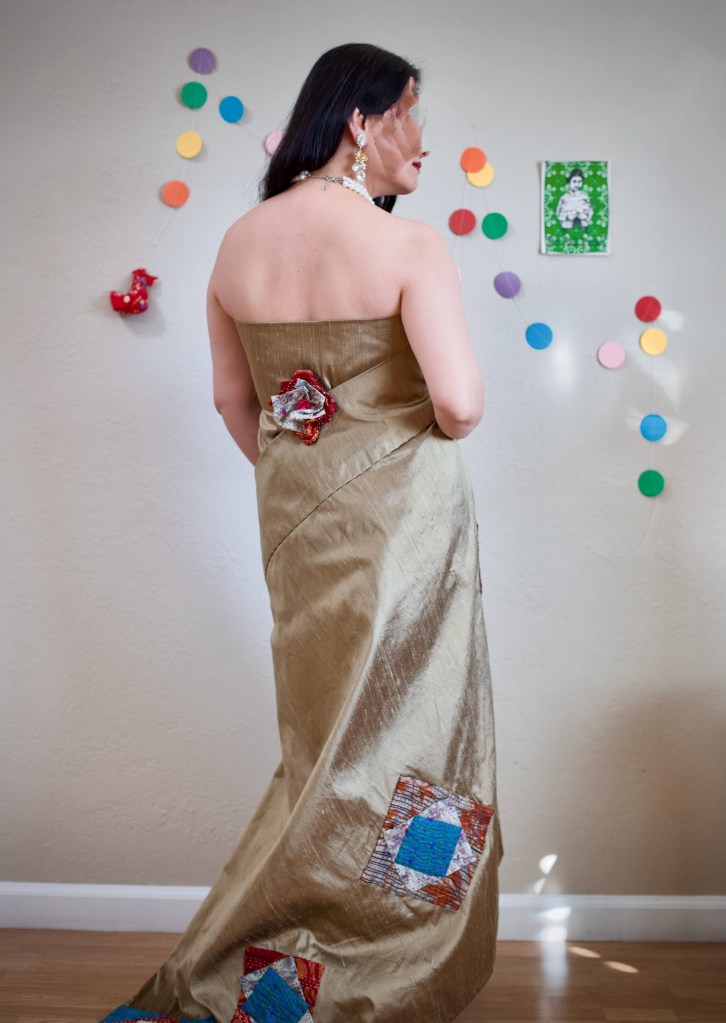
To celebrate the black gold bride, whose characters outshine her wealth, her power, or her fame, this bridal gown is molded from a silk rectangle in black gold hue, adorned with vintage kantha silk patchworks. Her story is never as simple as it may appear. History is written by victorious men, but who knows – one day in a distant future, someone may dig it all up and be fascinated that it happened at all.
 hardlyplaying.blog