
The flower garden bedazzles in springtime. First come snowdrops and daffodils in sparkling white and bright yellow. Then come a profusion of cherry blossoms and tulips in every brilliant hue. Finally Lady Banks’ roses arrive in thousands upon thousands of tiny bouquets, dangling like delicate wind-chimes. All is a gorgeous feast for the eyes, especially after a cold dreary winter. As if magically, they synchronize their timing to know exactly when to bloom throughout the season. Indeed it is for this evolutionary feature that the flowers are able to survive and thrive together. How do they do it?
It was not until the early 20th century that scientists could gain insights into how plants flowered at different times during the year. While some believed that plants could sense temperature, others claimed that they could sense day length. The correct answer turns out to be the latter. Like animals, plants use an internal time-keeping mechanism known as the circadian clock to detect changes in day length. The circadian clock regulates the timing of the specific photoreceptor for flowering. When the photoreceptor protein is expressed, it activates the “Flowering Locus T” protein in their leaves that induces flowering. And very recently, scientists finally discovered that it starts in the gene. The gene determining when flowering occurs is a type of messenger RNA (mRNA), which controls the formation of these proteins.
Even though humans have adored colorful flowers for as long as we have known beauty, they do not bloom for us. In the flowering plant, the flower is its reproductive organ, and the colors they reflect is their way to advertise food to birds and insects, who pollinate them. Their color pigments absorb a specific wavelength of light. The colors perceived are what is reflected. For example, carotenoids are pigments imparting color to carrots, tomatoes, and sunflowers. Reds, purples, blues, and pinks are the result of anthocyanins, a class of flavonoids. But the spectrum of colors that flowers reflect is much more than our eyes can see. For example, bee’s purple is a combination of yellow and ultraviolet light, which we can’t see. Meanwhile, butterflies have 2 large compound eyes composed of about 12000 lenses, as compared to humans with only 2 lenses, one in each eye. We have 3 color photoreceptors, while they have between 6 to 15. They see the world in millions of colors made up of ultraviolet, violet, blue, green, and red.
Going beyond color reflection, flowers have even developed complex mechanisms of display to attract specific species of birds and insects. For example, hummingbird-pollinated flowers, who evolved from bee-pollinated ancestors, have developed a strategy to encourage bees to look elsewhere for nectar rewards. While bees see purple very well, they don’t see red at all. Consequently, bee’s flower varieties tend to be upright and have blue or purple coloration, while hummingbird’s flower varieties have a horizontal orientation and red or orange coloration. Above all, orchids are the pollination masterminds. Some can mimic other flowering plants, and certain varieties, such as fly orchid, bee orchid, and spider orchid, can mimic the insects themselves. The resemblance is so close that the males visit the flower in an attempt to copulate. Once they realize the false female, they move on, carrying the pollen along to the next flower.
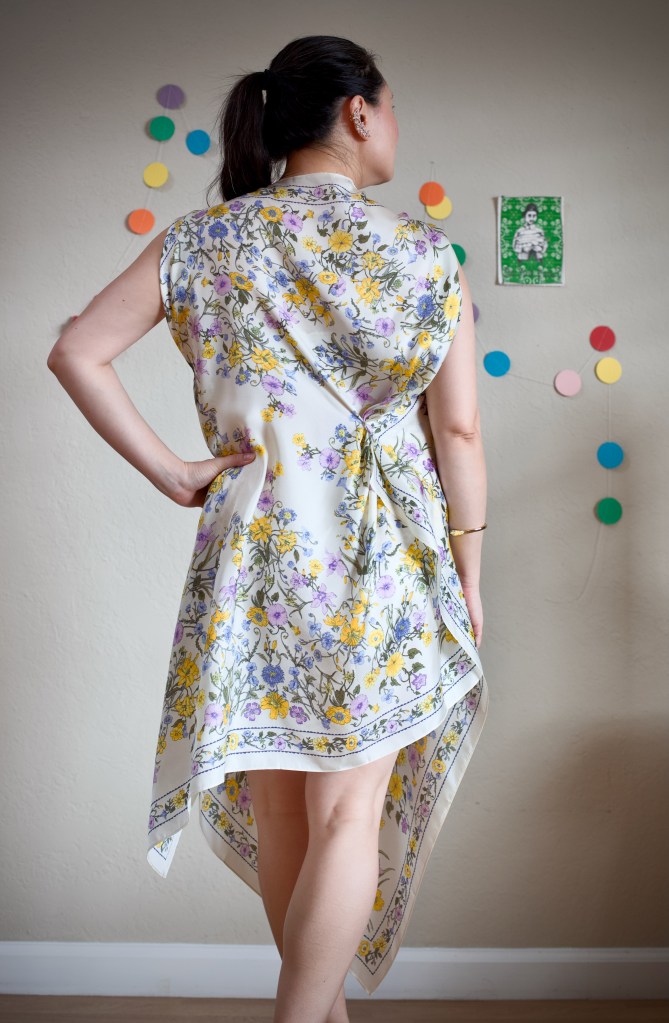
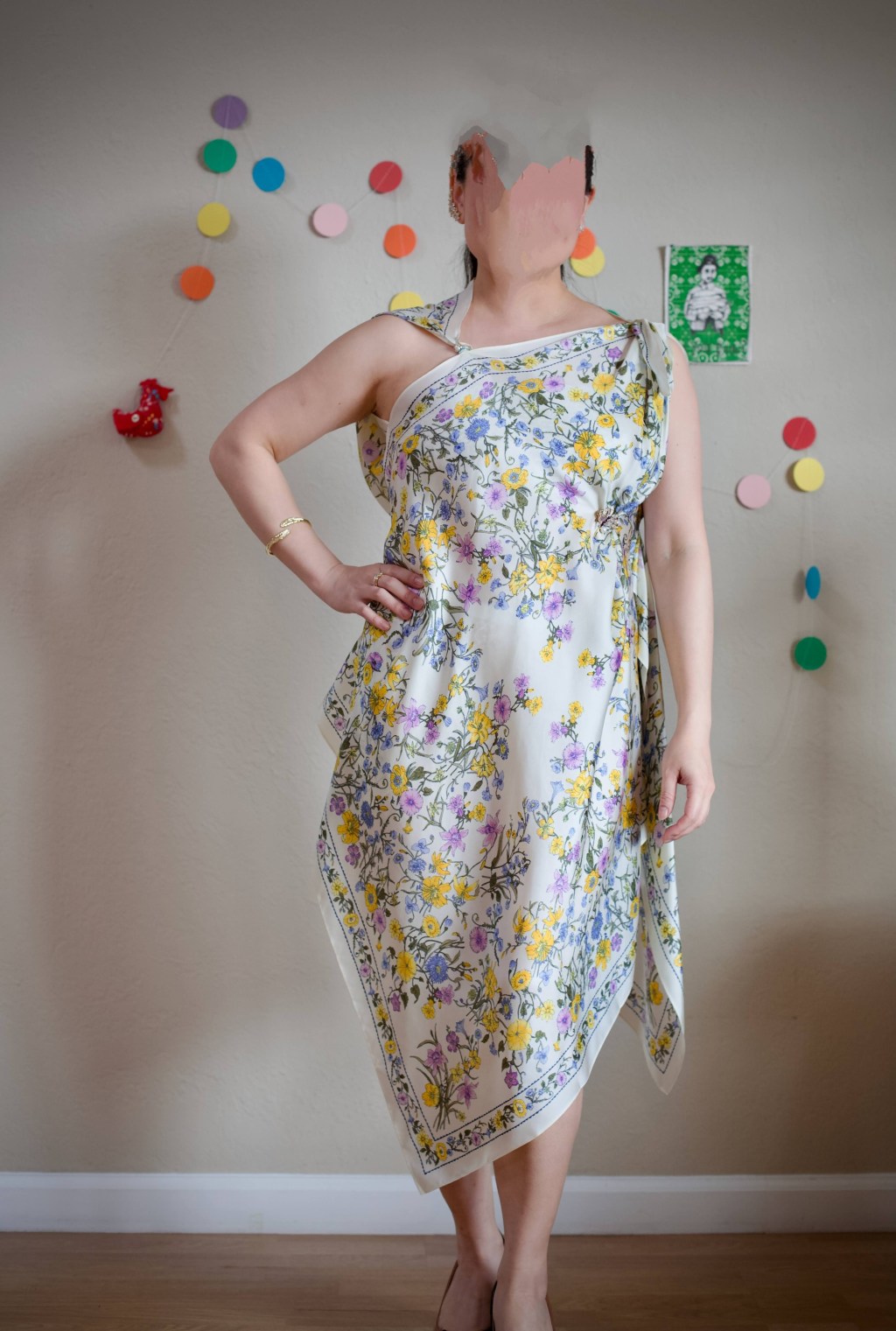
As flowers have not evolved to bloom for us, humans have not evolved to need them to survive. Yet, what is life without flowers? In Dead Poets Society, John Keating said, “We don’t read and write poetry because it’s cute. We read and write poetry because we are members of the human race. And the human race is filled with passion. And medicine, law, business, engineering, these are noble pursuits and necessary to sustain life. But poetry, beauty, romance, love, these are what we stay alive for.” So it is flowers who are the poetry of life. Inspired by the bloom of spring, this dress is molded from two silk squares, printed with flowers of purple and yellow hues. The scarves are made from fine silk, adorning an effortless and ethereal feel and look.
 hardlyplaying.blog