In 1898, the literary critic Hermann Bahr wrote in the journal Sacred Spring, “Our art is not a combat of modern artists against those of the past, but the promotion of the arts against the peddlers who pose as artists and who have a commercial interest in not letting art bloom. The choice between commerce and art is the issue at stake in our Secession. It is not a debate over aesthetics, but a confrontation between two different spiritual states.” It was a declaration for the new art movement, the Vienna Secession, led by the painter Gustav Klimt, to challenge the artistic establishment’s imposingly academic mindset, restrictive exhibition policies, and old-fashioned presentation methods.
The success of the Vienna Secession was spectacular. By the end of 1898, a gleaming white building, located near the central Karlsplatz, was erected for the association. It was celebrated as a truly modern structure with its simplicity and adaptability, announcing a resolute departure from pre-classical architecture, and with its entrance enshrined the Secession’s motto, “To every age its art, to art its freedom.” The art critic Ludwig Hevesi observed, “The arrangement of the exhibition..is in itself already a work of art in the modern taste”, referencing the stark contrast to the traditional exhibition of heavy draperies, floral arrangements, dark walls, and dimly lit spaces.

The decade following the founding of the Secession saw the transformation and invention of Klimt as we know him today – from a skilful academic painter to a protagonist of one of the most avant-garde movements in Europe at the turn of the century. In this period of extraordinary creativity, Klimt created some of his most significant and stunning works, from the groundbreaking treatment of a classical subject matter such as the Pallas Athene to the height of ornamental opulence in The Kiss, one of the world’s most recognized artworks today. Not only did his style revolutionize into a sumptuous and erotic Art Nouveau style, he also became a leading advocate for the concept of “total work of art” to integrate all arts into a unified whole under architecture. Considered the most significant achievement of the artistic revolution in Vienna around 1900, it was a time when architects, designers and makers, poets and musicians collaborated to create an artistic whole, reflecting a longing for universal harmony beyond the individual. In the “Beethoven Exhibition” of 1902, the architect Josef Hoffmann designed the architectural layout and framework, including the staging of Klimt’s Beethoven Frieze, which represented the artist’s interpretation of Beethoven’s Ninth Symphony. The Frieze’s success, with its transformation of ordered ornaments into abstraction, would lead Klimt into his next artistic evolution to create a series of rich and opulent paintings.
The artist’s visits to Ravenna, Italy, in 1903, where churches were bedecked with gleaming Byzantine mosaics, inspired his golden artworks at the height of his “Golden Period”, some being intensely ornate with the female figure standing at the center, such as The Kiss. The erotic yet profoundly tender artwork uses the artist’s signature gold-leaf motif to dazzling effect. It was sold to the Austrian government on the first day of exhibition for an exorbitant sum at the time. Danaë, done in the same time period, pushed the erotic expression even further, depicting the myth of Zeus impregnating the unclothed Danaë in the form of golden rain. In this work, she is curled in a royal purple veil, harking to her imperial lineage. Some time after her celestial visitation she gave birth to a son, Perseus, who slayed the Gorgon Medusa and rescued Andromeda.
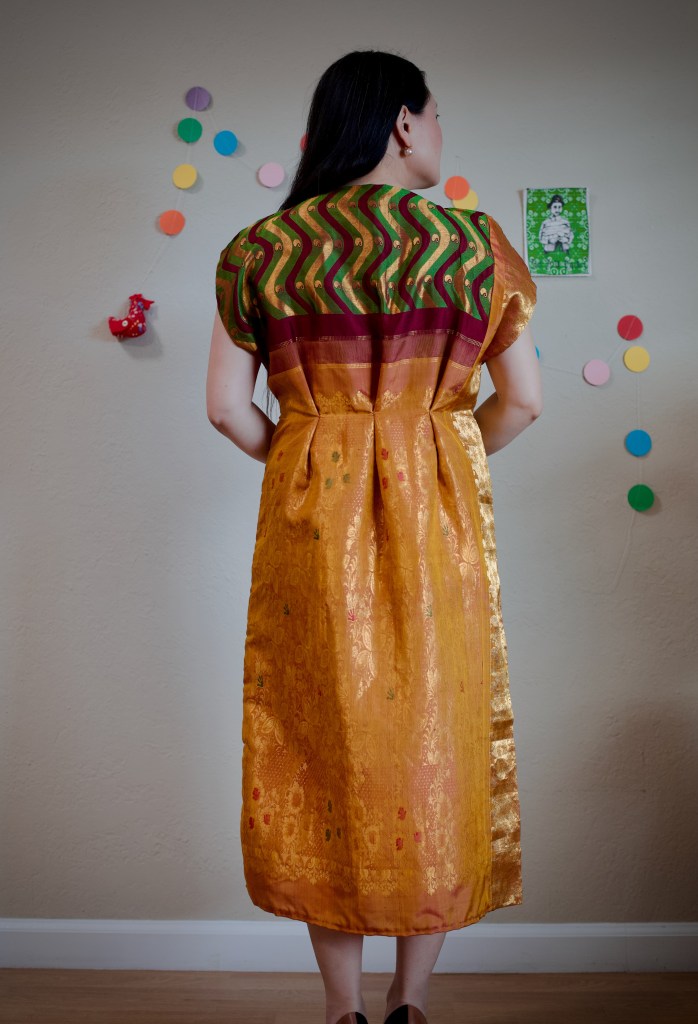
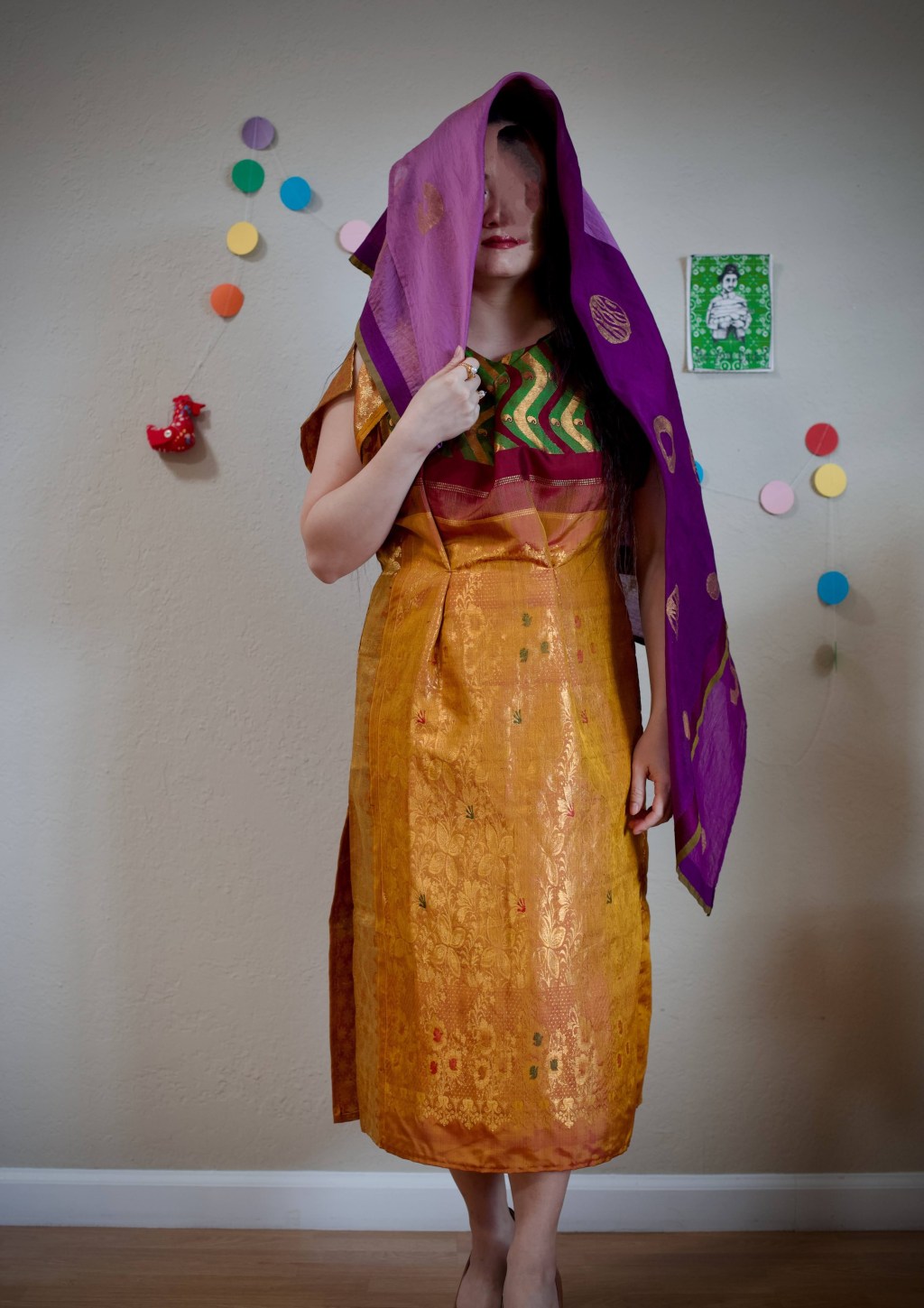
With the impending Great War of 1914, the Vienna Secession came to an end, but the artist and the movement’s triumph are historically sealed as the founder to the most significant period in 20th-century Austrian art. His work is forever an inspiration for their richness, tenderness, and thought-provoking concepts. Inspired by Gustav Klimt’s golden art, this dress is molded from two rectangles woven with golden zari threads on silk cloth, which come from a vintage sari. To accompany the dress is the head scarf, which is hand painted with a motif inspired by Danaë’s purple veil.
 hardlyplaying.blog