
“And the serpent said unto the woman, Ye shall not surely die:
For God doth know that in the day ye eat thereof, then your eyes shall be opened, and ye shall be as gods, knowing good and evil.”
Genesis 3:4-5
Thus Eve eats the fruit of the Tree of the Knowledge of Good and Evil, and gives some to Adam to eat too. They’re then banished from the Garden of Eden, and the serpent is cursed above all cattle and above every beast of the field, to go on its belly and to eat dust all the days of its life. A traditional interpretation of this passage goes that the serpent is the personification of the Devil, tempting Eve to commit sin. However, the Bible, like other classic texts of the world, is of layers and depths. It is open to multiple interpretations for multiple audiences, keeping abreast to the current of time.
The snake appears in mythologies and legends across cultures, representing diverse beliefs and opinions toward the animal itself. In ancient African and Near East civilizations, the snake is worshiped as a protection emblem, but also as a potent helper into the next world. Legend has it that Cleopatra took her own life with the bite of an Egyptian cobra. In the Far East, the snake is the sixth of the twelve-year cycle of animals in the Chinese zodiac. The animal is considered smart and cunning. Sun Tzu, in The Art of War, wrote, “The skillful tactician may be likened to the shuai-jan. Now the shuai-jan is a snake that is found in the Ch’ang mountains. Strike at its head, and you will be attacked by its tail; strike at its tail, and you will be attacked by its head; strike at its middle, and you will be attacked by head and tail both.” In Antoine de Saint-Exupery’s The Little Prince, the snake was the first one to greet the little prince on earth and the one to help him return to the star. It speaks in riddles all the time because it solves them all. The snake can thus be understood as the personification of God.
But the most enduring symbol of the snake into modern times is that of medicine. It is depicted to be coiling the Rod of Asclepius, a Greek deity associated with healing and medicine. The snake’s ability to shed and renew its skin is seen as a symbol of renewal and rejuvenation, and its venom a symbol of the double-edged sword – the dual nature of the work of the apothecary physician who deals with life and death, sickness and health. Hippocrates of Kos, considered the father of Western medicine, was believed to be a direct descendant of Aesculapius. The Hippocratic Oath goes thus: “I swear by Apollo Physician and Asclepius and Hygieia and Panaceia and all the gods and goddesses, making them my witnesses, that I will fulfill according to my ability and judgment this oath and this covenant.” Today the Rod of Asclepius is the emblem of medical organizations across the world, including the World Health Organization. Yet in the history of civilization, harvesting and turning wild plants into food and medicine is almost everywhere a female activity. If it was Eve who desired the fruit of the Knowledge of Good and Evil, who listened to the serpent, then it would explain why the witch is depicted historically as a woman who brewed potions to perform magic, who could heal sickness and bring health.
Eve ate the fruit because she desired knowledge of Good and Evil. Eve and Adam were thus casted down to earth, because to stay in heaven would be to remain innocent and blind. The price for knowledge and wisdom is the journey into darkness. Lao Tzu, in Tao Te Ching, wrote:
“The tao that can be told
is not the eternal Tao.
The name that can be named
is not the eternal Name.
The unnamable is the eternally real.
Naming is the origin
of all particular things.
Free from desire, you realize the mystery.
Caught in desire, you see only the manifestations.
Yet mystery and manifestations
arise from the same source.
This source is called darkness.
Darkness within darkness.
The gateway to all understanding.”*
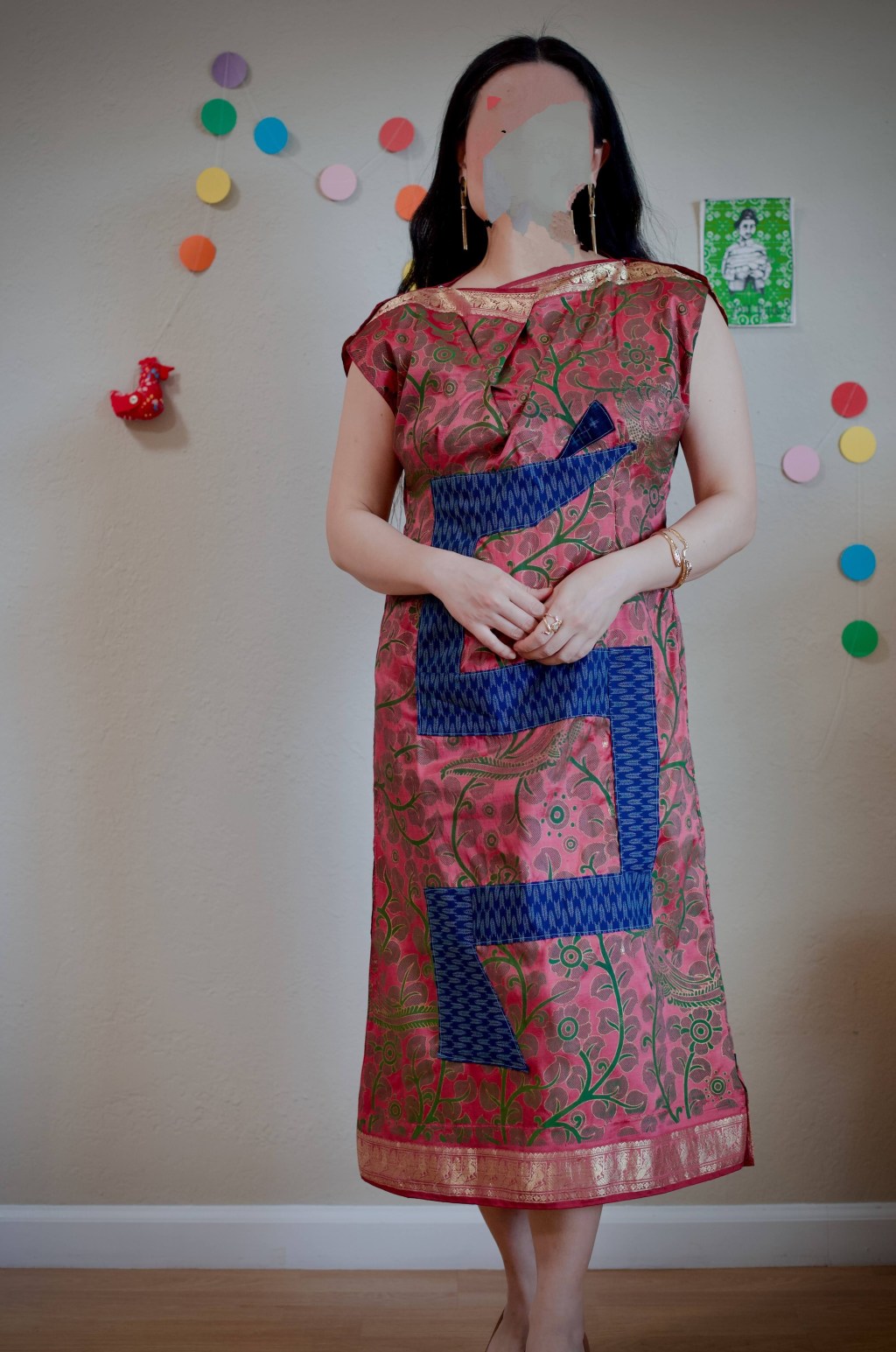
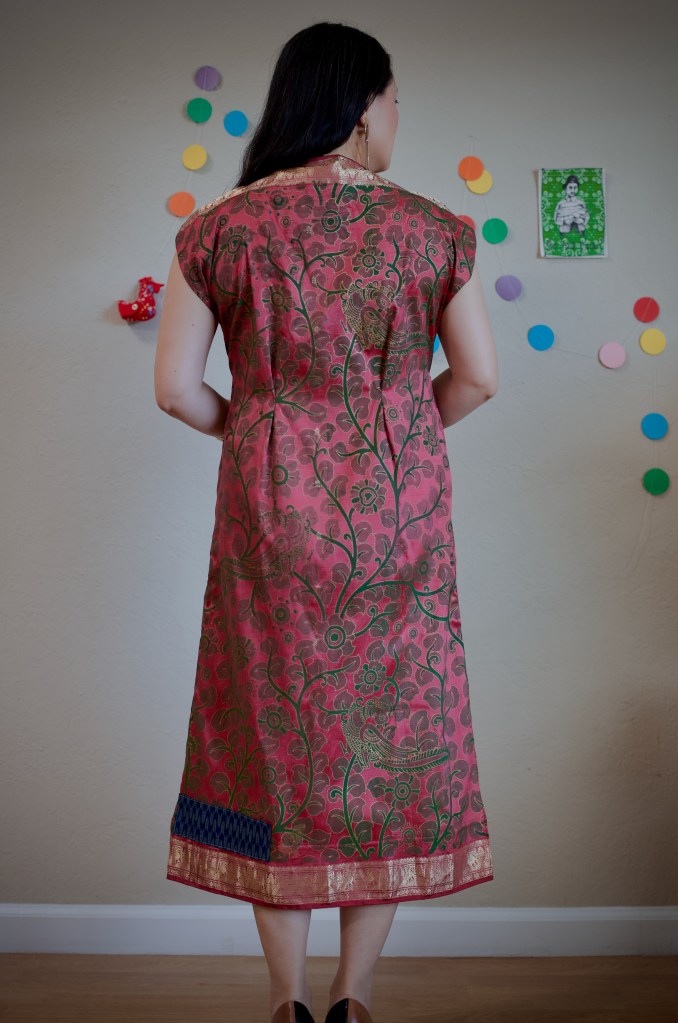
To celebrate the Lunar year of the snake, this dress is molded from two silk rectangles, which come from a vintage sari. It is adorned with a patchwork motif representing the snake.
*Lao Tzu, Tao Te Ching. A rendition by Stephen Mitchell.
 hardlyplaying.blog