

Among the stories written by Hans Christian Andersen, The Little Mermaid must be the most well-known of them all, so famous that the statue of the little mermaid by the waterside in Copenhagen has come to symbolize the city itself. And it is beloved the world over for good reason. Beside the beautiful writing that is signature of Andersen, in less than 20 pages it contains piercing depth, with overwhelming wisdom to be gained.
The heroine of the story is the little mermaid, daughter of the sea-king, a princess of the sea-folks. On her 15th birthday she rises up to the sea surface and rescues a beautiful prince from shipwreck. She falls in love with the prince and wishes to come on land to be with him, despite her grandmother’s objection. Says the grandmother to her, “What is beautiful here below, your fish tail, they consider ugly on earth – they do not know any better; up there one must have two clumsy limbs, which they call legs, in order to be beautiful.”
Thus the little mermaid sets out to get a pair of legs. To do so she must meet with the sea-witch. The sea-witch is all-knowing and wise. She dwells amidst bare gray sandy soil where all the trees and bushes are polyps, which are half-animals and half-plants. They look like snakes with many hundred heads, growing out of the ground. The polyps hold in their arms white skeletons of people who have perished at sea and have sunk into the depth, the oars of ships, and chests, skeletons of land animals, and a little mermaid whom they have caught and strangled. There in a house built with the white bones of shipwrecked people the sea-witch sits, letting a toad eat out of her mouth, as we should feed a little canary with sugar. The ugly fat water-snakes she calls her little chickens and allows them to crawl all over her.
The sea-witch is able to give her legs, “but you must pay me,” warns the witch, “and it is not a little that I ask… I will have the best thing you possess in exchange for my costly drink, for I must give you my own blood, that the drink may be strong enough, and as cutting as a two-edged sword.” The two-edged sword, the sacrifice one must make in order to gain something else, is a recurring theme throughout the story: -when the grandmother tells that pride must suffer pain, -when beautifulness is juxtaposed with torment, as the pair of legs will pierce her like a sword and she will become wretchedly unhappy, -when gracefulness is juxtaposed with agony, as every step will feel as if treading upon needles and knives, but lightly and graceful as a soap-bubble, -and most apparent when for a chance to win the prince and to gain an immortal soul, the little mermaid must trade in her most prized possession that is her voice.
But the princess insists upon forging ahead. Thus the potion is brewed, and the witch cuts the little mermaid’s tongue off; now she is dumb, and can neither sing nor speak. She goes onto shore to meet the prince. Taken by her beauty, the prince takes her by the hand and leads her into the castle. They give her splendid dresses of silk and muslin to put on, and she’s the most beautiful of all women in the castle; but she is mute, and can neither sing nor speak.
The prince calls her his little foundling. He cares more for her from day to day; he loves her as one would love a dear good child, but he never has the least thought of marrying her. He says to her, “Yes, I care most for you, for you have the best heart of them all. You are most devoted to me, and resemble a young girl whom I once saw, but whom I shall certainly not find again.” He only wants to love the girl who saved him from the shipwreck, but he does not know that it was she. He believes it was the beautiful girl at the temple whom he cannot have, the first one he saw as he opened his eyes. Yet the little mermaid has to become his wife to obtain an immortal soul, otherwise she would turn to foam on the sea. Soon the prince is to marry another princess, whom he does not wish to marry. He says to the mermaid, “I cannot love her; she is not like the beautiful girl in the temple, whom you resemble. Should I one day select a bride, I should prefer you, my dumb foundling with the eloquent eyes.”
Andersen frequently weaved in different colors to sharpen images and imagination, but particularly interesting is his usage of black and blue in this story. To open the story, he described the ocean water blue as the petals of the finest corn flower, but it is very deep, much deeper than any anchor-chain can fathom. He replicated the depth of this blue in the little mermaid’s eyes – being dark blue, blue as the sea in its greatest depth. Of the ocean floor, he described it to be covered with the finest sand, blue as the flame of sulfur, an electric-blue color of lava eruption. The prince’s eyes, however, are not blue, but black, and so is the color of the sea-witch’s blood, depicted when she pricked herself in the breast to brew the potion for the mermaid. That her black blood is able to transform the princess suggests the sea-witch to be an octopus.
Dark-blue eyes would again be depicted when the prince meets the other princess, who has been educated in a sacred temple to learn every royal virtue. The author described this princess almost a replica of the mermaid: “her complexion was clear and delicate, and behind dark lashes smiled a pair of dark blue, faithful-looking eyes”. The prince immediately falls in love with her. He says this princess the one that saved him when he was lying like a dead body on the beach.
The church bells peal; heralds ride through the streets to announce the engagement. The little mermaid is dressed in silk and gold and carries the bride’s train, but she only thinks of the night of her death, and all that she has lost in this world. Then she sees her sisters rising out of the waves; they were pale as herself, their beautiful long hair no longer fluttering in the wind. All of theirs and their grandmother’s hair was cut off. They have given it to the witch to obtain a knife in order to save the princess. Before the sunrise she must thrust the knife into the prince’s heart. When the blood spurts upon her feet, they will grow back into the fish tail, and she may live as a mermaid again.
The story’s ending is poignant, but holds the warmest wisdom of all – that one may not choose to be intelligent, but they can choose to be good. The mermaid could have chosen to kill the prince to gain back the life that she has lost in trying to win him, but instead, she throws it far out into the sea; where it falls the waves look red, as if drops of blood are spurting up out of the water. As she’s passing away she looks once more at the prince, then throws herself into the sea and feels her body dissolving into foam.
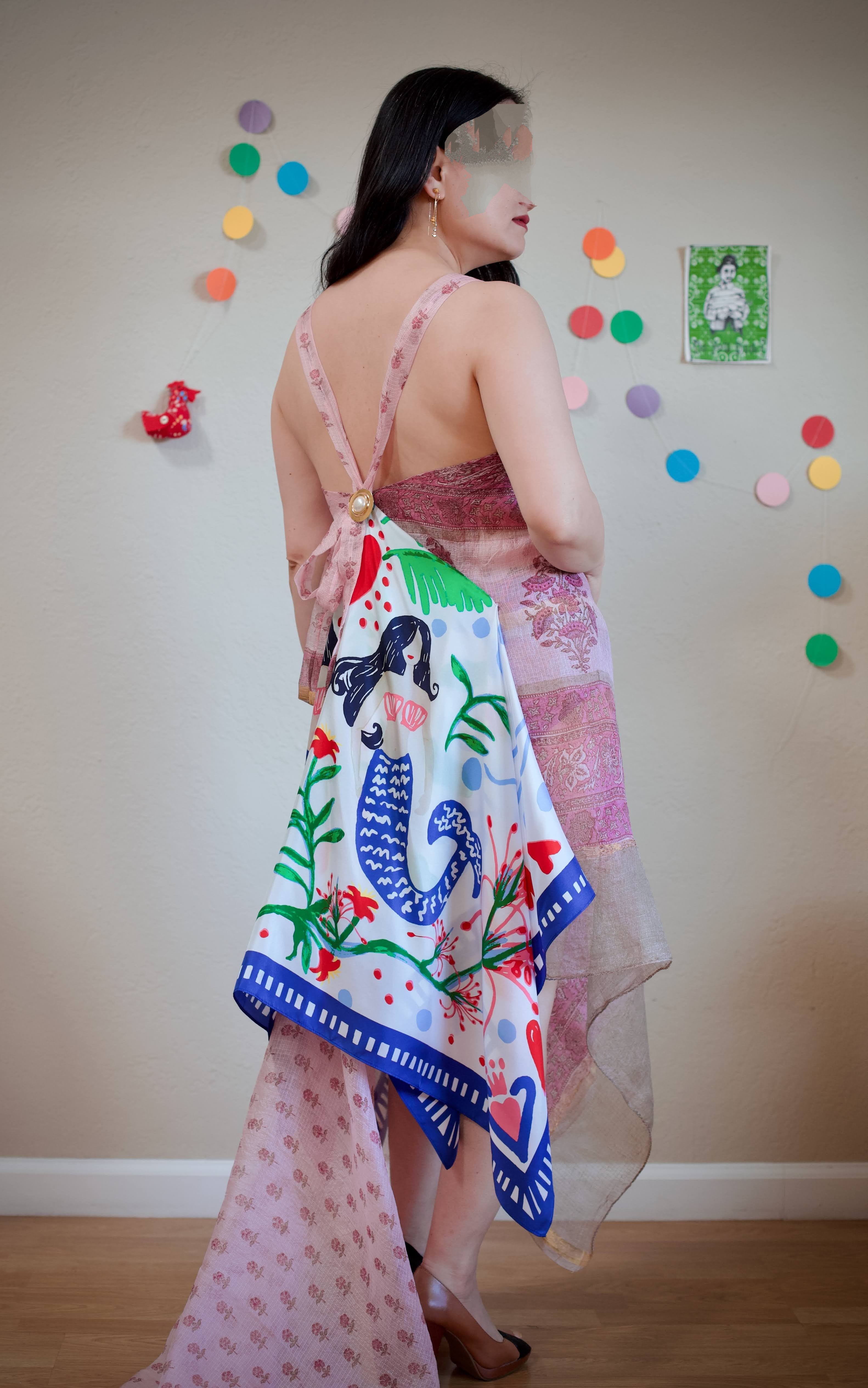
The sun rises out of the sea; his rays fall with gentleness and warmth upon the cold sea-foam. Above the little mermaid hover hundreds of transparent beings; their language melodious, but so ethereal that no human ear can hear them, no earthly eye can see them. They’re lighter than air and float about in it without wings. Then she notices that she has a body like theirs, which rises higher and higher out of the foam. She has transformed into a daughter of the air. The daughters of the air have no immortal soul either, but after 300 years of good work, they may gain one to float into the eternal Kingdom of God. For the little mermaid with the best heart of them all, this dress is molded from a silk rectangle, block printed with rose motifs. A silk square of mermaid print adorns the back of the dress.
 hardlyplaying.blog