

To muse about the pink flamingo, one must first look back into the history of American landscape design to visit Andrew Jackson Downing, considered the father of American landscape architecture. A devotee of the English school of garden design, Downing designed landscapes for country estates throughout the Northeast early in his career, while aiming to adapt the English principles for smaller estates. Publishing his first book in 1841, A Treatise on the Theory and Practice of Landscape Gardening, Adapted to North America, Downing advocated for landscape gardening as a way toward beauty, morality, and civility.
Downing was the first to propose development for New York City’s Central Park in The Horticulturist magazine. After the Civil War, Frederick Law Olmsted, Downing’s student, entered into the competition and won the contract to design the Central Park. The park embodies his egalitarian ideal, that is a common green space equally accessible to all citizens – the public park. Olmsted and his landscape architecture firm would go on to design many more parks and lawns for cities, university campuses, and residential neighborhoods across the country.
Meanwhile, homeowners, inspired by the estate parks and lawns, incorporated the tree-dotted rolling lawns into their home landscaping. To further enhance the pastoral and picturesque style, they decorated their lawns with animal statues such as deer, frogs, and rabbits. In the 1920’s, they were made from cast-aluminum. The 1930’s brought along the Depression Era and DIY cement animal statues. Then World War II pushed plastic technologies surging ahead, flooding lawns birthed along the suburban sprawl after the war with low-cost plastic animal statues such as dogs, frogs, ducks, and flamingos.
The ascent of the statue flamingo coincided with the native flamingo’s disappearance from Florida in the beginning of the 20th century. In the 1910’s and 1920’s, Miami Beach’s first grand hotel, The Flamingo, associated the bird with wealth and pizzazz. After a 1926 hurricane leveled Millionaire’s Row, developers built modest hotels catered to the middle class served by new train lines. In South Beach, architects employed the Art Deco style, replete with bright pink and flamingo motifs. In 1946, Benjamin “Bugsy” Siegel’s Flamingo Hotel in Las Vegas conjured an air of a flamboyant oasis in the desert. By the 1950’s, namesake Flamingo motels, restaurants, and lounges sprang up across the country. It’s not only the flamingo that was bright pink, the 50’s saw bright neon colors as forward-looking. The journalist Tom Wolfe called them “the new electrochemical pastels of the Florida littoral: tangerine, broiling magenta, livid pink, incarnadine, fuchsia demure, Congo ruby, methyl green.” Karal Ann Marling wrote that “sassy pinks” were “the hottest color of the decade.” Washing machines, cars, and kitchen counters proliferated in passion pink, sunset pink, and Bermuda pink. Elvis Presley bought a pink Cadillac when he signed his first recording contract in 1956.
By the 1980’s, plastic pink flamingos covered poolsides and condo porches. They were gifted at birthdays, housewarmings, and weddings. In 1985, over 450 thousand plastic flamingos were purchased in the United States. In 1987, the governor of Massachusetts issued a proclamation that the pink flamingo was an essential contribution to American folk art. At a 1996 exhibit on Marilyn Monroe and Elvis, the Philbrook Museum of Art in Tulsa featured a plastic flamingo, a memorabilia of the 1950’s. And the pink flamingo was a featured entry in the now closed National Plastics Center and Museum.
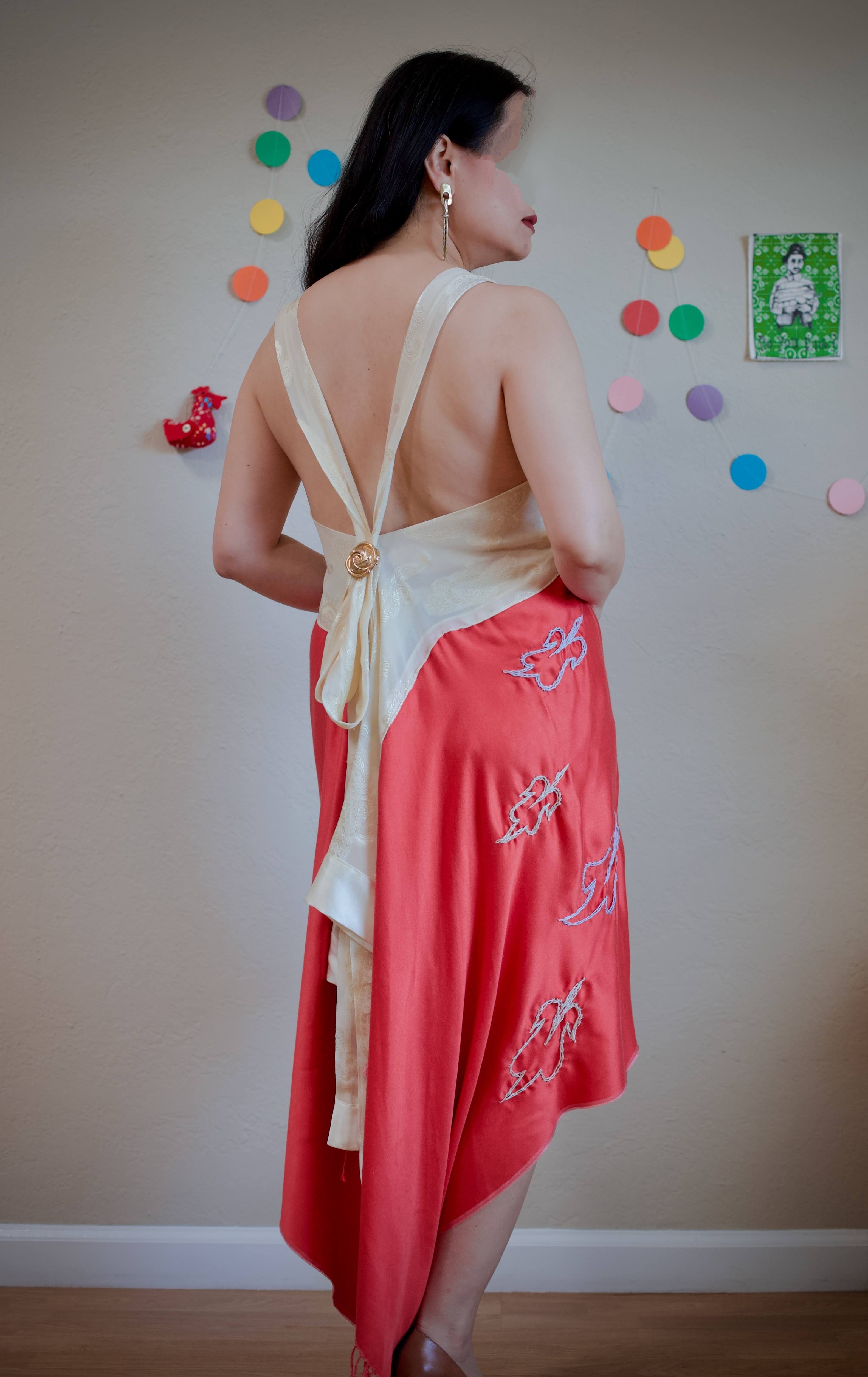
I have a pink flamingo in my garden too, but it’s made of iron. In the 21st century, plastic is no longer the hottest thing since sliced bread. It’s been rusting and fading color over the years, giving its own charm and timelessness. Something possesses a naturally enduring quality. Inspired by the flamingo, this dress is molded from a silk rectangle and accentuated with a cream colored scarf to represent the natural colors of the flamingo. With a drifting feather embroidery motif and floating tail, it evokes the ethereal quality of the bird.
 hardlyplaying.blog