While the French Bulldog has reigned as America’s favorite canine for the last 2 years, our most beloved dog breed rotates between the Labrador Retriever, the Golden Retriever, and the German Shepherd dog. It’s no dispute that the dog is America’s favorite pet. The sheer number of movies with a dog as the star of the show would prove thus. If one accounts for the number of movies with a dog in a supporting role, it would be near innumerable. Among many of our favorite canines in show include Togo – the Siberian Husky who led a team of sled dogs in the 1925 serum run to Nome across Alaska, Hachikō – the Akita who waited everyday for his deceased owner at Tokyo’s Shibuya railway station for 9 years, and of course, Snoopy – the beagle in the comic strip Peanuts by Charles M. Schulz.
America’s beloved non-human companions are beloved for their good nature and friendliness. Yet, these sentiments are not shared across cultures. As descendants of the wild wolf and the jackal, the opinion upon the dog varies from being unclean, clever, wise, to doleful. Ancient Egyptians depicted Anubis, the god of the Underworld, as a jackal. He’s often portrayed to be perching atop a tomb, symbolizing his protection of the necropolis. Among his many titles include The Dog who Swallows Millions, Master of Secrets, and Lord of the Sacred Land. In Bengali tantric tradition, the jackal represents the goddess Kali, whose name means She who is Black, who is the Ruler of Time, for she is the warrior goddess of creation and destruction. She has no permanent qualities; she will continue to exist even when the universe ends. It is therefore believed that the concepts of color, light, good, and bad do not apply to her. It is said she appears as jackals when meat is offered to her. The Brihat Tantrasara wrote:
“She is dark as a great cloud, clad in dark clothes. Her tongue is poised as if to lick. She has fearful teeth, sunken eyes and is smiling. She wears a necklace of snakes, the half-moon rests on her forehead, she has matted hair, and is engaged in licking a corpse. Her sacred thread is a snake, and she lies on a bed of snakes. She holds a garland of fifty heads. She has a large belly, and on her head is Ananta with a thousand heads. On all sides she is surrounded by snakes….She has a snake-girdle and an anklet of jewels. On her left is to be imagined Shiva in the form of a boy. She has two hands and has corpses for ear ornaments. Her face, decked with bright new jewels, shows she is pleased and calm.”

The sole reason that the dog has become man’s best friend is because we have made them so through selective breeding. While dogs have been domesticated since millenia for the purpose of safeguarding, shepherding, and hunting, the bulk of diversification happened within the last 200 years, starting in Victorian England. For example, Dudley Marjoribanks, the first Lord Tweedmouth, developed the breed Golden Retriever in the Scottish Highlands during the reign of Victoria. Desiring a dog suited to the rainy climate and rugged terrain of the area, he crossed his Yellow Retriever with a now-extinct breed, the Tweed Water Spaniel. “Through several generations of clever breeding,” an admiring historian wrote, “Tweedmouth created a consistent line of exceptional working retrievers.” With a little more refinement after Tweedmouth’s time, the Golden Retriever became a favorite for their beauty and dash, and their sweet, sensible temperament, and then became America’s favorite through the era of President Gerald Ford and his beautiful Golden named Liberty.
But the most astonishing and on-going domestication experiment started in 1959 by a team of Russian geneticists in Siberia. Only within a decade, their selective breeding program in silver foxes produced puppy-like foxes with floppy ears and curly tails. Along with physical changes came genetic and behavioral changes as well. They became increasingly interested in human companionship with each generation. Lee Alan Dugatkin and Lyudmila Trut wrote their book, How to Tame a Fox (and Build a Dog), to tell of these visionary scientists and their Siberian tale of jump-started evolution.

Perhaps language evolution lags selective domestication, for language expression involving a dog can still reflect the ancient view, despite changes in opinion over time. For example, the word “perros” in Spanish, which means “dogs”, also refers to misery. The Mexican film’s title Amores Perros implies misery love with a canine flavor. And calling a man a dog or a woman a bitch is hardly a good thing. Regardless – be it a dog or a fox, when we have chosen to make them our pet, we have chosen to love them and to take responsibility for them. Once again, I am reminded of a passage in Antoine de Saint-Exupéry’s The Little Prince. It was what the little prince said to a rose in a garden of thousands of roses: “An ordinary passer-by would think my rose looked just like you. But in herself she matters more than all of you together, since it is she that I watered.” So it is the time you have wasted on your rose that makes your rose so important.
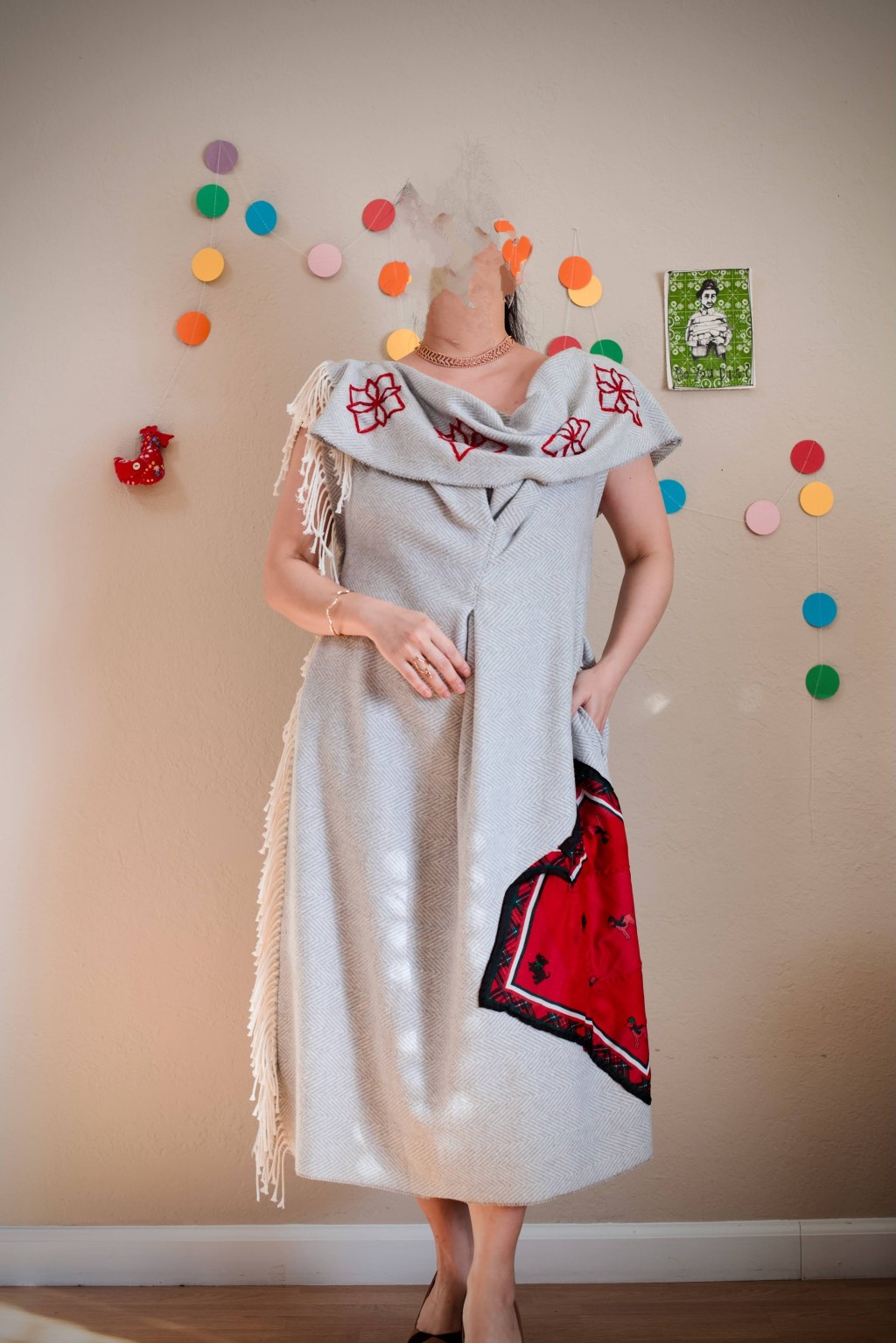
For the love of the dog is expressed in many ways, this dress features a red scarf printed with our beloved canines in holiday attires. It is molded from two cotton-blend rectangles of the same dimension. Adorned over the folded cowl neckline is an embroidery motif inspired by the poinsettia flowers.
 hardlyplaying.blog