
In 1666, Isaac Newton proved that white light is composed of the rainbow spectrum. He used a prism to refract a white light beam into a spectrum of colors, and then another prism to put it back into white light again. Color, however, is perceived inversely. An object soaks up a part of the light when the light hits it. What’s not absorbed gets reflected off the surface into the eyes, which constitutes color. Consequently, the color we perceive of the object is actually the color it isn’t. This is the essential difference between light’s colors and the object’s color being reflected from it. A perfect mixture of colored lights produces white, while a perfect blend of colors that our eyes see makes the color black.
The British Prime Minister William Gladstone, in his Studies on Homer and the Homeric Age, noted the lack of color description in ancient Greek language. Honey was green, the sea was wine-dark, and the sheep were violet. There were 170 mentions for black, 100 mentions for white, but only 13 for red, fewer than 10 for yellow, green, and purple, and no mention of the color blue. It was a similar puzzle with other ancient texts, and when the word for blue appeared, it was usually added to the spectrum of green or black. The link between language and colors is still not well understood. Some argue that language affects how we perceive colors, while others believe that basic color categories are rooted in our biology.
The Spanish artist Joan Miró made a peinture-poésie, or painting-poetry, of a patch of blue color above the phrase, “this is the color of my dreams.” But in ancient Rome, specific shades of blue were associated with barbarism, mourning, and misfortune. Although the color blue was not named, ancient Romans used blue in their everyday life. Common blue dye was made from woad, a flowering plant native to the Mediterranean. While caesius, a pale grey-blue or sky-blue, was admirable, caeruleus, a deep sea-blue, was considered inferior. The Romans regarded yellow haired, blue-eyed German tribes barbaric, and women with blue eyes were thought to have loose morals. In his second expedition to Britain, Julius Caesar wrote in the Gallic War, “All the Britons, indeed, dye themselves with woad, which produces a blue [caeruleum] colour, and makes their appearance in battle more terrible.”
By the time of medieval Europe, the color blue had become well circulated, so that “blue blood” was used to identify wealthy, aristocratic families. While it is commonly thought that a blue-blooded person was called such because their veins appeared exceptionally blue underneath their pale, untanned skin, the more plausible explanation is the condition known as agyria. Agyria is caused by swallowing silver particles unable to pass through the body, turning the skin, eyes, internal organs, nails, and gums a blue-grey color. Silver compounds accumulated in various parts of the body decompose to silver sulfides when exposed to sunlight. These microscopic particles deposit in the skin, effectuating changes in pigment color. Which also gave way to the expression “born with a silver spoon in one’s mouth”, indicating inherited wealth, originated from the fact that the aristocracy was the only part of the population able to afford silver eating utensils.

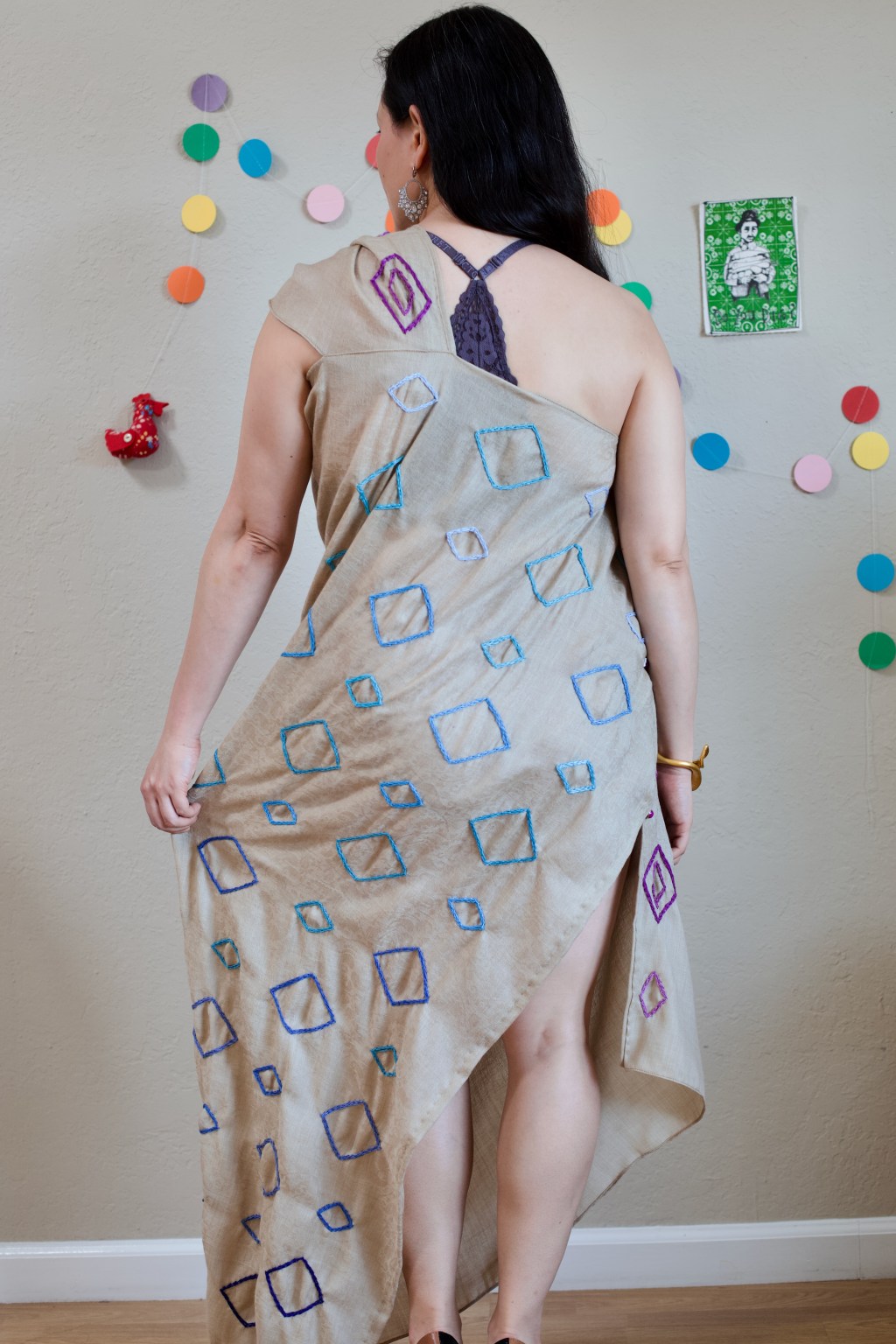
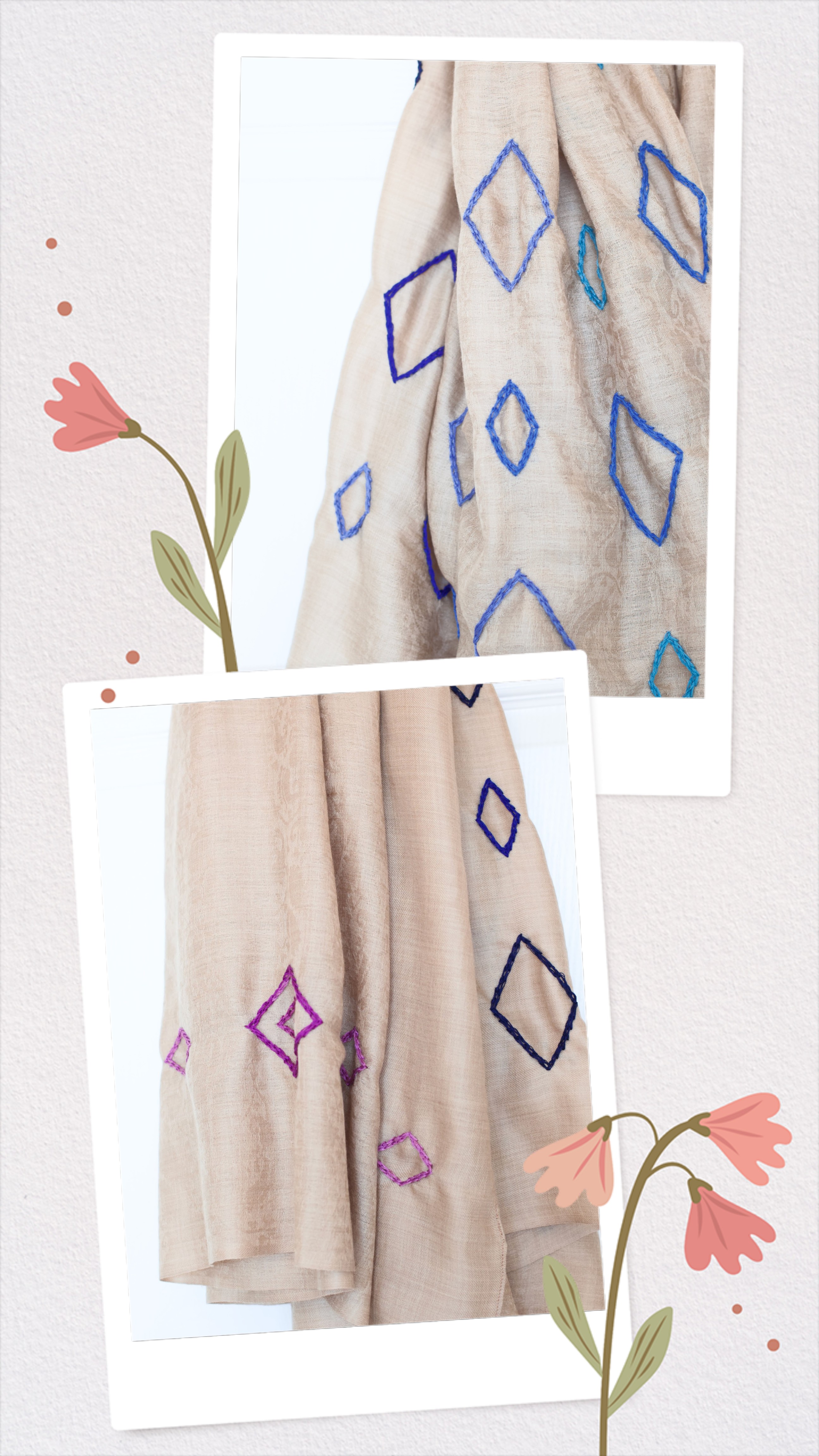
Contemporary blue has become a most favorite color and a most favorite word. From blue jeans, blue collar, blue ribbon, to blue chip – true blue has come to express that which is faithful and loyal. Molded from one jacquard wool square, this dress is to reminisce the Roman stola. Diamonds of blue gradient are embroidered across, and the border is embroidered with diamonds of purple gradient. Worn with a palla, the ensemble is the attire of our Lady of Liberty.
 hardlyplaying.blog