
“I’d swim the ocean wide
just to have you by my side.
Though you’re no Queen of Sheba,
for worlds I’d not replace
your sunny, funny face.”
Debuted in 1957, the film Funny Face, starring Audrey Hepburn, was a parable for her ascending style and stardom. In the film, Jo Stockton, a downtown bohemian bookworm, was discovered by the charming fashion photographer Dick Avery. Set in Paris against the backdrop of haute couture, Jo was transformed into a confident cover girl.
Audrey looked like every girl and like no girl. The cameraman Franz Planer once said of her, “She has lots of faults that make her Audrey Hepburn: thick eyebrows, uneven teeth. She doesn’t mind if her hair is disheveled or if she falls into a pot of soup. She is a real girl.” Gregory Peck, her co-star in Roman Holiday, considered her sense of humor one of her most undervalued assets. “She was a cutup, she was a clown.” In the age of Jane Russell and Marilyn Monroe, she developed an image that emphasized her thinness, height, and singularly linear form. She was so successful in countering contemporary notions of beauty that Vogue hailed her as “today’s wonder girl,” who “has so captured the public imagination and the mood of the time that she established a new standard of beauty.”
Richard Avedon’s photographs of Audrey for Funny Face showcased her vital influence on fashion: strolling down the catwalk in a white floor-length silk gown and short-sleeved pink blazer, fluttering in front of the Louvre in a slim-waisted black dress with a bouquet of balloons, yearning at the trainstation in a bouclé wool suit with her lapdog and a rattan valise, or just slumming in a bar in a cropped A-line raincoat. With her blend of European elegance and American sportif, Audrey would popularize the gamine haircut, flat ballet shoes, the turtleneck, slim capri pants, oversized sunglasses, cinched waists, three-quarter sleeves, and waist-wrapped shirts. Cecil Beaton wrote of her style, “nobody ever looked like her before World War II… now thousands of imitations have appeared.”
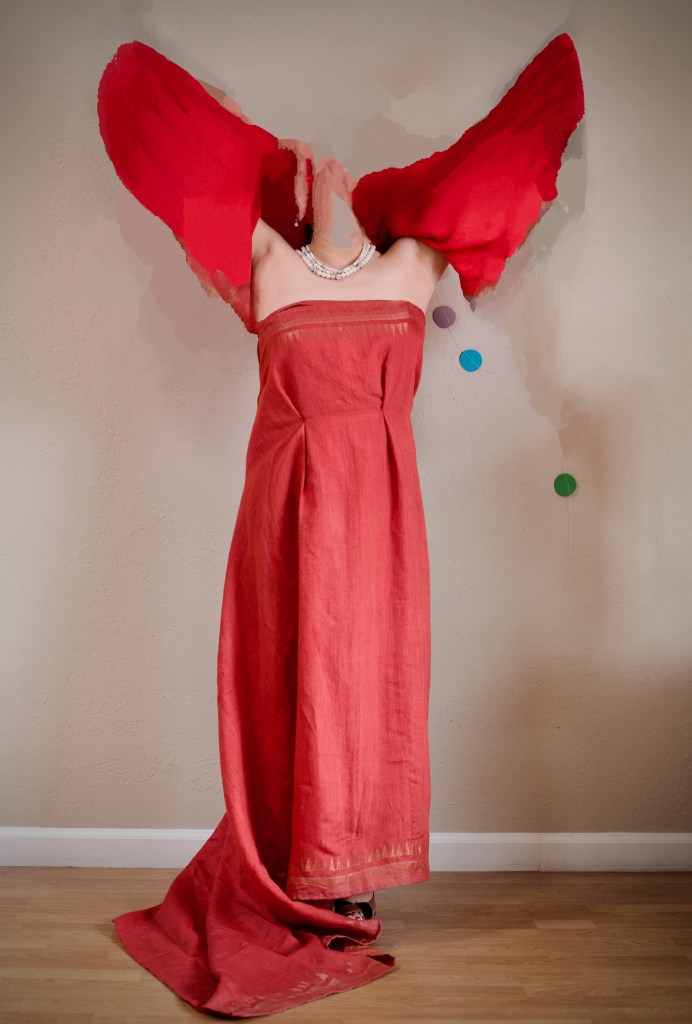
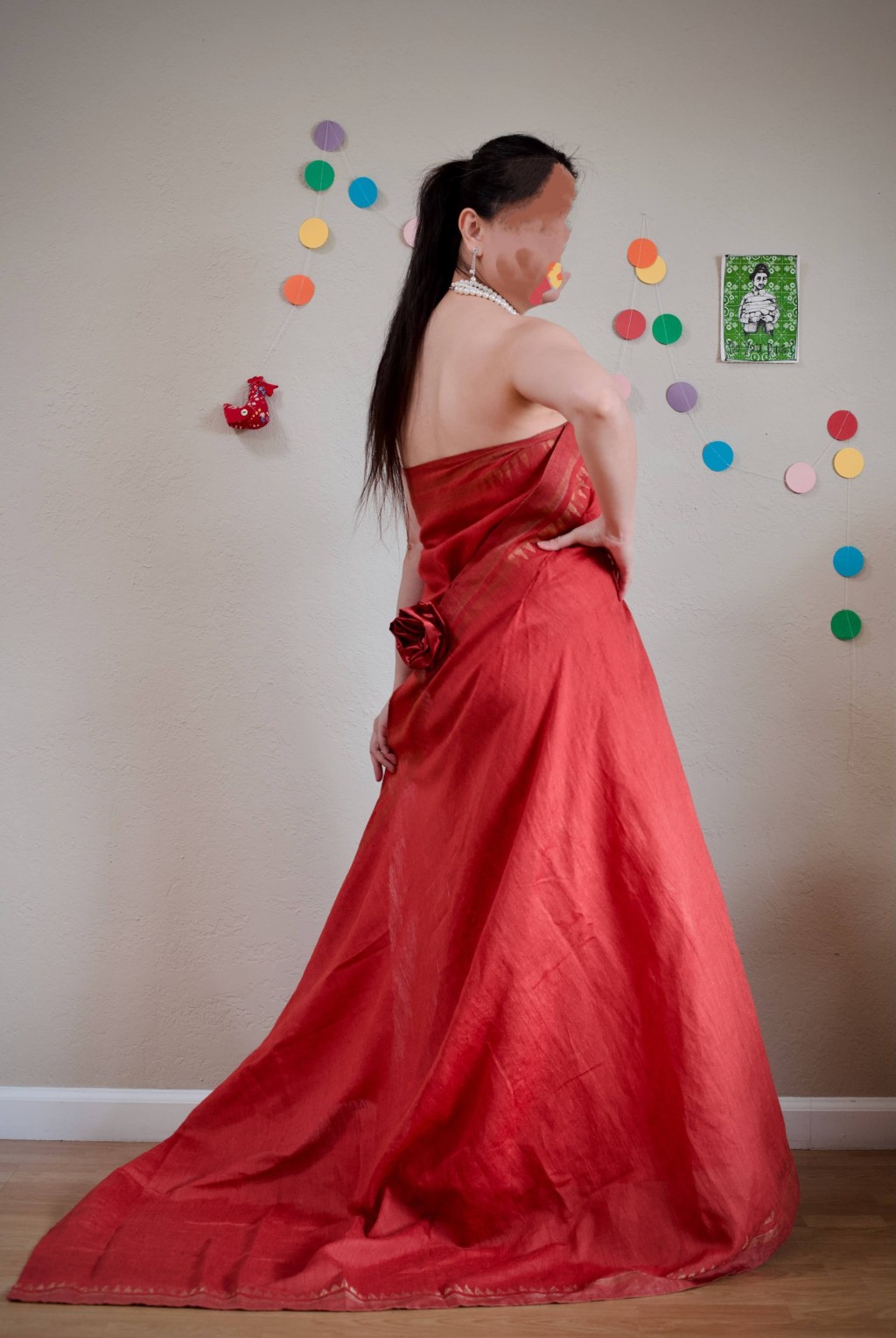
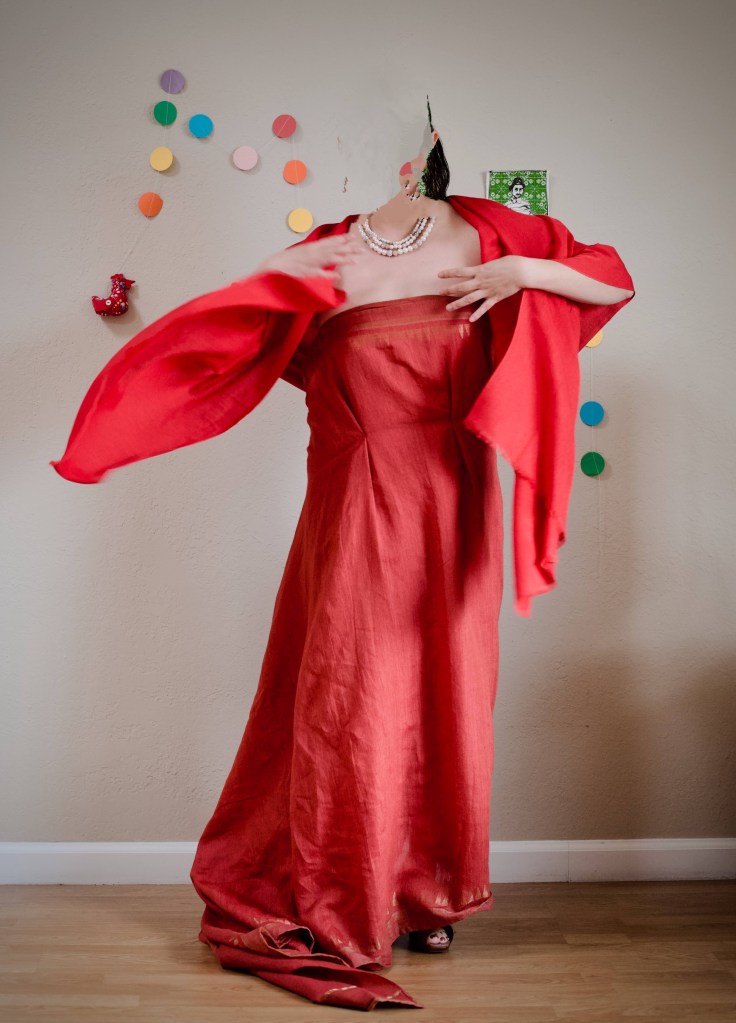
As the French fashion designer Hubert De Givenchy said of her, “There is not a woman alive who does not dream of looking like Audrey Hepburn,” we can all admire this icon of elegance and grace and emulate her style. This gown in red is homage to Audrey’s impeccable dance as she sweeped down the Daru staircase of the Louvre. She’s donning a glorious red gown, her red scarf floating through the air, mirroring Nike, the winged goddess who heralds victory of Samothrace in the background. A rectangle cloth, which comes from a silk-blend vintage sari, swathes around the body with an ample fishtail train. Without any cutting, the gown hugs the body with double hook closure, front darts, and a back-stitched floral bow.
 hardlyplaying.blog