
The American artist and art teacher Josef Albers once proclaimed that if you were to say “red” to 50 different people, there would be 50 different versions of the color. Names for color, in particular, evolve with language across cultures. For example, the word for pink once meant yellow in Dutch. While ochre meant “pale yellow” in ancient Greek, today the word is an umbrella term for earthy colors containing iron oxide, or hematite. The variant of ochre containing dehydrated hematite, when combined with clay, makes the color Indian Red.
The European counterpart of Indian Red is Burnt Sienna. Sienna comes from Italian, terra di Siena, which means “Earth of Siena”. It takes its name from the city-state of Siena, where it was produced during the Renaissance. In its natural state, the raw sienna is not chemically distinguishable from yellow ochres. When it is heated, the pigment is calcined, dehydrating the iron oxide to become burnt sienna. Burnt sienna contains around 50% iron oxide and varying amounts of clay and quartz.
The use of earth colors date back to prehistoric times. Along with ochre and umber, burnt sienna was among the first pigments used by humans. The pigment is absolutely stable, demonstrated through cave paintings still in excellent condition after many thousands of years. It is widely used from old masters’ paintings to the present day. The color palette of 17th-century painters such as Rembrandt and Caravaggio were earth tones such as burnt sienna and raw umber. Indian culture regards the beginning of creation with earth colors like Indian red. The paste of the red sandalwood tree is used in the Ganesh festival to mark the birth of Ganesha, the god of new beginnings. Anish Kapoor’s series of “blood paintings” makes a visceral link between the body’s iron composition and the red earth. His 2006 collaboration project with Salman Rushdie, Blood Relations or An Interrogation of the Arabian Nights, featured bronze and blood-red wax structures.
When mixed as an epoxy resin, Indian red exhibits anti-corrosive qualities and has been a popular choice for industrial paint applications. Up until 1996, Indian railway trains were painted brick-red in color. Although it is never described as Indian Red, model-train enthusiasts have come to recognize it to be this color.
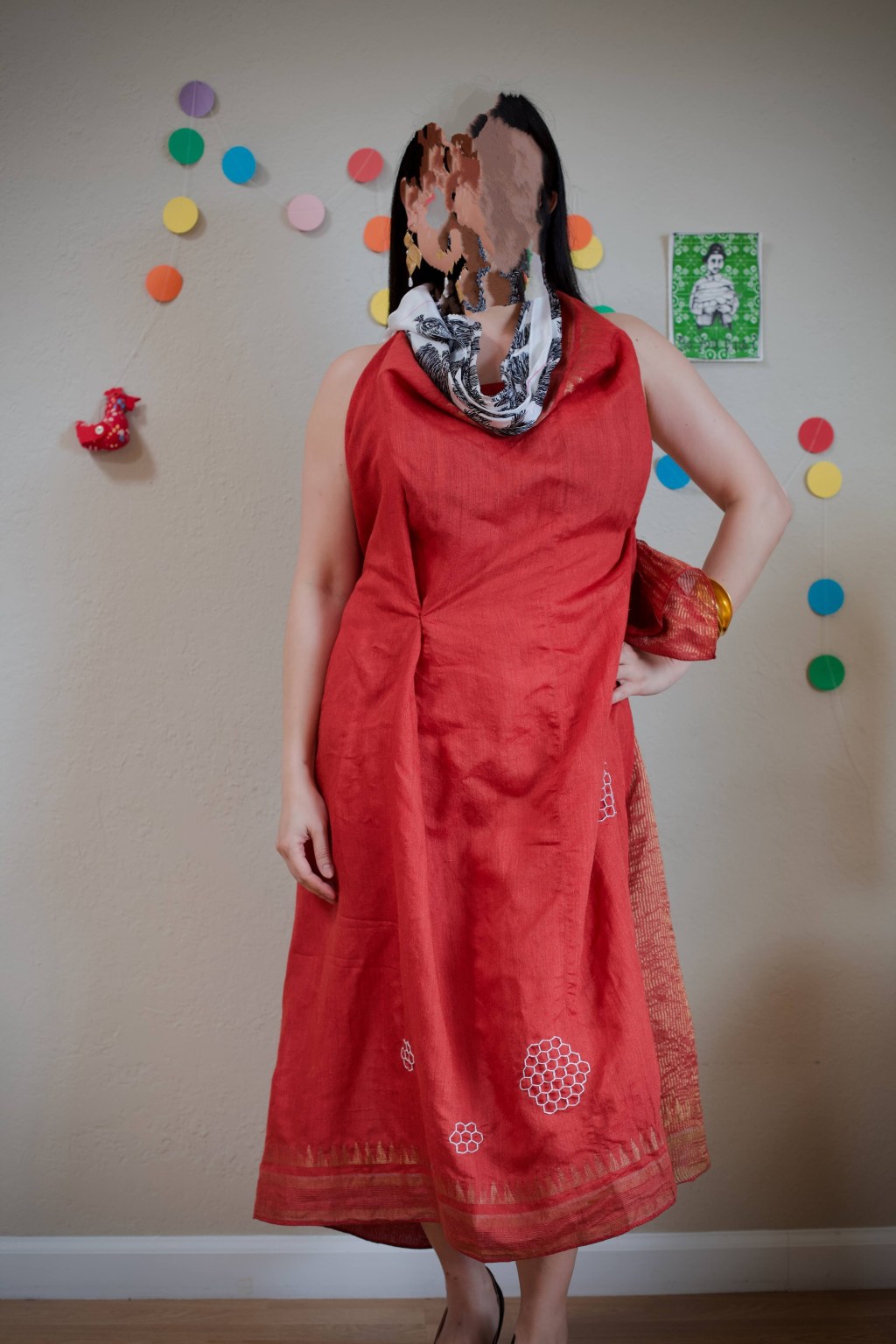
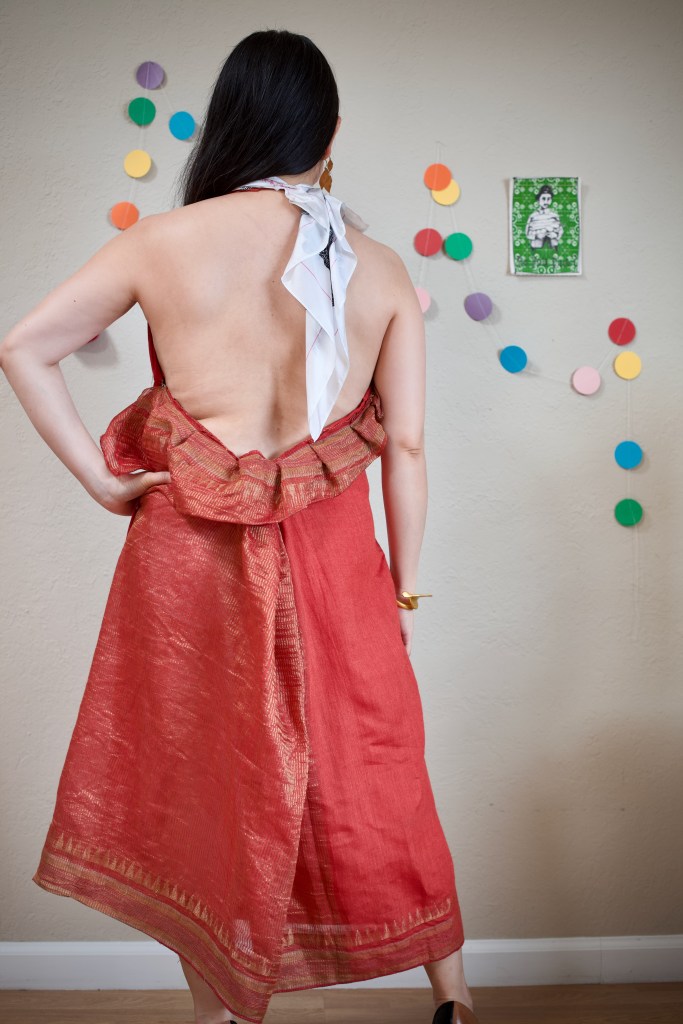
Brick-red is also widely used to dye fabric, such as the one that I am wearing here. This halter-neck, drop-back dress is molded from a rectangle, which comes from a silk-blend vintage sari. The cloth is weaved with golden metallic threads to obtain a lamé effect. The dress front is embroidered with a honeycomb motif. The halter-neck is decorated with a silk square, depicting the dogs in the Westminster Kennel Club Dog Show, which has been held in New York City annually since 1877. The “Best in Show” is given to the dog chosen as the winner.
 hardlyplaying.blog