The world’s most spectacular border ceremony takes place daily before dusk at Wagah, roughly halfway between Lahore in Pakistan and Amritsar in India. Large crowd gathers between the Indian Border Security Forces and the Pakistan Rangers to witness a spectacle of what could be appropriately coined “Peacocks at Sunset.”
Using their body instead of weapon, each guard is over six feet tall, sports thick facial hair, and dons turban-cum-coxcomb headgear. As they parade about, flaunting chauvinism in full, national passions are further inflamed by displays of precision nastiness in which thumbs are used to terrifying effect. The guards measure out the lengths of rope. They must get it absolutely spot on so that the tricolor of secular India and the Crescent Moon of Muslim Pakistan descend at exactly the same time. Despite the show of bellicosity, this is in fact a combined operation with both sides working together to make it run like clockwork. It ends with a chorus, a quadrille of stamping soldiers, the briefest of handshakes, and the border between India and Pakistan is sealed.
In the aftermath of WWII, Great Britain realized it could no longer hold on to India, the jewel in its imperial crown; the objective was to get rid of India in a hurry without getting blamed for the intensifying communal conflict. On July 8 1947, the British lawyer Sir Cyril Radcliffe, who had never set foot in India before, arrived with a brief for a line on the map to split up the Hindu-majority lands from Muslim-majority ones. With barely five weeks between start and finish, Radcliffe had to chair not one but two boundary commissions: one for Bengal in the east, another for the Punjab in the west. The resulting deadlock between all parties left all the major decisions to Radcliffe himself.
The everyday border spectacle is a masterly demonstration of how to lock horns without inflicting any casualty. It is just about the safest way to engage in a display of conflict, as the Radcliffe’s arbitration has effectively elevated the British Raj’s inter-communal conflict to that of an international fault line, making possible even the threat of a nuclear war in May 1998. India still has the world’s third largest Muslim population, and among the most diverse ethnic makeup – a blend of Indo-Aryan, Dravidian, Persian, numerous other ethnicities, and even passerby such as the Greek descendants from Alexander’s brief invasion into the northwestern fringe of the Indian subcontinent.
“In jungles of poisonous plants strut the peacocks,
Though medicine gardens of beauty lie near.
The masses of peacocks do not find gardens pleasant,
but thrive on the essence of poisonous plants.
In similar fashion, the brave Bodhisattvas
Remain in the jungle of worldly concern.
No matter how joyful this world’s pleasure gardens,
These Brave Ones are never attracted to pleasures,
But thrive in the jungle of suffering and pain.”*
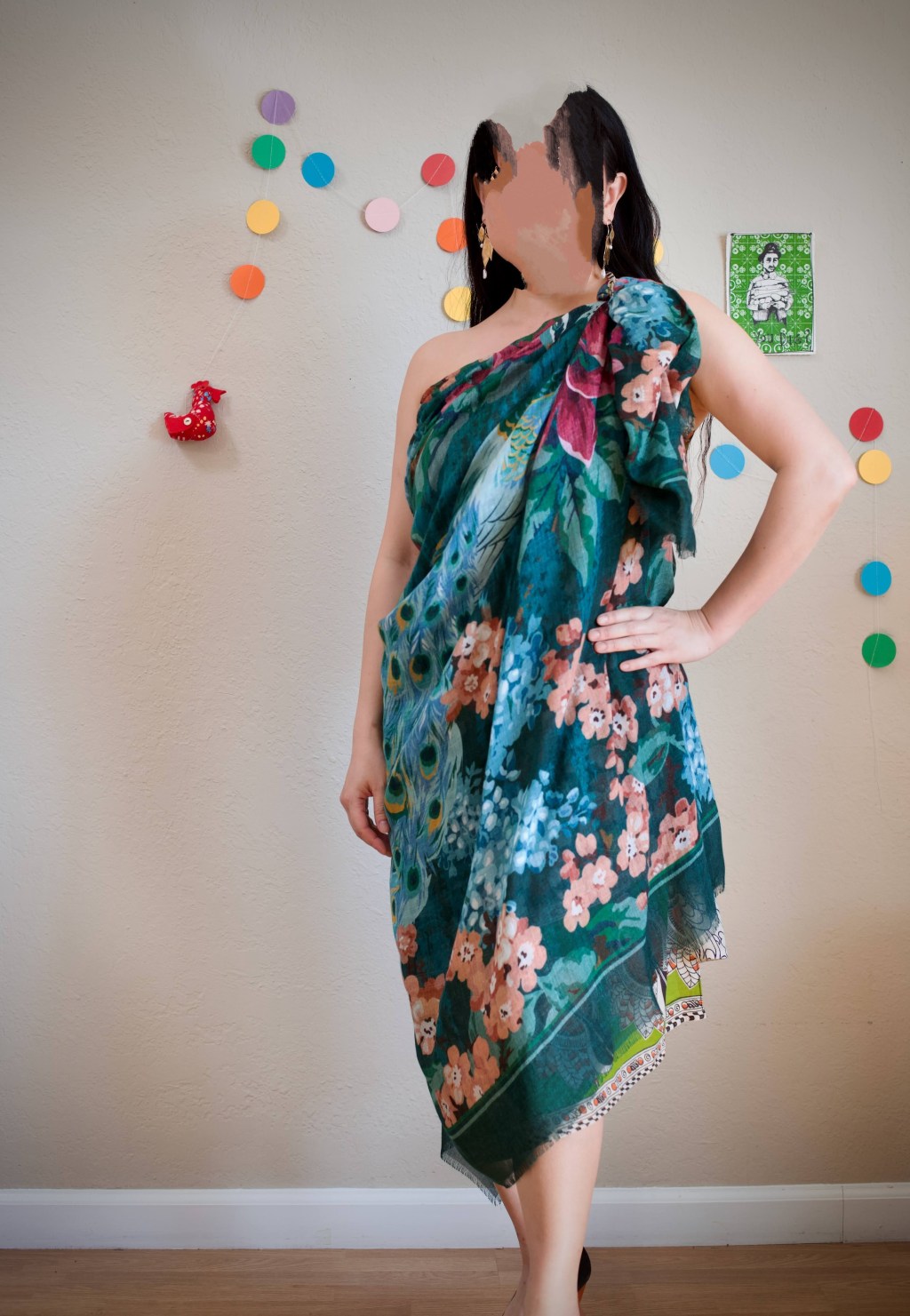
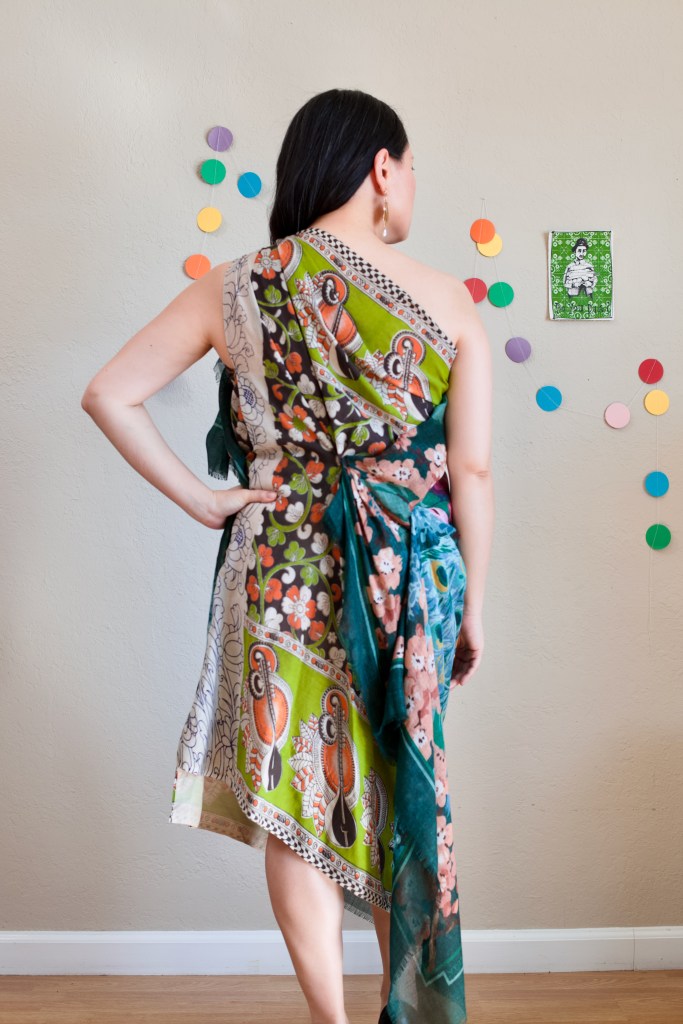
For this ensemble, the base dress is crafted from a cotton rectangle, which comes from a vintage cotton sari of floral and peacock details. The base dress is molded from the rectangle without any cutting and knotted at the shoulder. Donning atop is a silk-cashmere square with a most gorgeous peacock motif.
*Dharmarakṣita. The Wheel of Sharp Weapons – A Mahayana Training of the Mind.
 hardlyplaying.blog