“All gardening is landscape painting,” said Alexander Pope, the English poet in the 18th century. The picturesque tradition continues to dominate the field of landscape architecture to the present day. Dotted across the history of landscaping are alternative points of view, however. For example, the Sacro Bosco garden was unlike any other design during the Renaissance. Hidden in the wood, sculptures were made by hacking into rocks and filled with anarchic riddles and visual puns. The garden was a symbol of the gate to hell, a revolt against order and the cardinals’ gardens of the time.
Monet’s garden at Giverny, which fused the compositional techniques of Impressionist painting into garden design, serves as another alternative to the pervasive picturesque aesthetic. The garden design reflects the painter’s vision – to search for the universal ideal through capturing the fleeting moments. Over time, the garden became the center of his artistic life.
In 1883, Monet moved his family to the house he had rented at Giverny. It came with a large adjacent garden filled with blossoming apple trees. From this lot he would create his upper garden. The entire design, composed of geometric beds, is organized around a central axis, depicted in his painting series of The Garden Path. The use of an axial spine to organize the garden is a legacy of 17th-century French garden design.
A decade later, Monet purchased a piece of marsh land located across the railroad tracks at the southern end of the upper garden. After enlarging the pond that came with the land, he built an arched footbridge to extend the axis of the upper garden across the water. Through a series of alterations, he enlarged the water surface and molded the banks into sinuous curves. In contrast to the geometric arrangement of the upper garden, the form of the water garden is curvilinear. The water garden is complementary to the upper garden, “the former,” wrote the French art critic Arsène Alexandre, “is the world of colors, the latter is the world of nuances. The passage from one to the other entailed an emotional journey from exaltation to repose.”
The contrast between the two gardens also reflects a similar dichotomy in the painter’s work, wrote the art critic William Seitz. “Besides the simultaneity of pattern, depth, and live brushwork in these pictures, the tension of some of them is heightened through the stark opposition of tortuous curves to geometricity. Both qualities of form exist in nature and both have their psychological complements in the opposed human predispositions either to passion or structural order… The concurrent existence of two stylistic poles, the one rectilinear and the other curvilinear and free, is a historic characteristic of French painting.”

Monet achieved the effect of profusion in blooms through overcrowding the planting beds, turning the garden into a visual feast. Within the geometric layout, the color composition varies depending on whether the field of view is straight or diagonally across the beds. In order to maintain the mirror-like surface of the pond, daily cleaning to remove all traces of debris was required. He explained in an interview, “The effect does change, constantly, not only from one season to another, but from one minute to the next as well, for the water flowers are far from being the whole spectacle; indeed, they are only its accompaniment. The basic element of the motif is the mirror of water, whose appearance changes at every instant because of the way bits of the sky are reflected in it, giving it life and movement… The passing cloud, the fresh breeze… a rainstorm, the sudden fierce gust of wind, the fading or suddenly refulgent light… create changes in color and alter the surface of the water. It can be smooth, unruffled, and then, suddenly, there will be a ripple, a movement that breaks up into almost imperceptible wavelets or seems to crease the surface slowly, making it look like a wide piece of watered silk.…. Looking at it, you thought of infinity; you were able to discern in it, as in a microcosm, the presence of the elements and the instability of a universe that changes constantly under our eyes.”
Recognized by Monet himself as his “most beautiful masterpiece,” the garden expresses the aesthetic of the painter whose eyes could observe the finest nuances of color affected by the subtle dances between light and shadow. Throughout his career, he had sought to capture fleeting moments casted within the ever changing lights and shadows. When asked for a definition of Impressionism, Monet replied, “Impressionism is nothing more than immediate sensation.” In this immediate sensation the great Impressionist painter sought to express universal symbols and ideals.
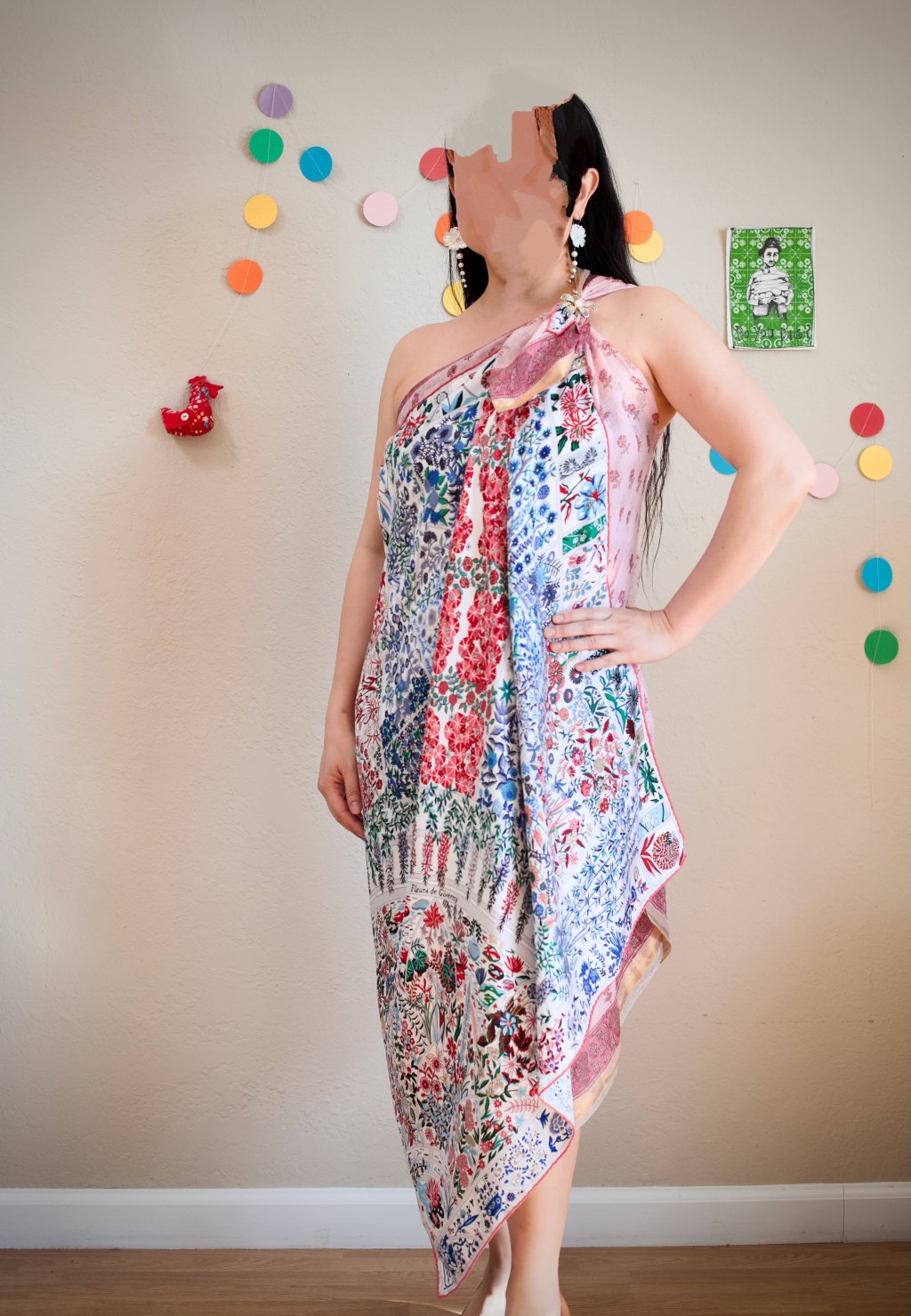
In this ensemble to celebrate Monet’s garden, I have crafted the base dress from a silk rectangle, which comes from a sari made of chiffon silk, block printed with rose motifs. The base dress is molded from the rectangle without any cutting and knotted at the shoulder with a brooch. Donning atop is a silk square filled with the rich colors of the garden’s flowers, while also depicting Monet’s carefully planned arrangement of forms and harmonies.
 hardlyplaying.blog