
Color had been considered superfluous in Western culture since ancient times. Classical writers saw it as being indulgent, even sinful, a distraction from the true glories of art, which were of line and form. Johann Wolfgang von Goethe wrote in Theory of Colors, 1810 that “savage nations, uneducated people, and children have a great predilection for vivid colors; that animals are excited to rage by certain colors; that people of refinement avoid vivid colors in their dress and the objects that are about them, and seem inclined to banish them altogether from their presence.” Herman Melville, in Moby Dick – The Whiteness of the Whale, depicted color as deified Nature’s harlot whose allurements covered nothing but the charnel-house within.

Yet, the desire to be dressed in color appears innate like a guise of human nature, so much so that color was restricted to social classes through sumptuary laws in 12th century Europe. Dull and earthy colors, such as russet, were given to peasants, while bright and saturated colors, such as scarlet, were reserved for the high-born. Among the colors, purple was the color of opulence and royalty. It came from the city of Tyre of Lebanon, then Phoenicia, giving its name Tyrian purple. In ancient Roman times, the color could only be obtained from mucus secretion by specific species of sea snail. Extracting this dye was a laborious and time-consuming process involving tens of thousands of snails. The Greek historian Theopompus reported, “Purple for dyes fetched its weight in silver at Colophon” in Asia Minor. The Roman poet Horace, in The Art of Poetry, likened weighty openings and grand declarations to purple patches and derided the gods and heroes who dressed in royal purple and gold, but appeared in dingy taverns with vulgar language, while Pliny lamented, “It is for this color that the fasces and the axes of Rome make way in the crowd; it is this that asserts the majesty of childhood; it is this that distinguishes the senator from the man of equestrian rank; by persons arrayed in this color are prayers addressed to propitiate the gods; on every garment it sheds a luster, and in the triumphal vestment it is to be seen mingled with gold. Let us be prepared then to excuse this frantic passion for purple.”

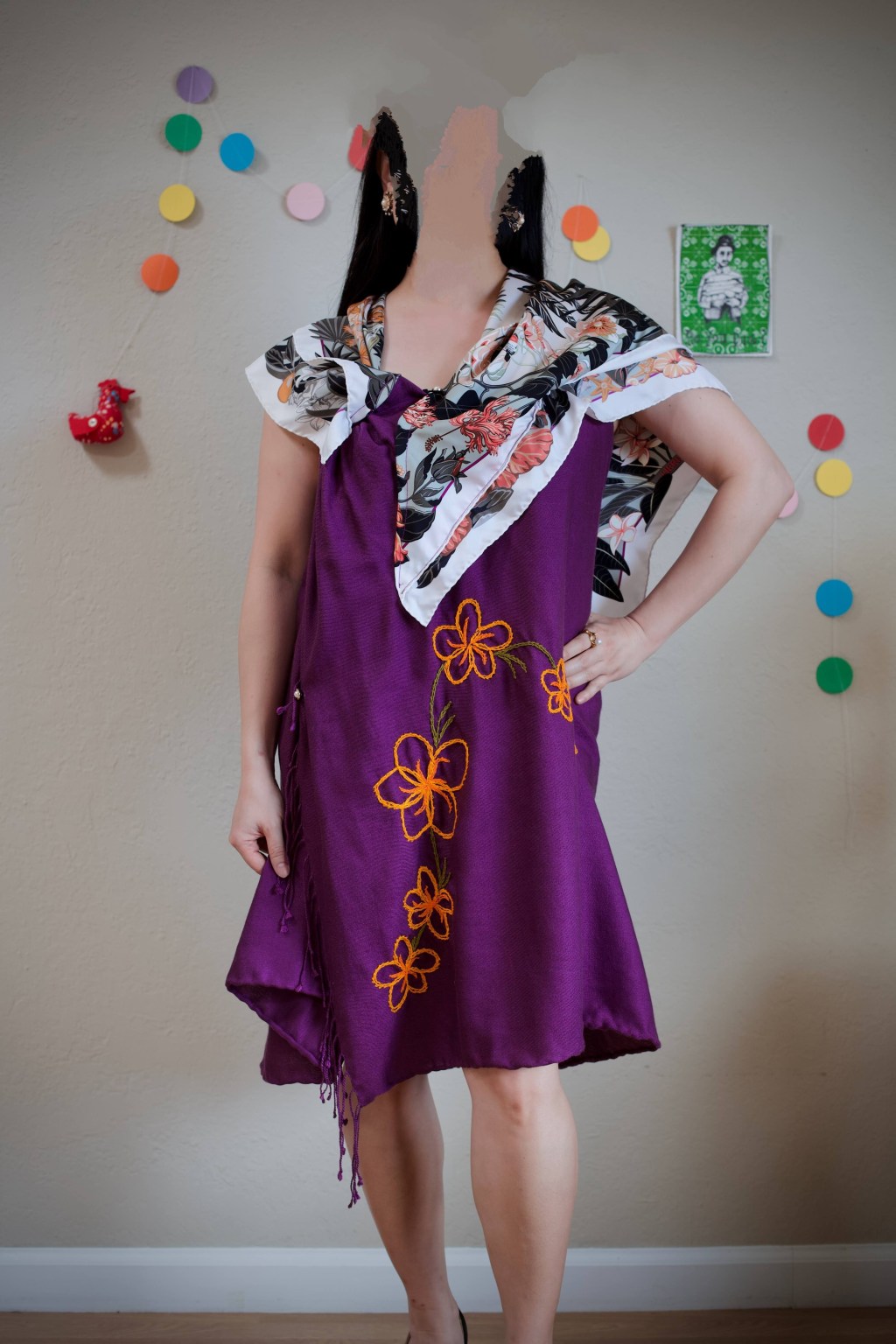
In my garden, California poppies grow wild in springtime. They sneak up right next to the lavender, claiming whatever space they can get. Their bright orange hue harmonizes the lavender’s purple astonishingly. Thus to accompany this purple dress, I have chosen a silk square with orange flamingos in a tropical floral motif. The dress is made from a rectangle cloth of silk-cashmere blend. It is draped entirely with pleats and darts; no cutting is involved. The bottom of the dress is rolled-hem. The silk square is folded diagonally and sewn atop the dress. An orange floral motif is embroidered across the dress to complement the silk square.
Made of luxurious cloth adorned in vivid colors and embroidery, yet still casual and fun for a cocktail party, this dress speaks of quiet luxury.
 hardlyplaying.blog