The story of the Polynesian Demi-God Maui fishing up islands explains the creation of the Hawaiian islands. In Polynesian lores, “fishing up islands” means to discover different islands, or to fish islands out from the sea. The story of Maui wishing to catch a big fish as an analogy for uniting the Hawaiian islands goes thus: Maui’s kupuna, or grandmother, said to him, “Take this bone from the top of my head and make yourself a hook. Then go out a whole day’s voyage, and part of the night, out to sea. When it is the middle of the night cast in your hook. Row for shore, and mind that you turn not behind you to look! When you enter Hilo bay, you will hear the people shouting because of the size of your fish. If you look behind you before your feet touch the sands, your fish will escape.” However, when people were shouting, Maui and his brothers could hardly refrain from looking backwards to see the fish, and Maui forgot his grandmother’s words. The line broke, and the one big island was broken into many smaller ones – Maui, Oahu, Kahoolawe, Lanai, Kauai, Niihau, Molokai – floating out to sea, thus they are nearer to each other but stay floating apart. He was so upset that he dived into the sea for his hook and threw it to the sky. There it became a group of stars called Ka Makau Nui a Maui, the Fish Hook of Maui, which is a part of the constellation Scorpio.
In The Forgotten Children of Maui, Lane Wilcken argues that Polynesian tradition and history of Maui can be traced back to the Philippines. His stories are also found in the Philippines, where his name comes in various forms such as Lumawig, Awig, Aponitolau, Dumalawi, and Wigan. There are rituals, tattoos, and locations to commemorate his life, for Maui was very likely a real life hero who had become a legend through myths and lores. Ancient Polynesians had the canoe technical know-how and navigational knowledge to travel far across the ocean, and it is likely that they traveled back and forth between the Philippines and Polynesia. Micronesians have indigenous names for sea routes from Yap, the Merir island, and Palau to the Philippine archipelago.

Among the Ilokano and Itneg peoples of the Philippine, the word for lawig, or fish hook pattern, is used as a textile design. The word lawig is the root word of the word “lumawig”, referring to Maui. The lawig design includes 8 fish hooks attached to the four corners of a diamond motif. It is also called “sinan-kappi”, or “crab-like”, which is a symbol for protection. The diamond motif represents the morning star, called “Baggak”, a contraction of “Bagbagak”, which means “I advise.” The morning star is actually the planet Venus, whose path does not appear to move across the sky from east to west like other stars. This brightest star appears in the east horizon. Over a 6-month period, it slowly rises and sets in the eastern part of the sky, making it a reliable way-finding star.
The number 8 is significant in the traditions of Maui. The 8 fish hooks in the lawig design could refer to his superhuman ability, such as having 8 eyes, 8 heads, or being the 8th child of his mother. The number 8 is used by Polynesians to emphasize the greatness of an object. For example, a house with 8 doors is exceptional. The sea god Kanaloa was an octopus with 8 tentacles. Satawalese navigators are taught to recognize 8 “waves”, one from each of the 8 divisions of the compass.
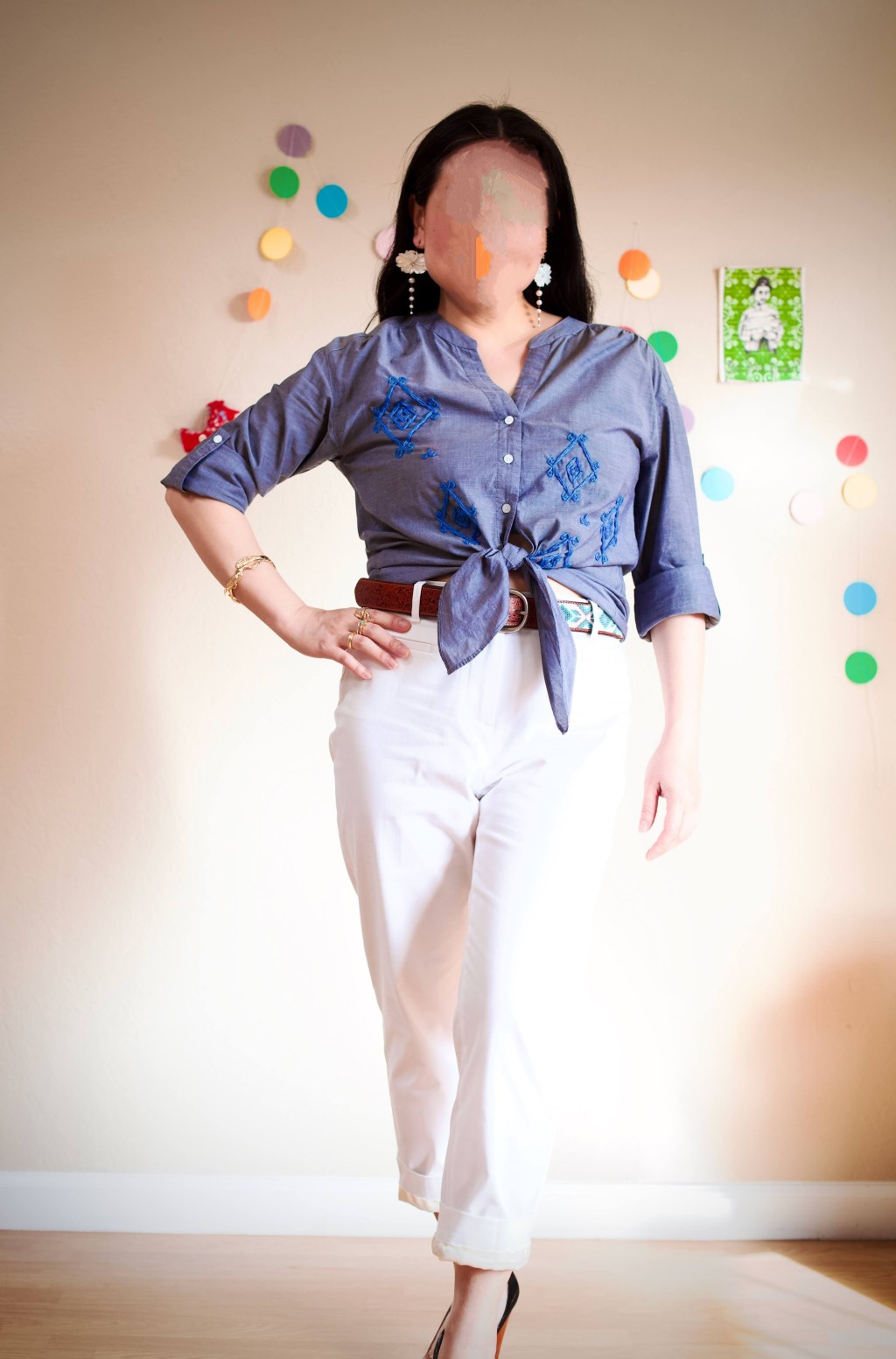
Inspired by Maui’s fishing up island story, this shirt is embroidered with his fish hook constellation, where each lawig motif represents its stars. Maui’s fish hook is a part of the constellation Scorpio of the southern sky, from Antares, the brightest star, to Shaula. It is one of the oldest constellations known. The Sumerians called it GIR-TAB, or “the scorpion,” about 5 millennia ago. The constellation lies opposite the Orion constellation in the sky, thus Orion is said to be fleeing from the scorpion as it sets just as Scorpius rises.
 hardlyplaying.blog