
If the 1960’s popularized twig-like Mod girls in mini-skirts and go-go boots and the 1970’s rebelled with the punk rockers, then the 1980’s ushered in the decade of the business woman. While women still earned less than their male counterpart, more and more were entering into high-status, high-paying jobs, and into power dressing. For a look to be taken as seriously as men, it was a time to steal from the male silhouette and adapt it to the female needs. Shoulder pads added width to create an illusion of strong shoulders in order to lend an air of authority. The classic jacket, worn over a narrow skirt, hung loosely from the wide shoulders to disguise the waist and narrow the hips, leaving all the femininity in the details and the hidden cloth, like the underwear.
None epitomized the powerful executive female of this decade like the British Prime Minister Margaret Thatcher, dubbed the Iron Lady while she lorded over the United Kingdom with a clenched fist for 11 years, yet at the same time a connoisseur of power dressing while exuding a feminine and clean-cut style. Who could forget the blue wool crepe suit she wore while famously booming “No! No! No!” to argue against further monetary integration between the U.K. and Europe? In fact, blue was the predominant color of her wardrobe. She never wore red in England because it was the color of the opposition, the Labour Party. Daughter to a dressmaker, she expertly constructed and solidified her brand through the power of dressing, whether it be riding in a NATO tank in her ivory silk headscarf or addressing the Miners’ strike of 1984 in her pussy-bow blouse. She once said that she wore pussy-bow blouses when making speeches for their “softening” effects, accentuated with rows of pearls and a 200-year old flower brooch.
At the other end of the spectrum, as if to rebel against the formal business attire, casualwear proliferated in ripped jeans and cut-out tops. Yet the trend still stayed true to the undercurrent of the time, that of an egalitarian ideal between men and women. Unlike the 1960’s and 1970’s, the ideal body was no longer skinny, but must be fit. Muscles had to be toned, fat worked away, and the body firmed up like an Olympic athlete’s. Movies featuring aerobic and dance studios, such as Dirty Dancing and Flashdance, dominated the box office. Debut in 1983, the movie Flashdance uncannily incorporated seismic changes within youth culture to ride the zeitgeist of the time. The couple, Nick and Alex, were equally olive-toned skin, dark brooding eyes, broad shoulder frames, and full mane. They could easily wear interchangeable outfits in the exact same colors. The androgyny was intentional as a way to neutralize gender power through dressing, striking a resounding chord with young women. Her mode of dressing became an unofficial uniform for teenage girls and college women to this day: work boots, green army jackets, multiple scarves around the neck, oversized cardigans, torn sweaters, ripped jeans.
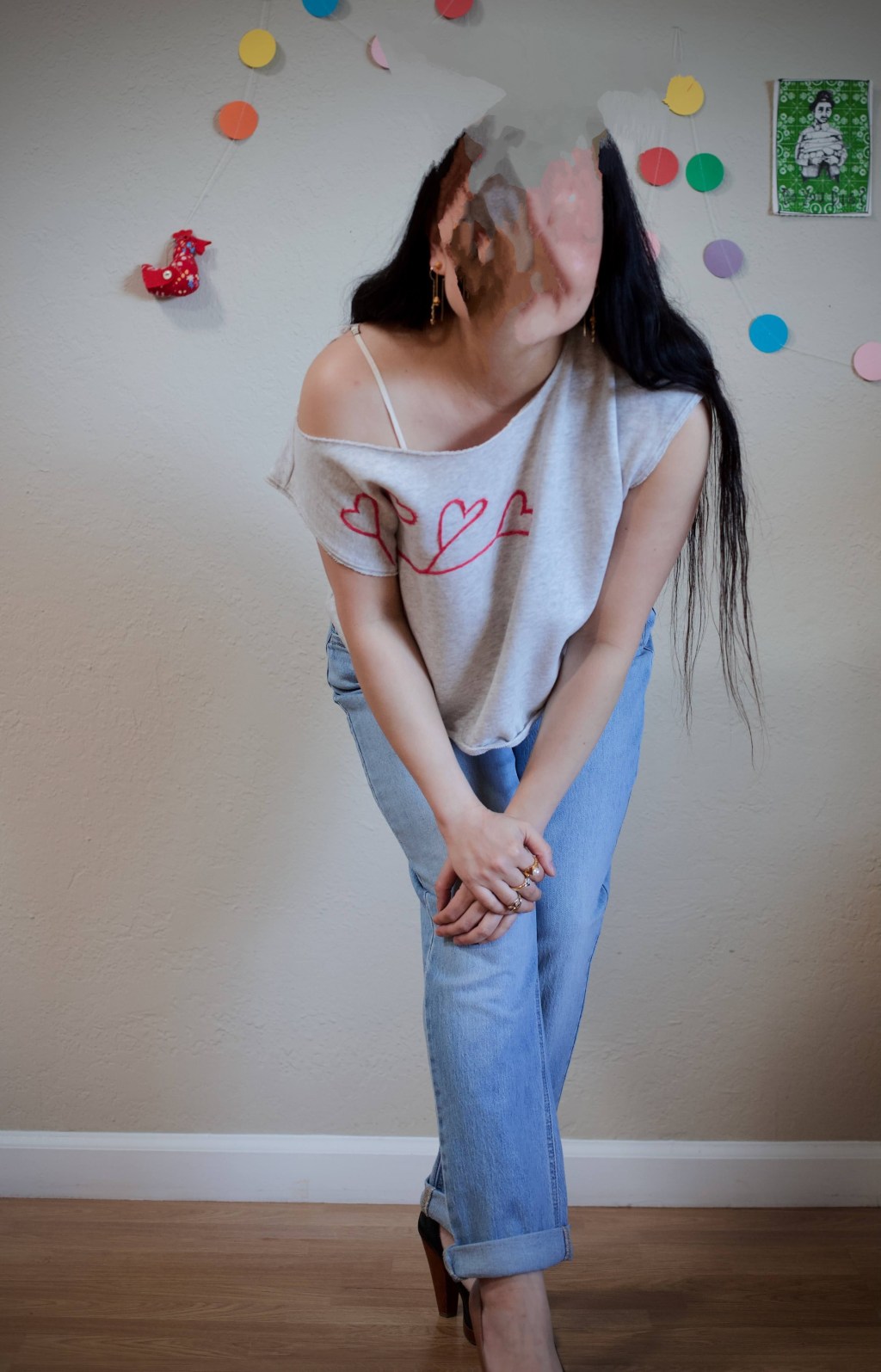
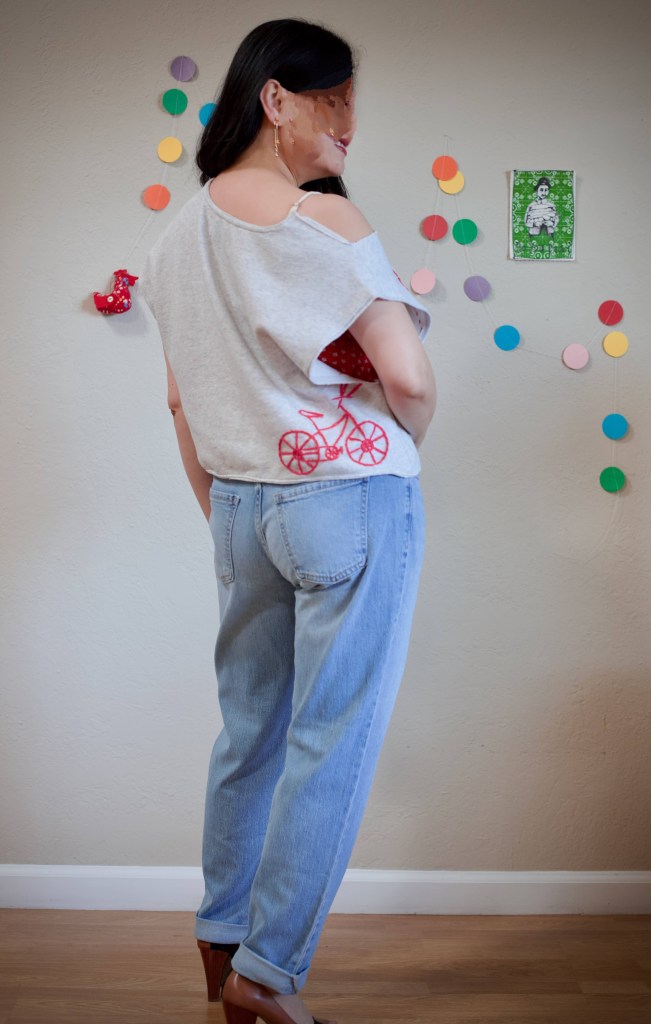
Then there is the shoulder-baring sweatshirt, loosely hanging over her shoulders as she pulls off her bra. Observe the look in his eyes as she does so, so it is the look of love. The cut-out sweatshirt’s incarnation was likely from ballet dancers’ dressing in rehearsal. Many dance studios were drafty and poorly heated, and dancers kept warm by wearing cut-out sweatshirts and sweaters for ease of movement. To make the shoulder-baring sweatshirt, it only requires a pair of scissors in 6 easy steps:
- Measure from your left side of your neck to 1 inch below your right shoulder. Cut the number of inches in half.
- Starting from a mark in the center of the sweatshirt collar, use the halved number to measure on a diagonal to a point on the shoulder seam.
- Cut in an arc between the two points only on the front of the sweatshirt. Do not worry if the cut isn’t perfect.
- Peel back the cut piece and trim off the remaining collar around the neck.
- Cut the border hem and the sleeves off at the inset seaming.
- Throw the sweatshirt in the wash so that the newly cut edges will curl. Throw over your head; bra not required.*
*Hal Rubenstein, The Looks of Love.
 hardlyplaying.blog