
Schrödinger’s cat sits in a sealed box with a flask of poison and a radioactive source. The flask shatters upon radioactivity, releasing the poison, which should kill the cat. Who can tell the cat’s fortune? Quantum physics dictate that until the box is opened, there is no way to tell whether the cat is dead or alive. The act of opening the box itself is a factor in determining the fate of the cat.
In proposing this thought experiment, Schrödinger was criticizing quantum physics by showing how absurd its ideas would be in the real world of human physical senses. Quantum theory posits that particles have no definite states, but only relative probabilities of one to another. That is until they are measured, when they seem to suddenly roll the dice and jump into formation. Stranger still, when two particles interact, they can become “entangled,” so that the two can travel lightyears apart, yet remain coupled. It’s as if they shed their individual probabilities to become components of a probability function that describes both particles together.
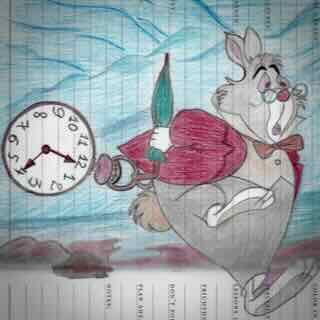
Schrödinger’s thought experiment shared a great deal of Albert Einstein’s skepticism. In response to the idea of a quantum system’s state as probabilities, Einstein famously remarked, “God does not play dice.” While taking a walk underneath the visible moon in Princeton, he asked Abraham Pais if he believed the moon was not there when no one was looking at it, exposing the fundamental disagreement between classical and quantum physics.
Going back more than 60 years, Fyodor Dostoyevsky had pondered the same philosophical question in The Dream of a Ridiculous Man. On a gloomy November night, he wrote, “I may almost say that the world now seemed created for me alone: if I shot myself the world would cease to be at least for me. I say nothing of its being likely that nothing will exist for anyone when I am gone, and that as soon as my consciousness is extinguished the whole world will vanish too and become void like a phantom, as a mere appurtenance of my consciousness, for possibly all this world and all these people are only me myself.”
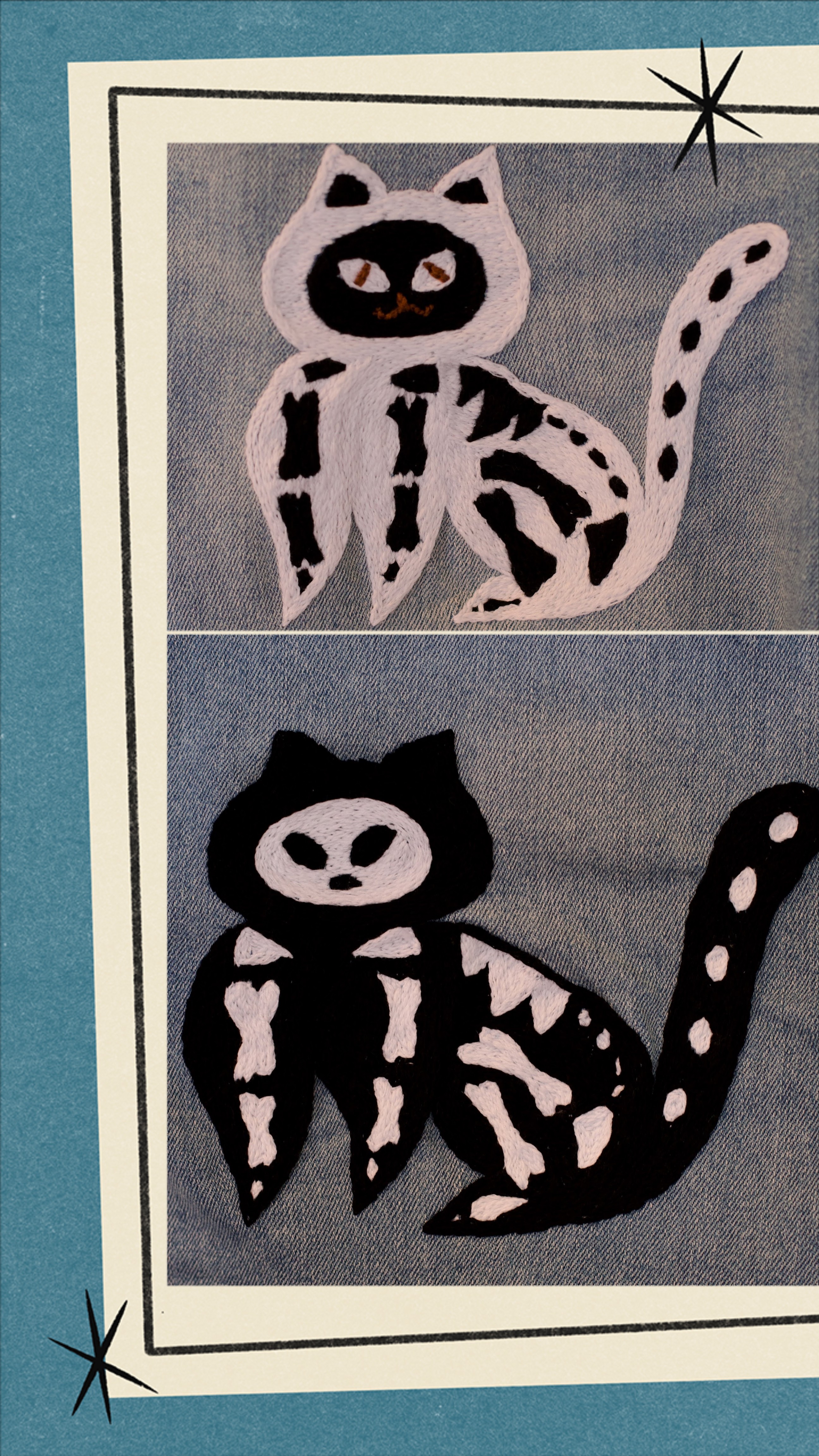
If a tree falls in a lonely forest, does it make a sound? If the box is never opened, does it matter whether the cat is dead or alive? If existence in the absence of an observer is at best a conjecture, then perhaps – we all need someone other than ourselves to prove that we are, in fact, alive. Inspired by Schrödinger’s thought experiment, I have embroidered his cat onto this pair of jeans. The cat is embodied in two contrasting color schemes to represent their two opposite states. To complement the jeans is this leather bomber jacket adorned with embroidered thistle flowers worn over a silk lace tank top.

 hardlyplaying.blog