
“I’ve been absolutely terrified every moment of my life and I’ve never let it keep me from a single thing that I wanted to do.”
– Georgia O’Keeffe
An icon of American modern art, Georgia O’Keeffe is best known for painting surrealism into the desolate American Southwest landscape. These paintings, such as Summer Days, have come to be regarded as American iconography: the copper-colored mountains, the storm coming over the horizon, the sun-bleached skull aloft above a bouquet of wildflowers to form an axis of heaven and earth. The art historian Randall Griffin described such paintings as “a pure and cohesive distillation of American culture, enriched by an unexpected dissonance… O’Keeffe transmuted bones into numinous portals linking earth and heaven.”
In the early days of her career, O’Keeffe was famous for her paintings of natural flora. Her work, The Green Apple, completed in 1922, depicted her notion of simple, meaningful life. O’Keeffe said that year, “it is only by selection, by elimination, and by emphasis that we get at the real meaning of things.” She made about 200 flower paintings in large-scale depictions, many of them carrying a sexual interpretation among the art critics. The journalist Paul Rosenfeld commented the “essence of very womanhood permeates her pictures”, citing her use of color and shapes as metaphors for the female body. O’Keeffe herself did not condone this interpretation: “when people read erotic symbols into my paintings, they’re really talking about their own affairs.” Despite her objection, Randall Griffin noted that “it now seems abundantly clear that, in spite of her vehement denials, O’Keeffe meant some of her paintings (not just the flowers) to look vaginal.”
The sexual speculation of her art may have started with her husband, the American photographer Alfred Stieglitz. “Stieglitz and his circle belonged to a tradition that used themes of sexuality in their art as a declaration of being avant-garde,” Randall Griffin explained. “Stieglitz read virtually all of Freud’s books, as well as Havelock Ellis’s six-volume Studies in the Psychology of Sex, which argues that art is driven by sexual energy. Thus, for Stieglitz, sex was a liberating source of creativity. O’Keeffe may or may not have thought of Freud when she painted her flowers, but the psychologist’s writings were a cultural touchstone at the time, with his ideas widely known in a simplified fashion.” Stieglitz subscribed to that simplified version, once declaring that ”Woman feels the world differently than Man feels it… The Woman receives the World through her Womb… Mind comes second.”
In 1929, O’Keeffe took her first trip to New Mexico. The change of scenery provided both a marital break and new artistic opportunities. She developed a new style of painting distinct from Stieglitz’s influence. “New Mexico presented a wide array of fresh subjects to paint that were congenial to her temperament,” wrote Griffin. “She chose to portray the desert as a timeless, exotic world filled with colonial churches and menacing crosses, a site of enigmatic symbols and visual poetry. The sweeping landscape, with its brightly coloured sandstone formations, also offered entirely new possibilities.”
Again, in response to the spiritual interpretation of her work, O’Keeffe maintained that she did not intend for these motifs to carry any specific symbolism. Her painting was “like a thread that runs through all the reasons for all the other things that make one’s life.” She wrote in the catalog for one of her New York exhibitions that, “The bones seem to cut sharply to the center of something that is keenly alive in the desert even tho’ it is vast and empty and untouchable—and knows no kindness with all its beauty”. She would later describe Summer Days simply as a “picture of summertime”.
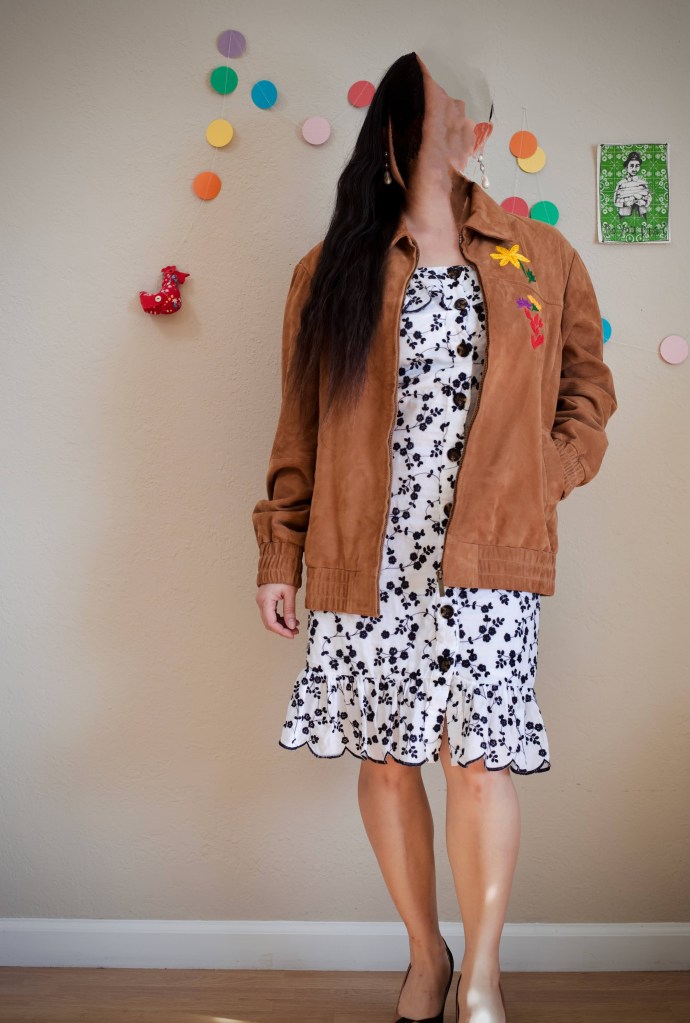
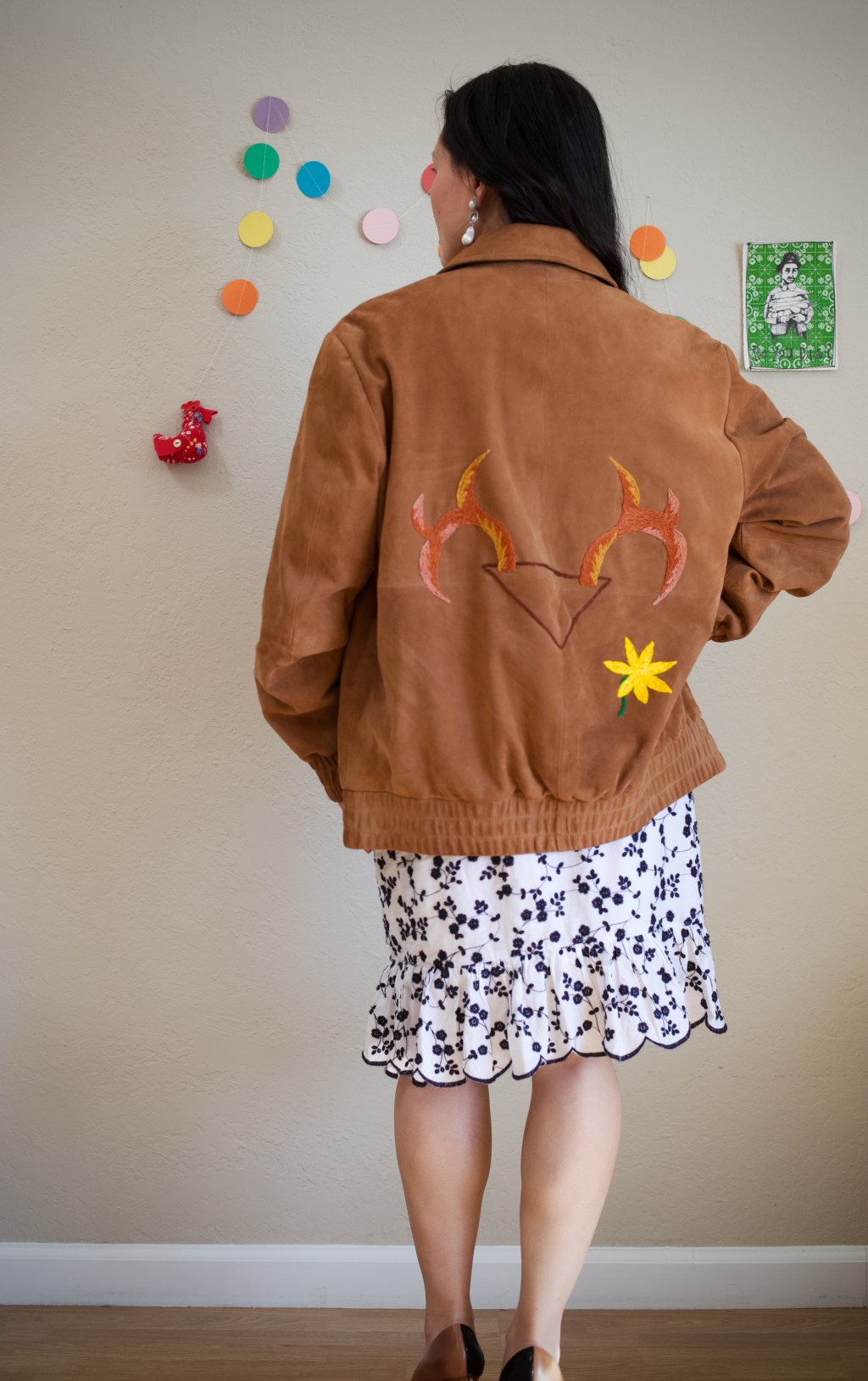
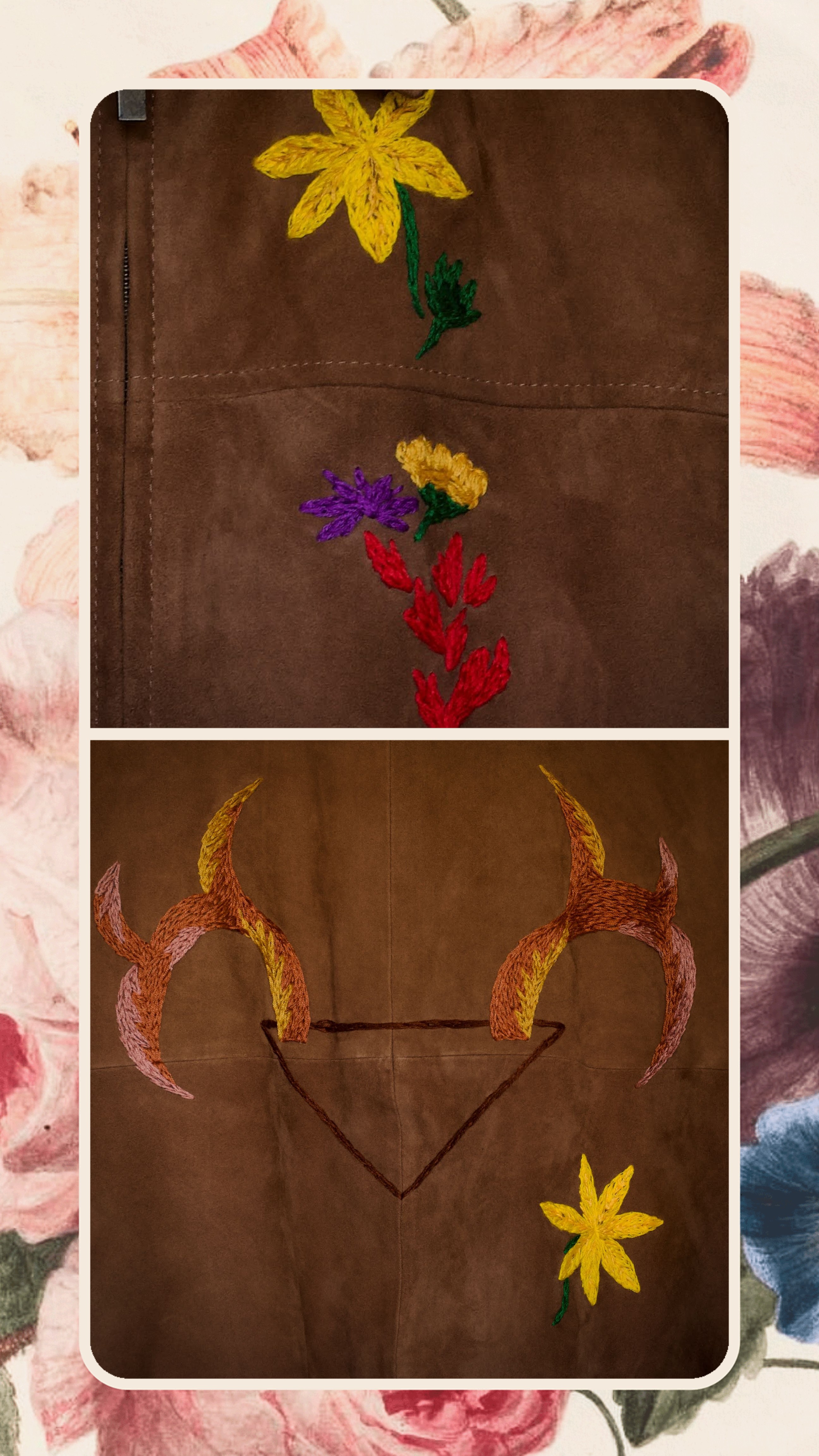
O’keeffe is dead-on that we see in the art what we carry in our heart. Personally for me, her art evokes a place mysterious, exotic, raw, and erotic, yet at once tender and intimate. Her paintings carry a tinge of poignancy and melancholy, yet the vivid colors and bold images are so striking and beautiful. I have chosen a brown suede jacket as the backdrop for the skull embroidery motif inspired by her Summer Days painting. Of the bouquet of wildflowers floating beneath the skull, the yellow floral, likely a five-nerved sunflower, is embroidered at the back. The Indian paintbrush and asters are carried to the front of the jacket.
 hardlyplaying.blog