The Great Wave off Kanagawa is Katsushika Hokusai’s first and most celebrated work in his collection of Thirty-six Views of Mount Fuji. It is of the Ukiyo-e genre, meaning “pictures of the floating world”, which flourished in 17th-to-19th-century Japan.
The woodblock print depicts three elements: three boats weathering the stormy sea, the great wave, and Mount Fuji. To view from left to right, the print portrays boaters riding along the wave. But if viewing from right to left, the way Japanese text is read, the boaters would be seen as encountering the massive claw of water about to swallow them up. Printed in indigo and Prussian blue, which was newly imported from Europe at the time, the distinctive color scheme became an immediate success. The next ten prints in the Thirty-six Views of Mount Fuji series were famous for this blue aizuri-e style.
The Great Wave off Kanagawa influenced Western artists in many genres, particularly the Impressionists. Vincent van Gogh, an admirer of Hokusai, wrote to his brother Theo that, “I did not know that one could be so terrifying with blue and green…these waves are claws, the boat is caught in them, you can feel it.” It has been suggested that the swirling blue night sky of Van Gogh’s The Starry Night was influenced by The Great Wave. Claude Monet’s Waves Breaking on the coast of Normandy, with its cliff fragments silhouetted against the blue sea, is also thought to be very close to the motifs of The Great Wave. Camille Claudel sculpted La Vague in The Great Wave’s form, engulfing a circle of three dancing women. In writing his orchestral piece La Mer, Claude Debussy, inspired by The Great Wave, featured the print on the cover of the original 1905 score. As such, The Great Wave has become one of the most recognized images in the art world.
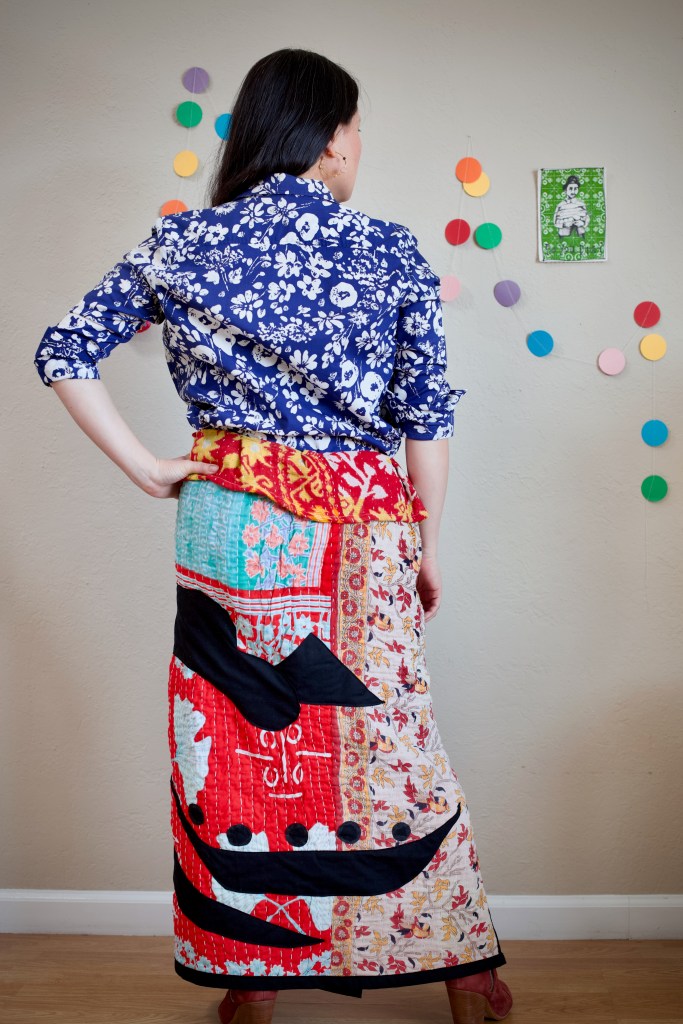
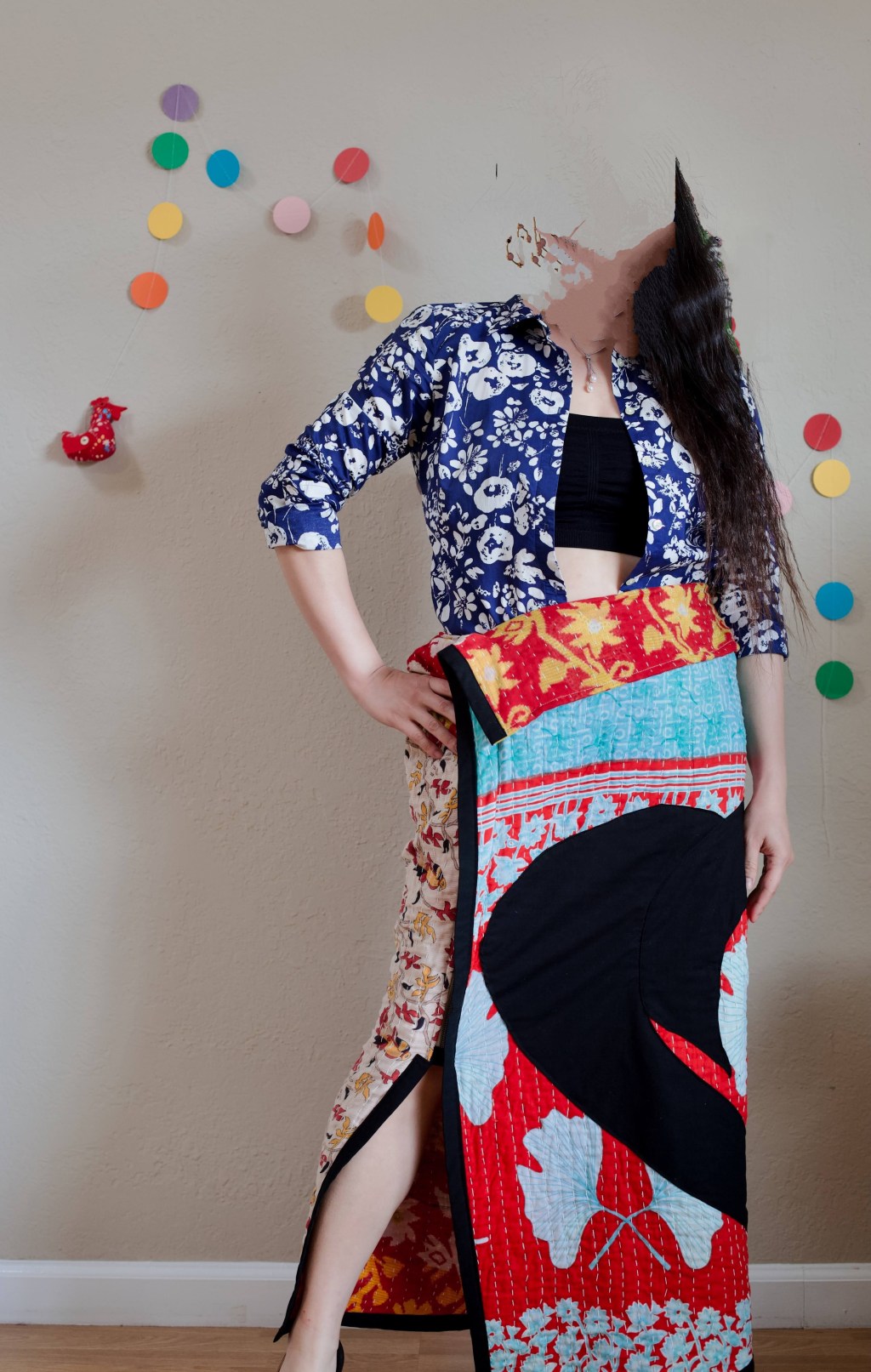
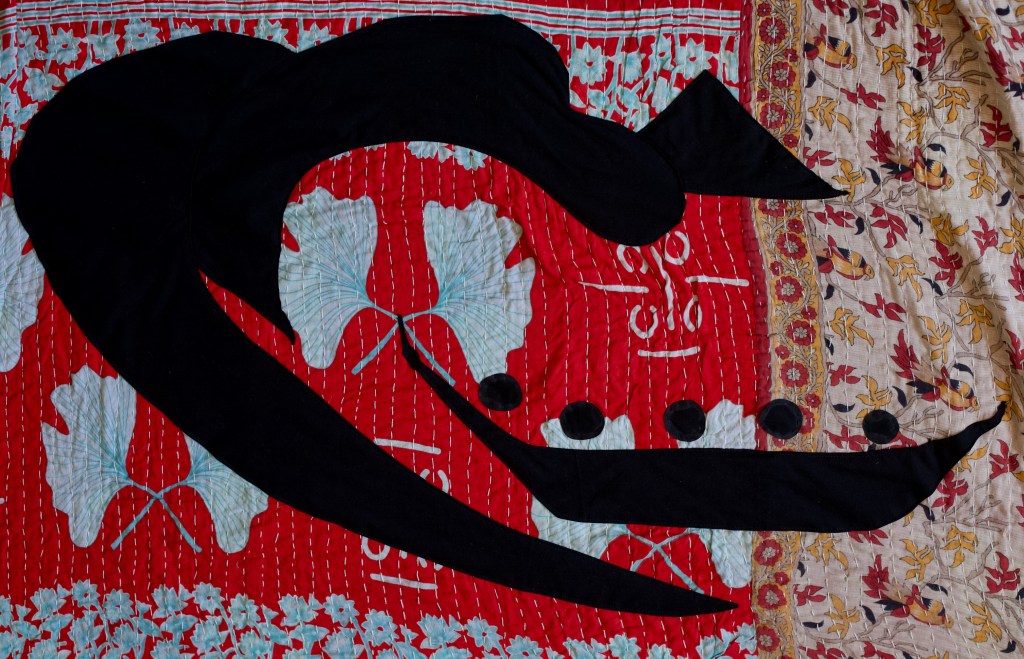
This skirt is made with a vintage kantha quilt, which is stitched together from recycled cotton saris. The ginkgo leaf print on the quilt takes me back to East Asia. Taking inspiration from The Great Wave, the skirt is adorned with the artwork’s three principle elements. In striving for a framing effect, I have given it a straight cut and black trim along the edges. The skirt is side-slitted for ease of movement.
As with the art of Kintsugi, I hope that by embellishing the skirt with an inspiration from a great artwork, the vintage quilt is made anew, that it will be worn with joy and affection for many more times.
 hardlyplaying.blog