Interviewed by Vogue in 1911 about the possibility of women wearing trousers, the English designer Charles Worth said, “Yes, certainly they will. They will accept it because it is vulgar, ugly, and wicked – those reasons insure the success of any article of feminine wear! The world has gone mad!” The earliest versions of female trousers designed by Worth had been Oriental pantaloons worn under side-slit skirts, revealing a glimpse of a trouser leg.
In the same year, the Paris couturier Paul Poiret, a student of Worth, introduced the harem pants as part of his efforts to reinvent and liberate Western female fashion. The alternative names for them were trouser-skirt or sultan-skirt. Poiret was an incurable Orientalist and brought opulence from the Far East to the Western fashion scene. Looking to antique and ethnic styles such as the Greek chiton, the Japanese kimono, and the North African and Middle Eastern caftan, Poiret advocated fashions cut along straight lines and constructed of rectangles, shifting the emphasis away from the skills of tailoring to those based on the skills of draping. It was a radical departure from the couture traditions of the 19th century, which relied on the precision of pattern making. Such an emphasis on flatness and planarity required a complete reversal of the optical effects of fashion. The cylindrical wardrobe replaced the statuesque, turning, three-dimensional representation into two-dimensional abstraction. It was a strategy that dethroned the primacy and destabilized the paradigm of Western fashion.*
By the 1940’s, a new style of pants came into being among Black Americans as part of the zoot suit attire, which grew out of the popular London-style “drape” suits worn in Harlem dance halls in the mid-1930s. These were ad hoc outfits, crafted from regular suits bought two sizes too large and then creatively tailored to dandyish effect. Zoot pants had the pegged, wide-legged look of the harem pants, but were high-waisted and tight-cuffed. When wool was rationed during WWII, the sale of zoot suits ended, being criticized as a wasteful use of cloth. Then in the 1950’s and 60’s, the British Teddy Boys popularized the look of zoot suits again with their “drape” jackets, reminiscent of the frock coats worn by dandies in the Edwardian period. By the 1980’s, a form of harem pants came back into fashion, popularized by MC Hammer, known as Hammer pants. These pants, like their Far East ancestors, are made for dancing. From belly dancing to hip hop dancing, they remain among the most popular dancing pants today.
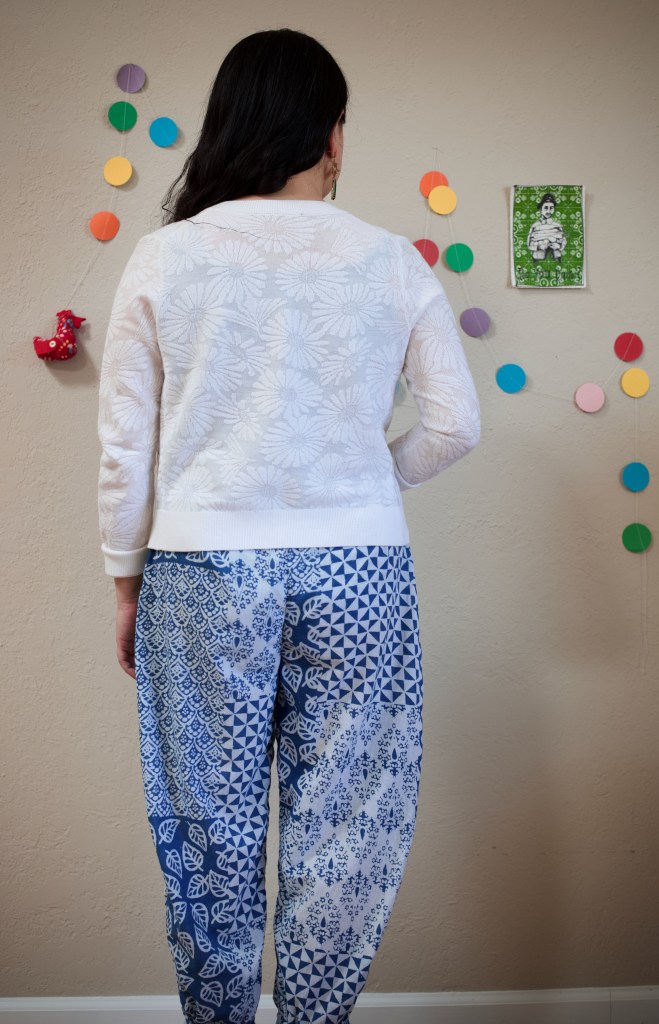
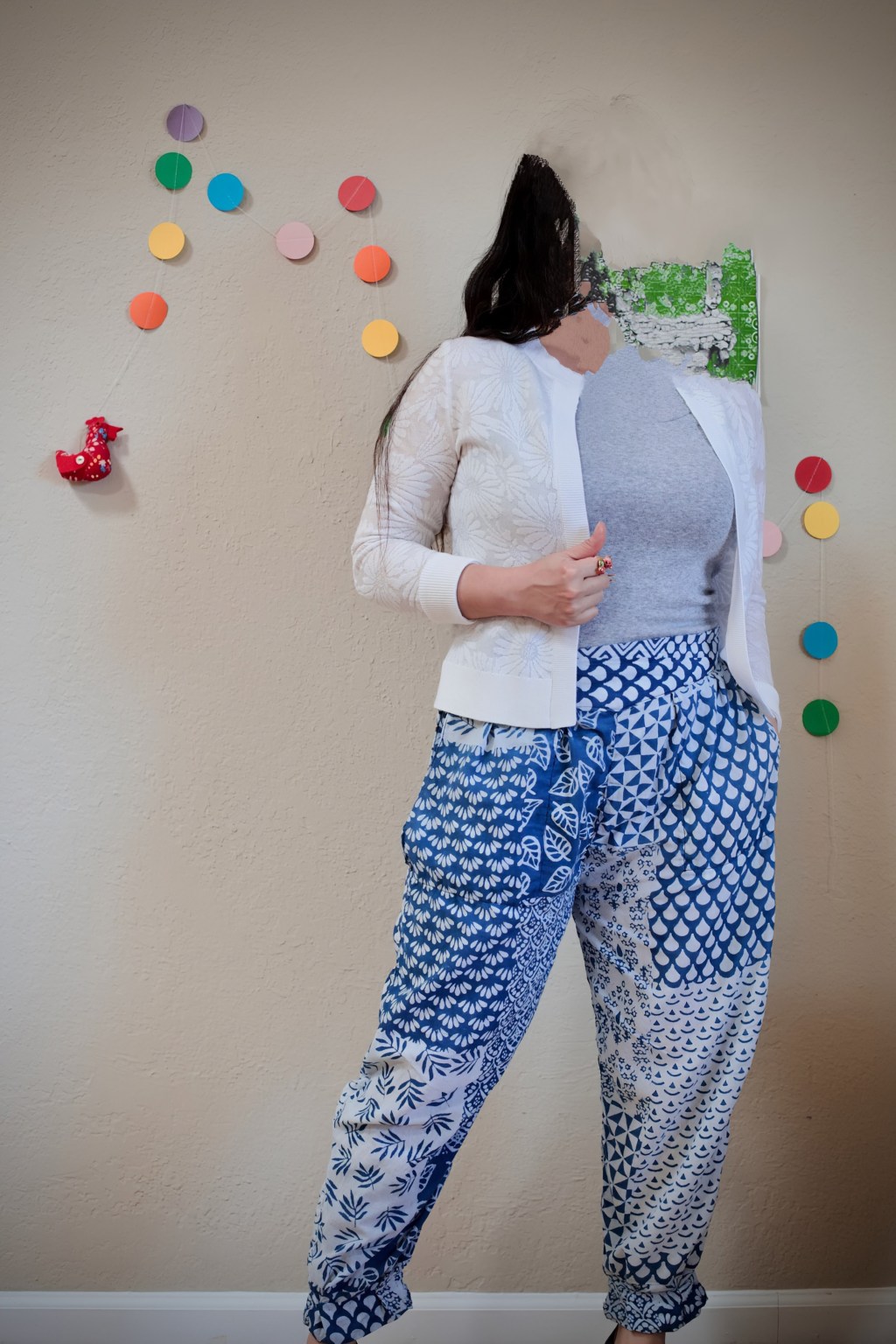
These pants are made like zoot pants – high-waisted, pegged, and tight-cuffed, but with a light weight cotton fabric instead of wool. They are perfect for lounging on hot summer days. They are breathable, airy, and light, as if you were wearing next to nothing.
*Koda, Harold, and Andrew Bolton. “Paul Poiret (1879–1944).” In Heilbrunn Timeline of Art History. New York: The Metropolitan Museum of Art, 2000–.
http://www.metmuseum.org/toah/hd/poir/hd_poir.htm (September 2008)
 hardlyplaying.blog