
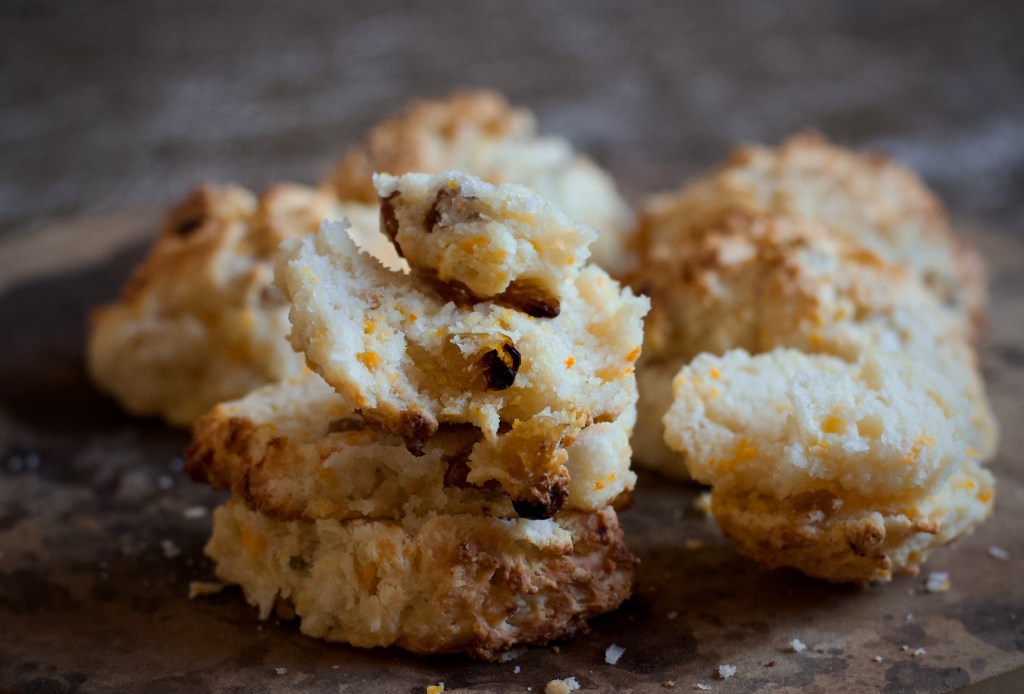
The biscuit is fluffy, soft, and flaky. That it should be flaky puts it in the flakes catalog. And unless we use lard or shortening for a flaky dough, they are flakes of butter strewn among flour that should only melt when they hit the oven. If you run a search for how to get butter flakes in a biscuit, you’ll find a popular advice is to grate frozen butter into the dough. But you can get the same result with the fraisage technique, which is to smear the cold butter into the flour with the heels of your hand, the same way you would do for a pie dough.
To create layers within a biscuit, it is prescribed to fold the dough five or six times, the same way one would perform a tourage, which is letter folding the dough for a total of 4 turns. I’d name this method “very rough” puffing, because there is no cold rest in between folding. Therefore, we won’t attain distinct layers or visible flakes in a biscuit. And we need to work fast to prevent the butter from melting before baking. But it takes less than an hour from flour to biscuits, which clearly has its advantage.
To achieve the softest and fluffiest biscuit possible, a low-protein wheat flour is of choice. High-protein equates to high-gluten, which makes a chewy bread. Professional bakers swear by White Lily self-rising flour, meaning that a leavening agent is already mixed into it. It is preferred because the leavening agent is then evenly distributed throughout the flour. When a recipe calls for a disproportionate ratio of baking powder to regular flour, it is trying to patch for the possible error of uneven distribution. At home, we can also soften all-purpose wheat flour by replacing some of it with cornstarch. Cornstarch’s proteins dilute wheat gluten, thus reducing the wheat dough’s chewiness.
Another way to soften the flour, or to weaken its gluten development, is to add an acid, such as vinegar. However, the really better way to go is to use buttermilk in place of milk, as it not only works as an acid to tenderize the dough, it also flavors it. There is a particular odor with quick bread, whether chemically leavened or yeasted, but it is neutralized when using fermented milk rather than plain milk. In my situation, I used a combination of plain yogurt and milk.
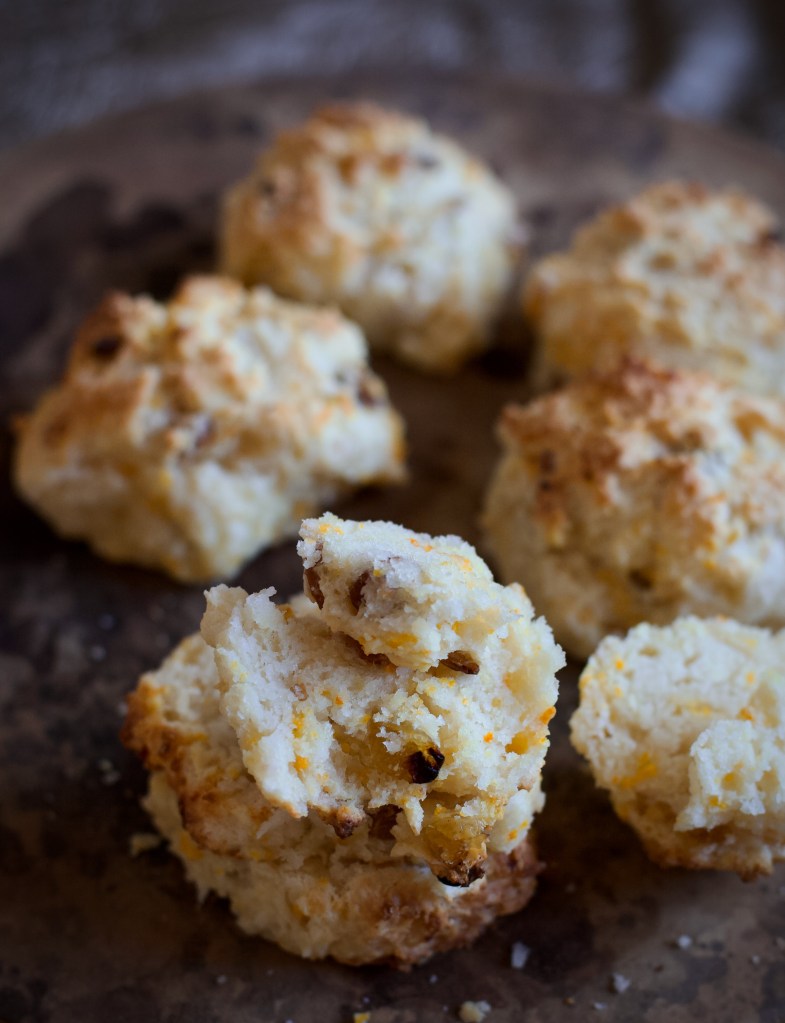
2 cups low protein wheat flour
2 tsp baking powder, omit if you will use self-rising flour
1 tbsp sugar
½ tsp salt
1 stick, or 4 oz, cold butter
1 generous cup cold buttermilk
⅓ cup golden raisins
Zest of 1 orange
Soak the raisins in the buttermilk and keep refrigerated while preparing other ingredients. If you will use yogurt rather than buttermilk, use ⅓ cup of milk instead.
To soften all-purpose wheat flour, swap out 4 tbsp of flour for 4 tbsp of cornstarch. Whisk the dry ingredients together – flour, cornstarch, baking powder, sugar, and salt, and pour it onto the counter. Cut the cold butter into 8 tablespoons. Apply the fraisage technique to smear each slab of butter to flatten it into the mass of flour. With a dough scraper, scrape and lift the flour from the edges in to incorporate the butter into the flour. Repeat smearing with the heels of your hand, then scraping, and lifting so that the butter is evenly distributed into the flour. Use your fingers to rub the butter into pea-sized pieces if needed.
Spoon out the raisins from the buttermilk and refill to have one full cup of buttermilk. To use plain yogurt instead, mix ~⅔ cup of yogurt with the milk to have one full cup of milk and yogurt. As a last option, add ~⅔ cup of milk with ½ tsp of vinegar to have one full cup of milk. Add the cold buttermilk into the flour mixture while continuing to scrape and lift with the dough scraper until there is a sticky lump of dough. Finally, mix the raisins and the orange zest into the biscuit batter.
Working as quickly as possible, pat the dough into a long rectangle and fold it in three like a letter fold, then turn it 90 degrees and repeat patting and folding. More folding makes more layers, but also more gluten development, which means less tender. Alternatively, the dough can be flattened, halved, and stacked repeatedly. I would not exceed 4 turns.
Finally pat the dough into a rectangle ¾-inch to 1-inch thick and use the dough scraper to cut it into 8 equal portions. Take each portion and roughly form into a ball with your hands. Otherwise, a large ice-cream disher with a release lever comes in handy. Place each biscuit close to each other in a lined baking tray, less than ½-inch apart; it helps them rise tall since they’re stacked against each other. Then freeze the tray for 15 minutes before baking. Keeping the dough cold before baking helps prevent it from spreading outward. Oven to 425F, then reduce to 400F once the biscuits are in; 20-25 minutes until golden brown.


2 responses to “Flakes, IV: The Biscuit”
[…] jam, balsamic vinegar, salt, and olive oil to taste and thin with water. The others are to bake biscuits strewn with golden raisins and orange zest, and then making a salad of store-bought salad mix, golden raisins, and wedges or orange. […]
LikeLike
[…] reason to stuff a $50 lobster in a $1 hot dog bun, so pick a bread fancied, perhaps croissants or buttermilk biscuits for lobster sliders. Similar to how bánh mì is served, these biscuits are hollowed out in the […]
LikeLike