
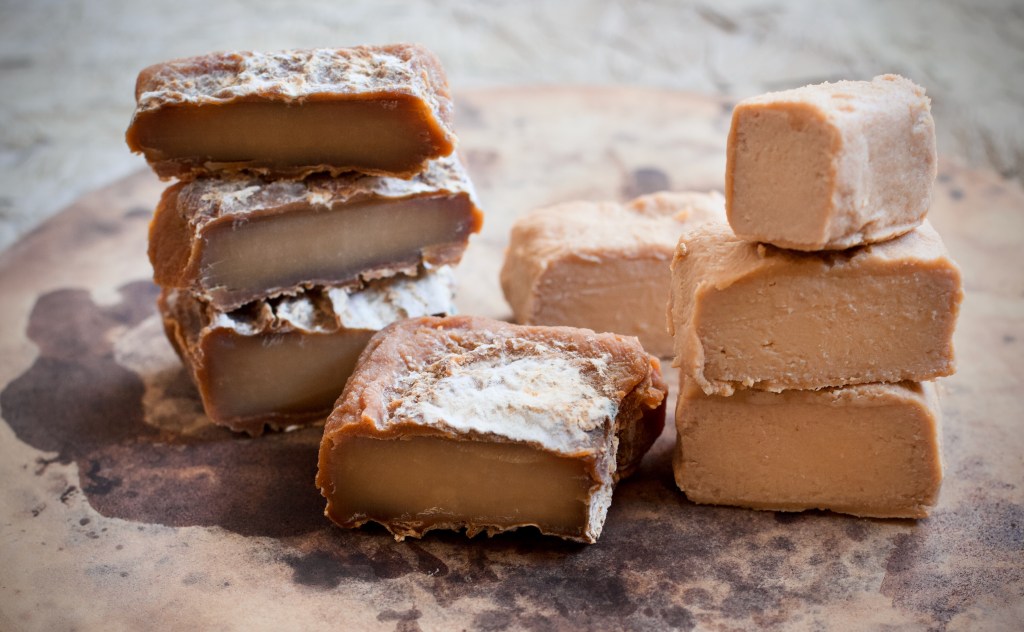
During the 2nd century BCE when soybean was being fermented, it was also made into curds, aka tofu. Tofu, then being fermented, was known as stinky tofu. As it ages, fermented tofu becomes pungent, fruity, and cheesy. Unlike fermented soybean, fermented tofu has not gained world-wide popularity, however remains a staple food in China. Doufu-ru, a version of stinky tofu, made its way to Lào Cai province in Northern Vietnam, where it’s called Nhự Tofu, and to Central and Southern Vietnam, where it’s called Chao Tofu.
Chao tofu follows a two-stage fermentation. First, grow several molds on cubes of tofu, then let the mold enzymes break down tofu proteins during months of brining.
Use only extra firm tofu and we will still need to further dehydrate it with a salt soak and compression. Bring the tofu to a boil in heavily salted water, keep it boiling for 3 minutes, then turn off the fire, cover, and let it sit in this salted water for another 10 minutes. It is a misconception that tofu easily takes on any flavor imparted upon it. Give it a taste and you’ll see that it does not take on salt even with heavily salted water. However, salting the surface draws out surface moisture and helps eliminate unwanted molds. Line the bottom and top of the tofu with a towel and compress it for 2 hours. I used a couple of 12-inch cast iron skillets for compression.
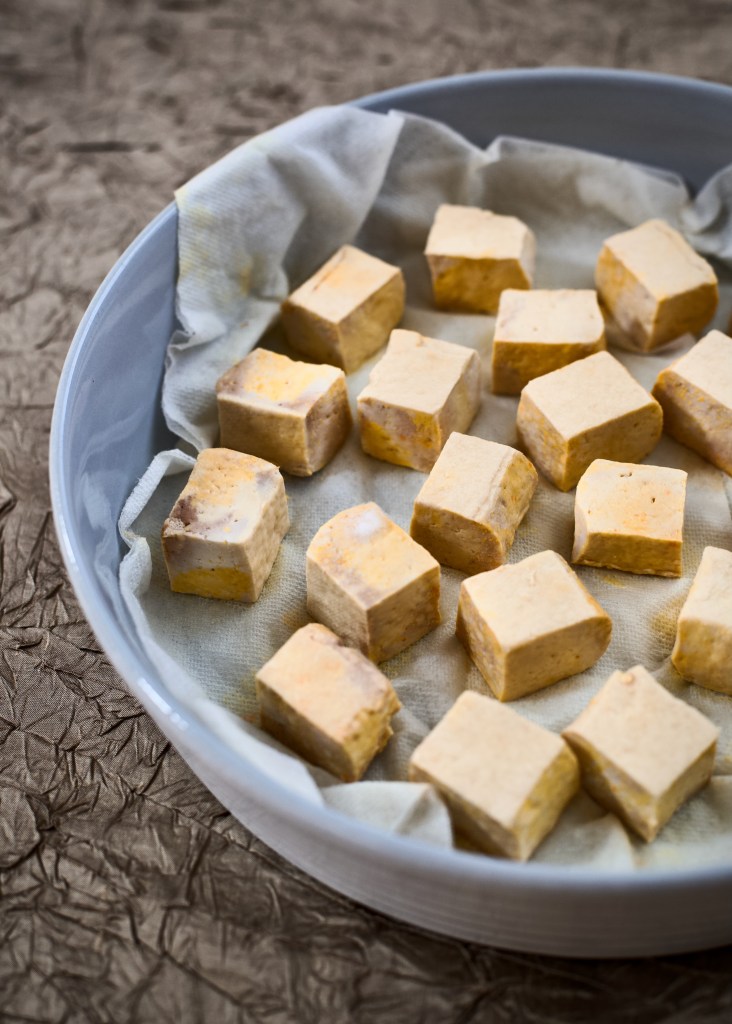
The first stage fermentation is mold development. Cut the tofu into 1×1-inch cubes and place them on a tray lined with paper towel, then cover the tray with cling film, poking a few holes atop for air ventilation. Keep the tray in a warm environment for a few days; try the oven. The tofu is ready when it achieves the “3S” criteria coined by Andrea Nguyen in Asian Tofu: slime, splotches, and stink. The splotches should be white mold with yellow and light purple patches. If blue or black mold appears, cut it away and change out the paper towels and cling film. Yellow and white mold should take over, but if blue and black mold take over instead, discard and make another batch.
The second stage fermentation is through brining. The brine includes water, a low alcohol rice wine such as sake, salt, sugar, and seasoning. The ratio between water, rice wine, and salt varies by preference. I attempted successfully two recipes, [300 ml water : 100 ml rice wine : 3 tbsp salt : 1 tbsp sugar] and [400 ml water : 100 ml rice wine : 3 tbsp salt : 1 tbsp sugar], one tasting saltier than the other. There are many options for seasoning, such as chili, lemon zest, sesame oil, and spices.
Bring water, salt, and sugar to a boil. Once the brine has cooled, mix into it the rice wine and seasoning. Place the tofu cubes in a sterilized glass jar and pour in the brine to drown them completely. Leave the jar in a cool and dark place for at least a month. The tofu will soften and become creamy and salty. With lemon zest, it is soured with a firmer texture, but will soften over time. With chili, it becomes extra soft and creamy to the point of breaking when agitated.
To make a condiment, mash the fermented tofu with sugar, lemon juice, and thin with its own brine. Adding it to a kombu broth is reminiscent of miso soup. Blend it with lemongrass and chili for extra zing. It’s good on grilled meat, salad, veggies, and rice bowl. It can also be used to marinate meat before cooking, but I find it rather extravagant this way.
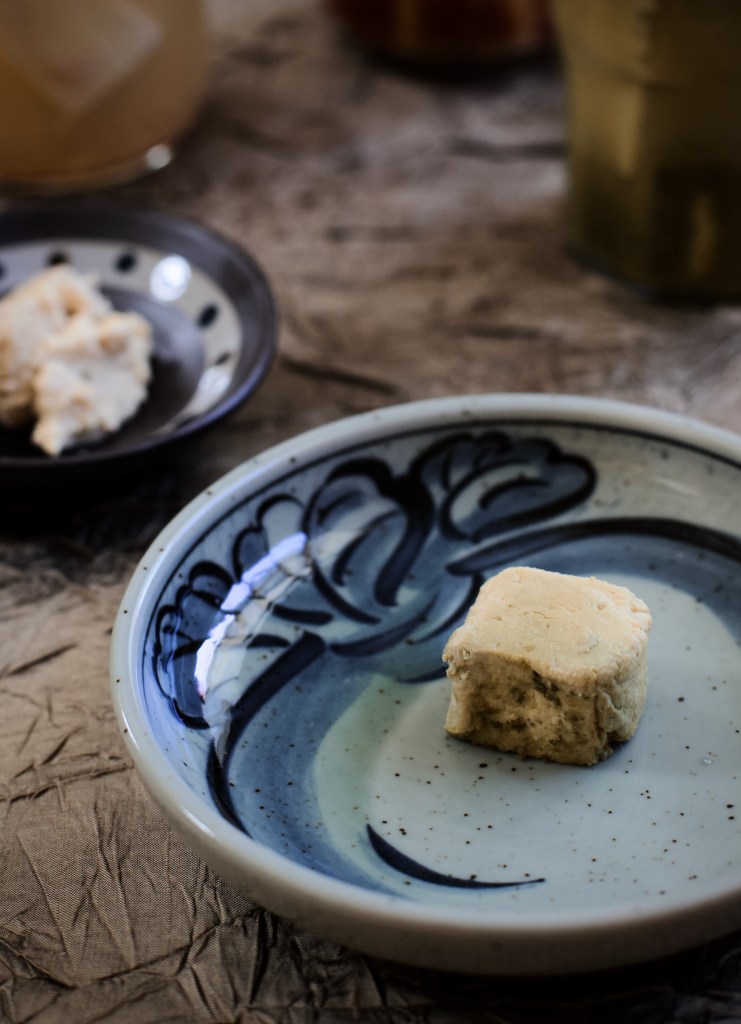
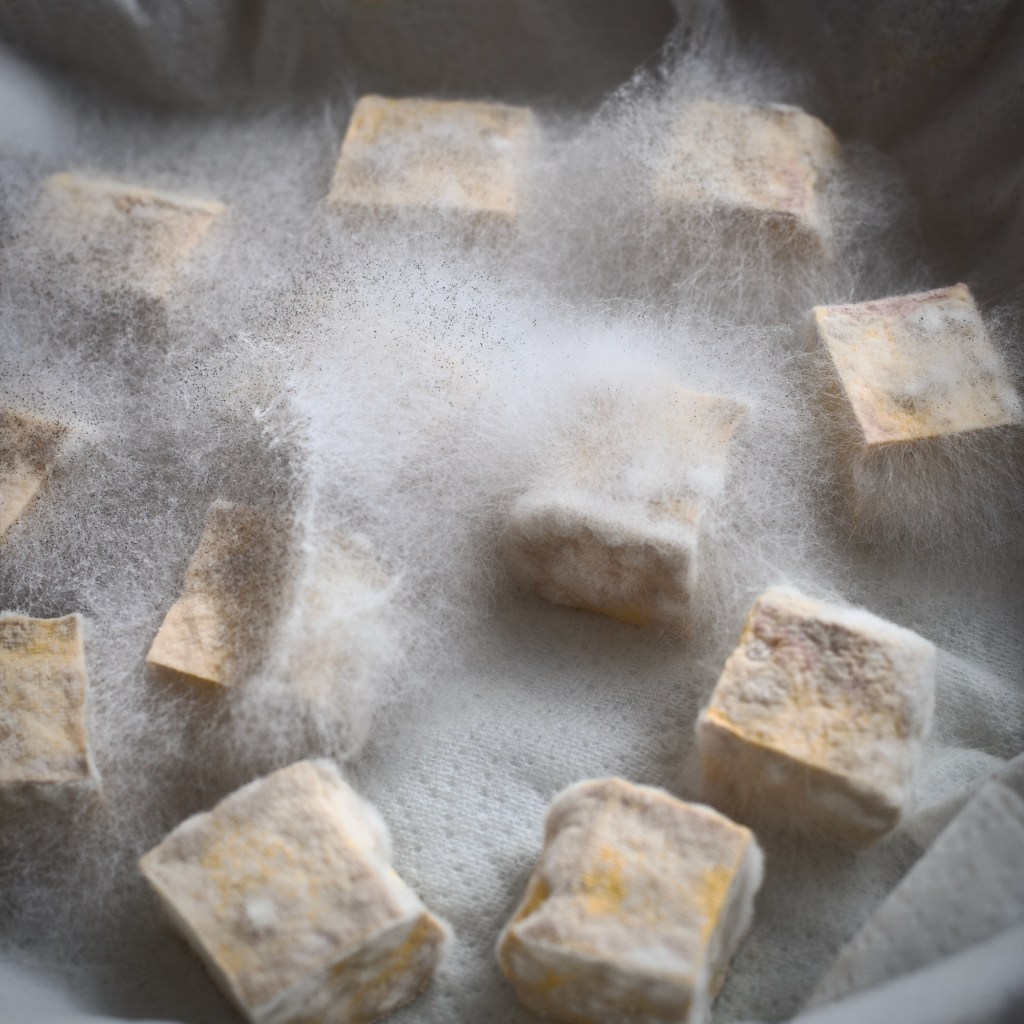
Similar to fermented soybean, fermented tofu can be categorized by fermentation time. For a quick fermentation, the tofu can be left to grow molds in the same way as Chao Tofu and/or inoculated with additional mold spores for 3-6 days. An example is Mao Tofu with hair-like filaments, enabled by rhizopus oryzae, the same mold grown on Tempeh. The longer it is left to ferment, the more pungent and creamier it becomes. Frying retains best its flavors and textures, and its moldy hairs act like a protective coating to prevent moisture lost during frying. Mao Tofu is a delicacy of the Anhui province of China.
Another is Misozuke Tofu, which takes at least 3 months to ferment. It is obscure, being local to the Fukuoka prefecture of Japan. Instead of being fermented with mold and brine, it is sealed in a layer of miso. The miso layer protects while its enzymes soften the tofu’s texture and sharpen its flavors. The recipe for Misozuke Tofu reads like an internet lore. It is said to come from a Vietnamese couple who ran a now-defunct food stall in Northern California.
Similar to Chao Tofu, use only firm or extra firm tofu and dehydrate it further with a salt soak and compression. Following instruction, I used the following ratio, [1 cup white – yellow miso : 2 tbsp sake : 2 tbsp sugar], and mixed it into a paste. To season with red pepper flakes, tea, or lemon zest, they were mixed into the miso paste before spreading. I wrapped the tofu in muslin cloths, then spread the miso paste to cover the cloth-wrapped tofu block. Then it was kept in a closed container and refrigerated.
To prevent molding, it was directed to line the container with paper towels and to replace them weekly, since the miso paste draws moisture from the tofu into the towels. However, mold started developing within a month of fermentation. What most troublesome was that it could not be detected unless the cloth, along with the miso paste, were unwrapped completely, since mold developed where the tofu contacted the cloth. After 3 months however, the tofu was still grainy and crumbly. The fridge’s cold temperature was not conducive to fermenting the tofu.
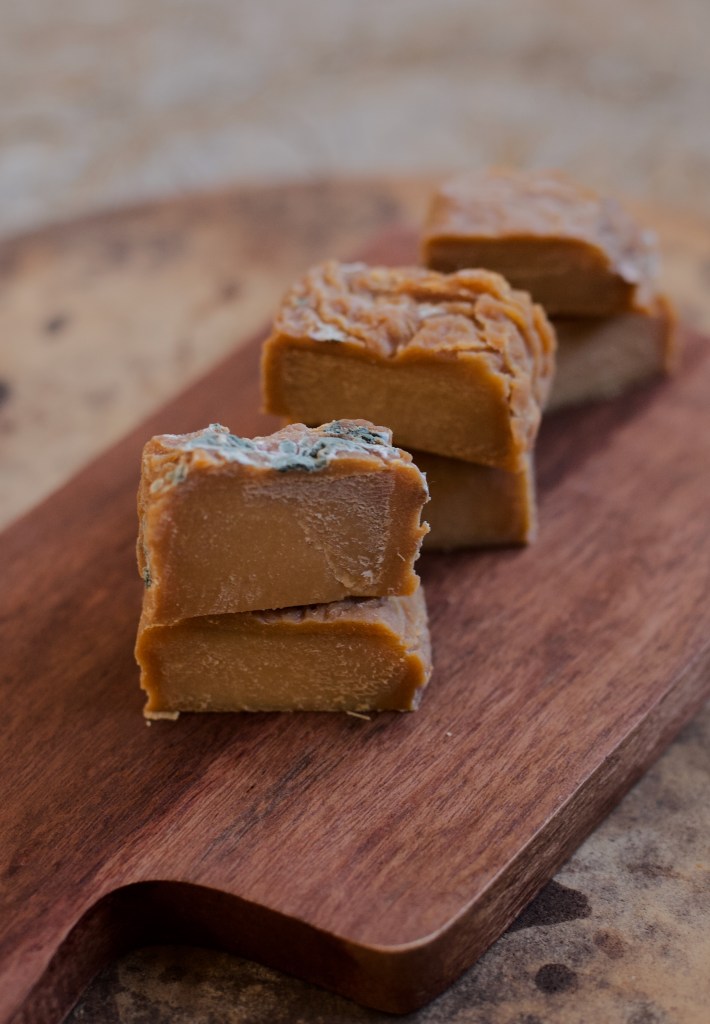
Then I thought about fermenting tofu the way miso is made. In making miso, a linen cloth covers atop. Molds grow on the cloth and the contacting surface between cloth and miso, but it does not enter the miso. Thus I could also wrap the linen cloth around the miso-plastered tofu blocks for the same effect. I found that using a large flat knife to plaster the miso paste directly onto the tofu was easier. And I would need a way to suspend the tofu from the bottom surface in order to drain the liquid from it. The cloth-wrapped tofu slab laid on a tofu mould’s lid, all placed inside a container and kept by the window sill.
For only about a week, the wrapping cloth remained moist. After a week, it started drying out as mold also started appearing on it. Mold development was similar to making miso and considered normal. From here, there were two ways to fermentation. Keeping the container closed prevented moisture loss, and the tofu fermented while remaining soft. Like miso, it takes months to become soft and creamy in texture, and longer fermentation time yields sharper, funkier, and cheesier flavor. Do taste test after a couple of months to observe fermentation development. Similar to Chao Tofu, it can be made into a condiment, but also appreciated as-is and as a spread.
If the container was kept opened, moisture continued to escape and the tofu transformed into a dry slab within 2 weeks. It could be shaved and grated, much akin to a block of hard cheese. The longer it’s left to ferment, the harder its texture, so it is important to taste test after 2 weeks of drying. To develop depth of flavor, I would experiment with combining both methods of fermentation – letting the tofu ferment in a closed container, then leaving it opened to gain firmness. Once a desirable texture is achieved, wrap in parchment paper and refrigerate.
Once deemed unsafe and obscure, the Asian methods for fermentation is now at the forefront of culinary innovation. They are being leveraged for various grains and seeds, meat and fish, and wine and spirits to create new and exciting food for the rest of the world. The first act of science is writing it down. Then we can study and analyze, replicate and modify, and continue the cycle of evolving, growing, and creating.
 hardlyplaying.blog
One response to “Fermented Tofu”
[…] persimmons, I used a brine of salt and alcohol. It’s one I employed successfully before to make chao, a fermented tofu first inoculated with mold, then preserved in brine. The ratio for this brine […]
LikeLike